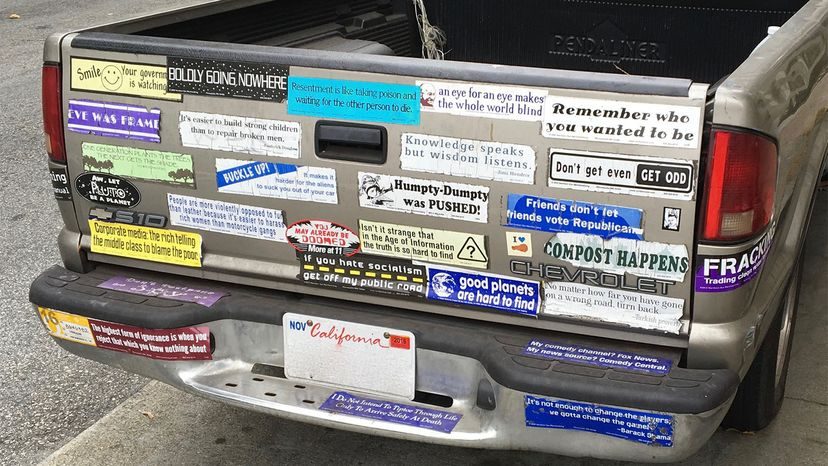
A bumper sticker is just an analogue tweet. It is the old-school method of broadcasting thoughts, opinions, ridiculous assumptions, insults, informative declarations, and political slogans. “Baby on board.” “Jesus loves you.” “Make America Great Again.” Or the classic “Ban pre-shredded cheese — make America grate again.” You get the drift.
But can you have too many of them?
That depends entirely on who you ask. The authorities have opinions, of course. Safety is the primary concern. In the U.S., every state has different regulations governing the use of stickers on car windows. Mississippi prohibits all window stickers save official ones. Indiana is more lenient, allowing them as long as they are 4 inches square (25 square centimeters) or less and located on the bottom of the passenger’s side of the windshield.
The Psychology of the Sticker Bomb
According to psychologist William Szlemko and a team of other researchers at Colorado State University, there’s definitely such a thing as too many bumper stickers. A study they conducted in 2008 found that the quantity of stickers on a car was a predictor of road rage. The more stuff plastered on the outside of your ride, the more likely you are to jump out brandishing a tire iron. This happens even if all your auto-messaging communicates peace and love.
The reason for this is simple. Some people identify strongly with their cars. They view them as their personal territory. Even when that personal territory is speeding along a public highway. The more territorial a person is, the more violent they’re prone to be when they perceive a threat to their space. Stickers are a good indicator of a driver’s territorial attitudes. So steer clear of be-stickered rigs whatever you do.
When Others Slap You With Their Opinion
Of course, it also depends who’s doing the stickering. The owner of the car? Or somebody else?
In Oakland, California, an SUV left unclaimed for too long in a parking spot on the street became the site for an intervention organized by an artist named Nite Owl. Participants were invited to a “Slapocalypse.” The result was a car covered in stickers from top to bottom, front to back.
Don’t park in a handicapped spot in Brazil unless you’ve got the right. One man returned to his morally indefensible parking space to find his vehicle so entirely smothered in stickers. He had to rip some of them off just to see through his windshield as he drove away in shame from the jeering crowd of onlookers. For added effect, the stickers were artfully applied to represent the universal handicapped sign of a person in a wheelchair. The incident may or may not have been a public-awareness stunt. One way or another, the message was highly adhesive.
The First Amendment provides a lot of protection for offensive speech, making it unlikely that most bumper-sticker citations would withstand a constitutional challenge.
The right to express yourself is a guaranteed Constitutional right. Bumper stickers represent a mainstream, and sometimes humorous, way for people to express themselves on every subject under the sun. But bumper stickers featuring profanity, a protected form of speech, occasionally lead to a citation or arrest.
Does your windshield look like a collage yet? Or is yours clean enough to see the road ahead?