BYD has officially moved its new “Heyuan” integrated powertrain architecture into series production, debuting it on the 2026 Denza D9. Unlike previous iterations of plug-in hybrid (PHEV) technology that focused primarily on engine efficiency, this new platform represents a fundamental shift in vehicle architecture and spatial packaging.
The Engineering Breakthrough: Relocating the Exhaust
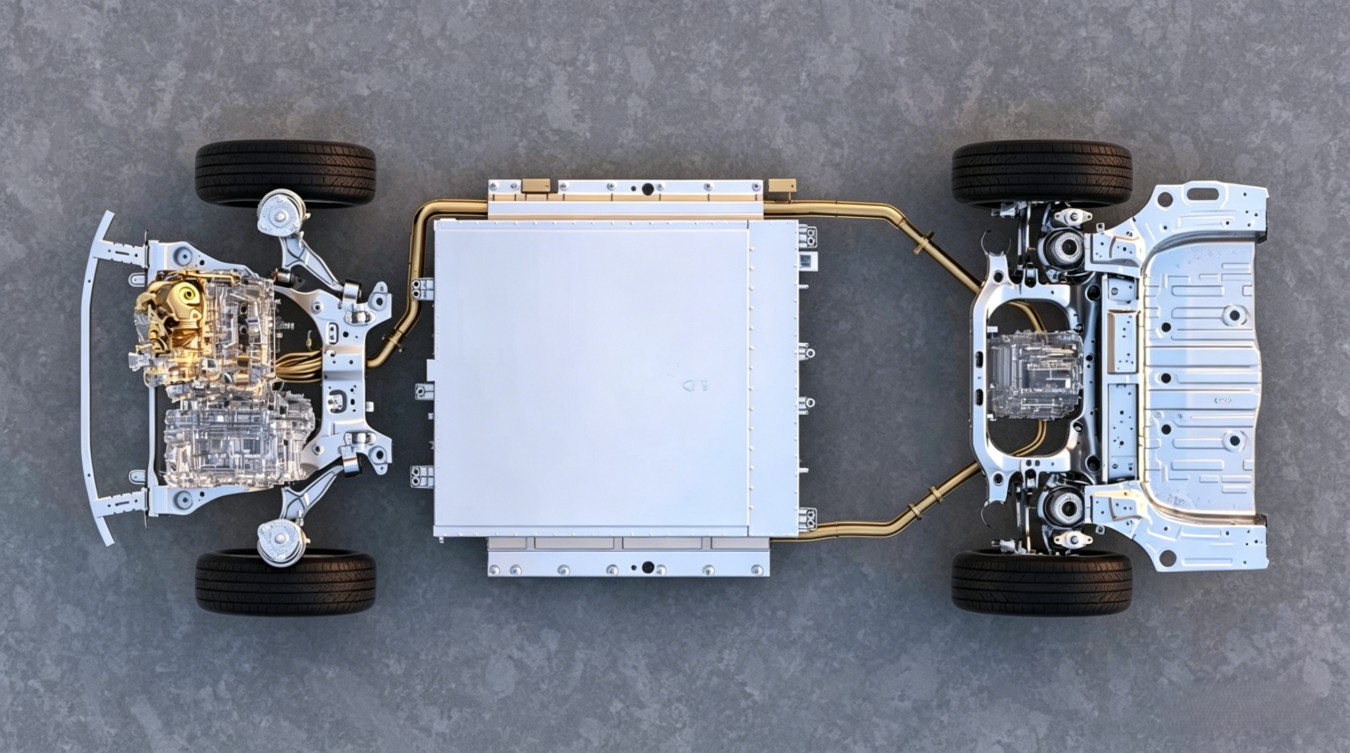
The core innovation of the Heyuan platform lies in its unconventional layout. In traditional vehicle design, the exhaust silencer is located at the rear, occupying significant space beneath the chassis. BYD has re-engineered this by moving the exhaust components into the front engine bay.
This structural change triggers a “domino effect” of design advantages:
– Centralized Battery Placement: By clearing the rear underbody of exhaust hardware, engineers can position the battery pack more centrally.
– Improved Weight Distribution: A more central battery mass enhances vehicle handling and stability.
– Increased Cargo Capacity: In the Denza D9, this layout creates 126 liters of additional concealed storage, bringing the total rear cargo volume to 882 liters—all without increasing the vehicle’s external dimensions.
Platform vs. Powertrain: Understanding the Difference
It is important to distinguish between BYD’s hybrid systems and this new platform. While the DM 5.0 series focuses on the “brain” and “heart”—optimizing fuel consumption, thermal efficiency, and engine-motor integration—the Heyuan platform focuses on the “skeleton.”
The Heyuan architecture manages the physical layout of the vehicle, allowing it to be paired with various hybrid systems to maximize both mechanical efficiency and interior utility. This move suggests a transition toward software-defined energy management, where hardware layout and digital control work in tandem to optimize performance.
Scaling for the Future: Larger Batteries and Longer Ranges
The most significant implication of the Heyuan platform is its ability to accommodate much larger battery packs.
– The current Denza D9 utilizes a 66.48 kWh battery.
– The redesigned chassis is capable of supporting configurations exceeding 100 kWh.
This capability addresses a major trend in the automotive industry: the push to increase electric-only range in plug-in hybrids. By enabling larger batteries in heavy, high-capacity vehicles like MPVs (Multi-Purpose Vehicles), BYD is bridging the gap between traditional hybrids and fully electric vehicles (EVs).
Market Context and Challenges
Despite these technical leaps, the Denza brand faces a complex market landscape. Recent sales data from China EV DataTracker shows a volatile trend: while March 2026 saw a month-on-month increase of 26.4%, year-on-year figures remain significantly lower than previous periods.
Furthermore, relocating the exhaust to the engine bay is not without engineering hurdles. To make this viable, BYD had to solve complex problems regarding:
– Heat Dissipation: Managing high temperatures near sensitive engine components.
– Acoustics: Controlling noise, vibration, and harshness (NVH) within a more compact compartment.
– Backpressure: Ensuring the relocated exhaust does not compromise engine performance.
As BYD prepares to expand the Denza lineup into Europe, the company is also planning the deployment of 6,000 flash-charging stations overseas to support its growing fleet of high-capacity hybrids and EVs.
The Heyuan platform marks a transition from merely improving fuel efficiency to fundamentally redesigning how hybrid vehicles are built, prioritizing both energy density and passenger utility.
Conclusion
BYD’s Heyuan platform represents a strategic evolution in hybrid engineering, using clever spatial reconfiguration to solve the traditional trade-off between large battery capacity and interior passenger space. This architectural shift positions the Denza D9 to meet the growing consumer demand for long-range, high-utility electric mobility.