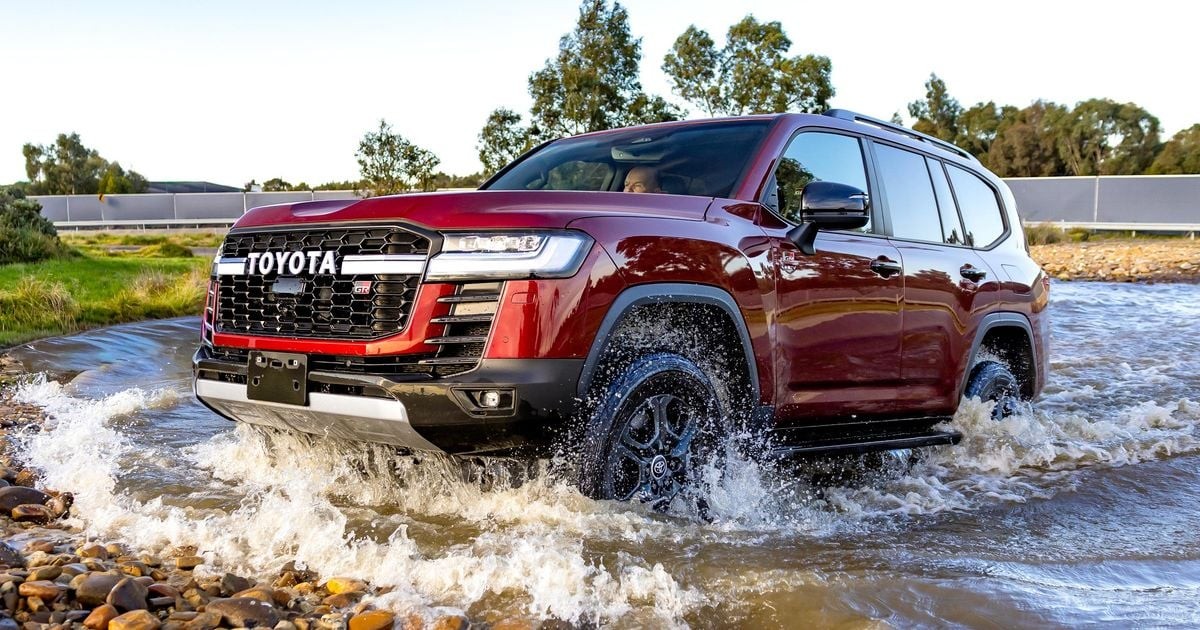
Toyota Australia has provided updated timelines for its highly anticipated electrified flagship, confirming that the LandCruiser 300 Series “Performance Hybrid” will arrive later than originally anticipated. While the brand is moving forward with its high-output hybrid technology, a hybrid version of the popular Prado remains unconfirmed, leaving a gap in Toyota’s lineup that competitors are already beginning to exploit.
The LandCruiser 300: High Power, Delayed Arrival
According to John Pappas, Toyota Australia’s Vice President for Sales, Marketing, and Franchise Operations, the LandCruiser 300 Performance Hybrid is now expected to launch after mid-2025. This follows previous indications that a March 2026 release was on the horizon.
Unlike the “efficient” hybrids found in smaller passenger cars, Toyota is positioning this as a “Performance Hybrid.” This distinction is critical for the Australian market, where heavy towing and off-road capability are non-negotiable requirements for SUV buyers.
Technical Specifications
The LandCruiser 300 Performance Hybrid will utilize a sophisticated powertrain shared with the Toyota Tundra and the Lexus LX700h:
– Engine: 3.4-litre twin-turbocharged V6 petrol-electric system.
– Output: A substantial 341kW of power and 790Nm of torque.
– Transmission: 10-speed automatic.
– Battery: 1.8kWh nickel-metal hydride (NMH) battery.
– Efficiency: A claimed fuel consumption of 10.9L/100km.
By focusing on “performance” rather than just “efficiency,” Toyota aims to ensure that electrification does not come at the cost of the vehicle’s legendary utility.
The Prado Dilemma: Why a Hybrid is Not Yet a Reality
While the LandCruiser 300 has a clear path to market, the future of a hybrid Prado remains ambiguous. Toyota Australia has maintained a cautious stance, suggesting that any decision to bring a hybrid Prado to local shores will depend on both availability and whether the powertrain meets specific customer needs.
The hesitation appears to be driven by two main factors:
1. Market Viability: Toyota has indicated that for a hybrid Prado to be economically viable in Australia, the brand would need to move over 10,000 units annually.
2. Technical Requirements: The global hybrid version of the Prado (known as the LandCruiser 250 Series in some markets) uses a smaller 2.4-litre turbo-petrol engine producing 243kW and 630Nm. Toyota must determine if this setup satisfies the rugged demands of Australian drivers.
Currently, the Prado sold in Australia relies on a 48V mild-hybrid system. While this offers slight improvements in efficiency, it lacks the ability to drive on pure electric power—a standard feature in Toyota’s broader hybrid lineup.
The Competitive Landscape: A Shifting Market
Toyota’s measured approach is occurring in an increasingly crowded and aggressive market. While Toyota waits to refine its hybrid offerings for large SUVs, Chinese manufacturers are already capturing market share by moving faster into electrification.
- GWM has already introduced hybrid versions of the Tank 300 and Tank 500, including plug-in hybrid (PHEV) options.
- Denza has begun delivering the B5 and B8 models, which directly compete with the Prado and LandCruiser 300, offering exclusive PHEV technology.
This shift suggests a trend where “traditional” off-road enthusiasts are being presented with electrified alternatives much sooner than they might have expected from legacy brands.
Toyota is attempting to balance the high performance required for heavy-duty utility with the growing demand for electrification, but the delay in its hybrid rollout leaves an opening for more agile competitors.
In summary, while the LandCruiser 300’s high-performance hybrid is finally on the horizon for mid-2025, Toyota’s hesitation regarding a hybrid Prado may allow newer, electrified rivals to gain a foothold in the large SUV segment.