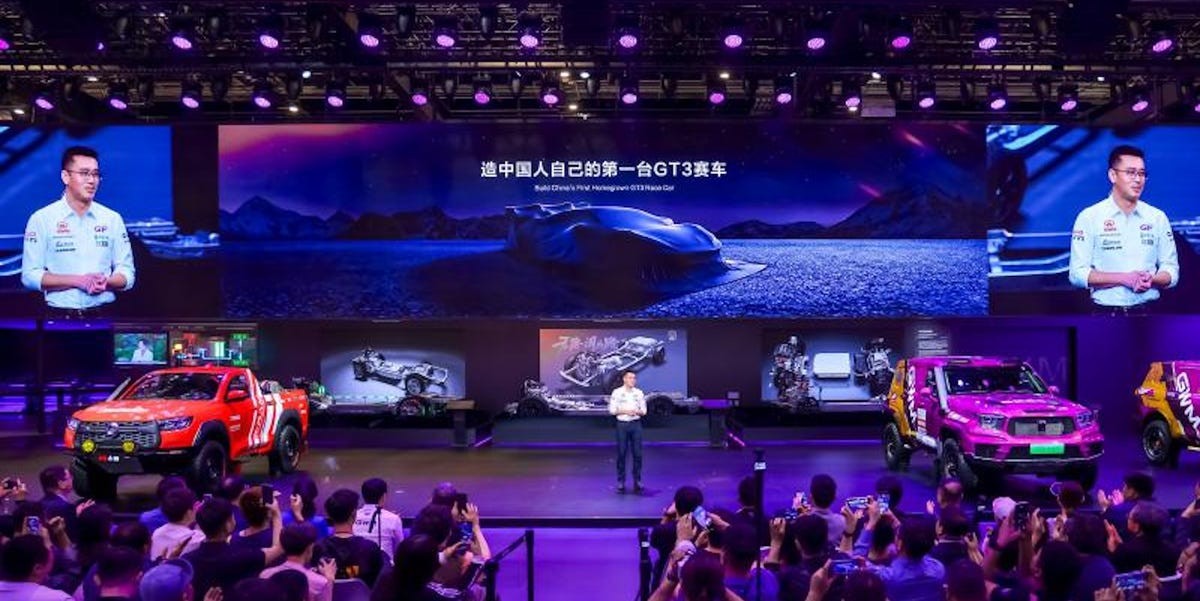
While the global automotive conversation is currently dominated by the rapid rise of Chinese electric vehicles (EVs), Great Wall Motor (GWM) is making a strategic pivot toward high-performance internal combustion. At the Beijing Auto Show, the manufacturer announced plans to develop a V-8-powered supercar designed to compete directly with legendary marques like Ferrari.
The “Great Faith” Vision: GWM GF
The new project will operate under a dedicated sub-brand called GWM GF (short for “Great Faith”), with an official reveal expected in 2027. Despite the limited technical details currently available, GWM has outlined a sophisticated foundation for the vehicle:
- Engine: A mid-mounted, 4.0-liter turbocharged V-8.
- Chassis: A lightweight, high-strength carbon-fiber monocoque.
- Racing Pedigree: The platform is intended to evolve into a GT3 race car, with plans for a road-legal GT3 version to follow.
To bridge the gap between mass-market manufacturing and elite supercar engineering, GWM has recruited Adam Thomson, a former McLaren GT chief engineer, to oversee platform and vehicle development.
Defying the Electric Trend
GWM’s decision to invest heavily in large-displacement engines marks a departure from the prevailing trend in the Chinese market, where plug-in hybrids and pure EVs are the primary focus. This “outlier” strategy is driven by a desire to capture global markets rather than just domestic ones.
GWM executives noted that feedback from international markets—specifically Australia—played a role in this direction. Nicole Wu, GWM’s Chief Technology Officer, highlighted a common sentiment among enthusiasts in regions with a strong car culture: “There is no replacement for displacement.”
By targeting enthusiasts who value the sound and character of an eight-cylinder engine, GWM is positioning itself to compete in the premium global segment where emotional engagement is as important as technical specifications.
Beyond the Supercar: The V-8 Expansion
The supercar is not an isolated experiment; it is part of a broader push for high-capacity power across GWM’s portfolio:
- The Tank 700: This off-road-oriented SUV will also feature a V-8 engine, though it will be distinct from the high-strung unit used in the GF supercar.
- Hybrid Integration: To navigate increasingly strict global CO2 emission standards, GWM intends to integrate these high-capacity engines into hybrid powertrains. This allows the company to offer the performance of a V-8 while meeting environmental regulations.
Why This Matters
For years, Chinese automakers have been viewed primarily as leaders in affordable, tech-heavy EVs. By moving into the supercar and GT3 racing sectors, Great Wall Motor is attempting to shift the perception of Chinese engineering from “value-driven” to “performance-driven.” If successful, this move could signal a new era where Chinese brands compete not just on price and software, but on pure mechanical prestige and racing heritage.
GWM is betting that the global appetite for high-performance internal combustion will remain strong enough to justify a costly, high-stakes entry into the supercar arena.
Conclusion
Great Wall Motor’s move into the V-8 supercar market represents a bold attempt to break into the elite tier of automotive manufacturing. By blending racing-grade engineering with hybrid technology, the company aims to conquer both the enthusiast market and the stringent regulatory landscapes of the global stage.