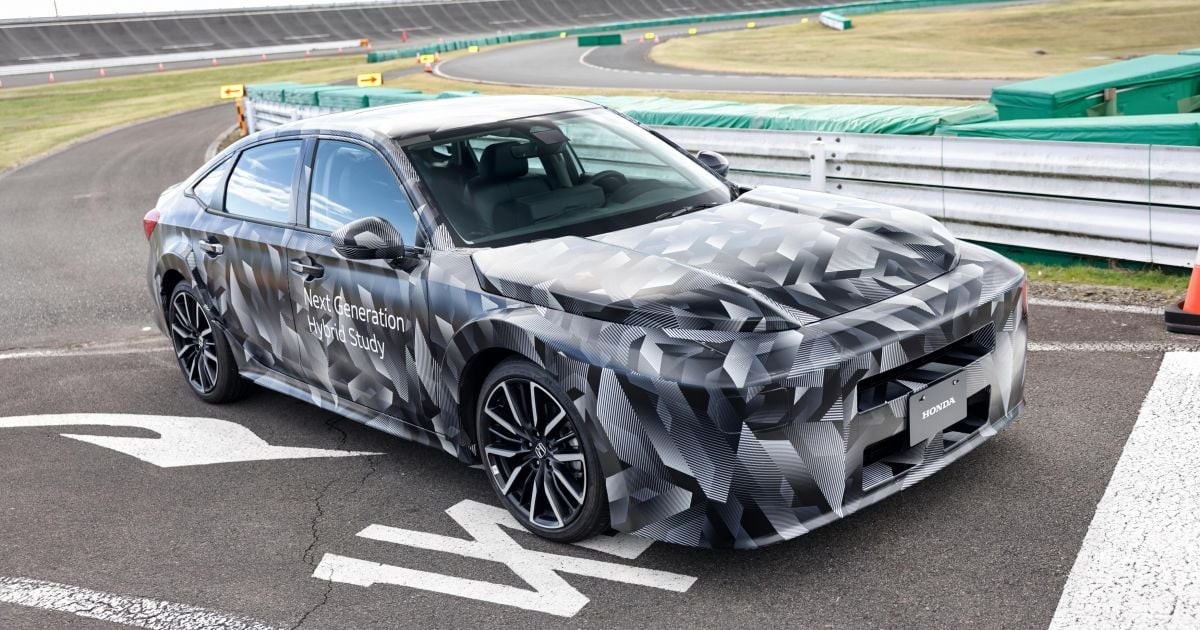
Honda has revealed a series of significant advancements in hybrid technology, poised to reshape its future lineup and finally deliver a compelling alternative to market leaders like Toyota. A recent technical deep-dive at Honda’s Tochigi proving grounds showcased innovations ranging from software-driven gearboxes to optimized engine designs – and the results suggest a shift toward both performance and usability.
The “Fake” Gearbox That Changes Everything
For years, Honda’s e:HEV hybrid system has been efficient but uninspiring, particularly for driving enthusiasts. The e-CVT often delivers a droning, elastic-band acceleration feel that detracts from the experience. Honda’s solution, dubbed “S+ Shift,” is a software-based virtual gearbox that transforms the e-CVT into a convincingly aggressive eight-speed dual-clutch automatic.
Under acceleration, S+ Shift mimics gear changes by momentarily reducing traction motor output while syncing engine revs with simulated shifts. The result is a crisp, tactile driving experience with audible and physical feedback – a breakthrough that could finally make Honda hybrids genuinely engaging. Engineers hinted that this tech could be adapted for turbocharged engines, potentially paving the way for a hybrid Civic Type R that avoids the traditional compromises.
Hybrid Power for Every Need: From Efficiency to Towing
Honda isn’t stopping at performance. The company also detailed plans for its broader hybrid range, adapting its technology to suit different needs. A redesigned 1.5-liter engine will power the next-generation HR-V, increasing high-efficiency operation by 40% and reducing noise. This move underscores Honda’s commitment to maximizing fuel economy in its core models.
For the North American market, Honda unveiled a V6 hybrid system designed for large SUVs and trucks. The goal here isn’t sportiness but low-end torque for towing, with a projected 30% efficiency gain over current V6 models. This suggests Honda is tailoring its hybrid tech to regional demands.
Packaging Problems Solved: The CR-V Gets a Makeover
A major pain point in Honda’s current hybrid SUVs has been compromised cargo space due to battery placement. The next-generation CR-V addresses this head-on, moving the battery and power control unit under the rear seats to create a full-size, flat-floor boot. This simple change could be the difference between a competitive hybrid SUV and one that falls short of customer expectations.
The platform will also feature a 10% weight reduction and a body structure designed to flex strategically during cornering, improving steering feel.
The Electric Future: Innovation and Questionable Choices
Honda’s EV plans are more mixed. The Super-One, a tiny electric kei car turned hot hatch, is confirmed for Australia but its pricing will be critical. If it exceeds $30,000, it risks being outpriced by cheaper Chinese EVs.
The 0 Series, built on Honda’s “Thin, Light, and Wise” platform, promises sleek design and efficiency. However, the decision to omit a front trunk (frunk) in favor of aerodynamic purity raises questions about practicality. Competitors like Tesla, Kia, and Hyundai have made frunks standard in EVs, and Honda’s omission may alienate potential buyers who value the extra storage space.
Conclusion: Honda is addressing its hybrid weaknesses head-on. The S+ Shift system is a game-changer for performance, and the packaging fixes in the CR-V are long overdue. While the EV strategy has some quirks, the company’s immediate hybrid future looks sharp, focused, and finally, genuinely exciting.