For years, diesel was the undisputed king of large family vehicles. Its torque handled heavy loads with ease, and its fuel economy on long highway runs was hard to beat. However, the landscape of family motoring is shifting. As more drivers spend their time navigating congested city streets rather than open motorways, hybrid technology has emerged as the superior choice.
Hybrids offer a compelling middle ground: they provide the range and convenience of a petrol car while significantly reducing fuel bills through electric assistance. Unlike fully electric vehicles (EVs), they eliminate range anxiety and charging infrastructure concerns, making them ideal for large families who need reliability without compromise.
In 2026, the market offers a diverse range of seven-seat hybrids, from budget-friendly MPVs to premium luxury SUVs. Below is a curated guide to the best options currently on sale, categorized by their strengths to help you find the right fit for your lifestyle.
Understanding Your Options: Mild, Full, and Plug-in Hybrids
Before diving into specific models, it is crucial to understand the three main hybrid technologies available:
- Mild Hybrids: These use a small generator to assist the engine, improving efficiency but cannot drive on pure electric power. They are generally less suitable for significant fuel savings in stop-start traffic.
- Full (Self-Charging) Hybrids: These combine an electric motor and battery with a petrol engine. The system charges itself via braking and engine power, allowing for short bursts of electric-only driving. This is the most “set-and-forget” option for daily commuting.
- Plug-in Hybrids (PHEVs): Similar to full hybrids but with a larger battery that can be charged externally. This provides a substantial pure-electric range (often 30–60 miles), ideal for short daily commutes, with the petrol engine kicking in for longer journeys.
Note: This guide focuses on full and plug-in hybrids, as they offer the most significant benefits for large family cars.
1. Dacia Jogger: The Value Champion
Price from: £23,330
Best For: Budget-conscious families seeking maximum space for minimum cost.
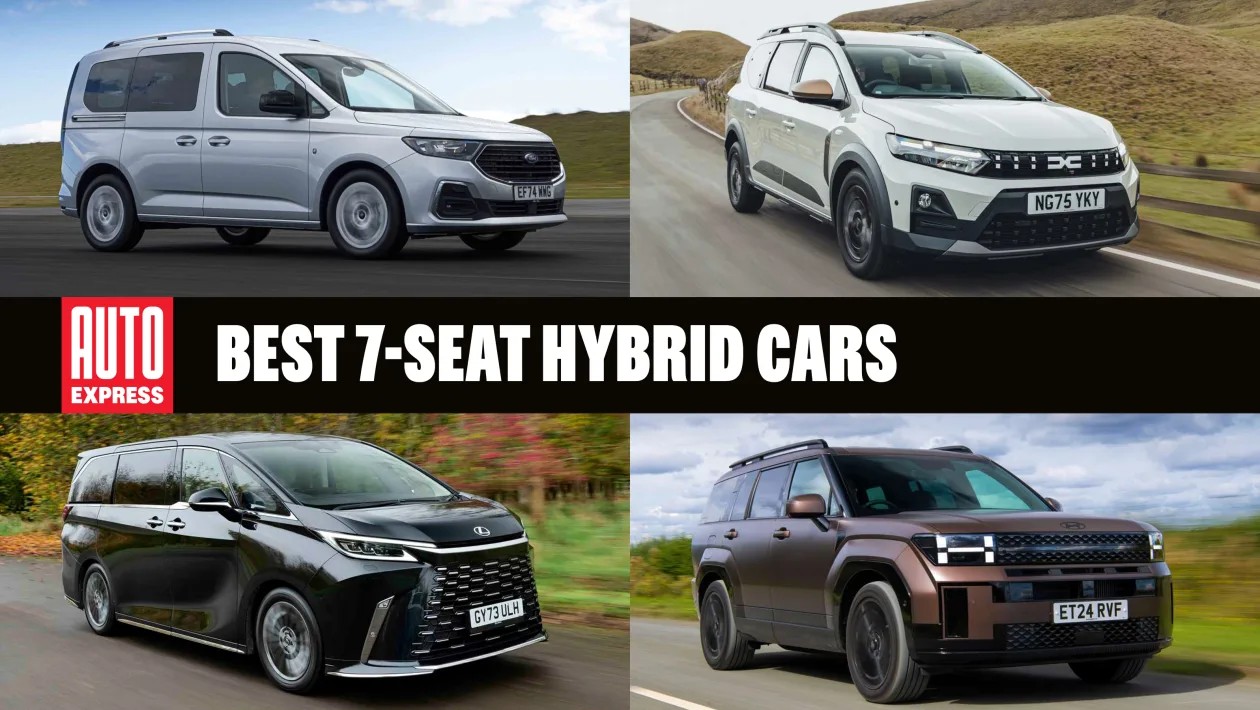
The Dacia Jogger remains the standout choice for value. Named Family Car of the Year in 2022 and 2023, it combines MPV-like practicality with an incredibly low price point.
Why It Matters
The Jogger proves that you do not need to spend a fortune to get seven seats. Its hybrid powertrain, featuring a 1.6-litre petrol engine and electric motor, is particularly effective in urban environments. It operates primarily in electric mode at low speeds, providing punchier acceleration than its non-hybrid sibling.
Key Features & Trade-offs
- Pros: Incredible value, strong residual values, surprisingly refined driving experience for the price, and easy access to the third row.
- Cons: A one-star Euro NCAP safety rating is a significant concern for some; interior materials feel cheap; brake feel can be inconsistent.
- Space: The boot is tiny (160 litres) with all seven seats up. However, folding the third row increases this to 565 litres, and folding both rear rows reveals a van-like 1,807 litres of cargo space.
“There’s plenty of room in the third row – only taller adults will have a reason to grumble about limited kneeroom, but we expect these seats to be mainly used by children anyway.” — Dean Gibson, Senior Test Editor
2. Hyundai Santa Fe: Style Meets Substance
Price from: £49,090
Best For: Families who want a bold design, premium interior, and genuine third-row comfort.
The new Hyundai Santa Fe abandons subtlety for a squared-off, rugged aesthetic. It is available exclusively with hybrid powertrains (self-charging or plug-in), ensuring modern efficiency standards.
Why It Matters
Unlike many rivals where the third row is a novelty, the Santa Fe offers genuine space for adults in the back. The plug-in variant offers a pure-electric range of 33.6 miles, making it highly efficient for daily commutes.
Key Features & Trade-offs
- Pros: Excellent second and third-row space, generous standard equipment, eye-catching design, and four Isofix points for child seats.
- Cons: Bulky and ponderous on the road; rough engine note; expensive compared to some rivals.
- Space: With five seats in use, the boot offers 628 litres—significantly more than the Peugeot 5008. A six-seat option with captain’s chairs is also available for added luxury.
3. Kia Sorento: The Practical Alternative
Price from: £44,705
Best For: Buyers who prefer understated styling and strong warranty coverage.
Closely related to the Hyundai Santa Fe, the Kia Sorento offers similar capability but with a more conservative design. It retains Kia’s renowned seven-year, 100,000-mile warranty, adding peace of mind for long-term ownership.
Why It Matters
The Sorento balances space and efficiency well. The self-charging hybrid combines a 1.6-litre petrol engine with an electric motor, delivering a claimed 42.2 mpg (though real-world tests suggest closer to 38.7 mpg). The plug-in version offers 35 miles of electric range.
Key Features & Trade-offs
- Pros: Spacious cabin with a flat floor, strong residual values, four-wheel drive is standard.
- Cons: Engines can lack refinement under hard acceleration; feels heavy on the road; pricey compared to some competitors.
- Space: The cabin is exceptionally spacious, comfortably seating seven adults without feeling cramped. The boot offers 608 litres with five seats up.
4. Volvo XC90: Luxury That Endures
Price from: £73,765
Best For: Families seeking premium safety, comfort, and understated elegance.
Although the XC90 is older than some rivals, its 2024 facelift keeps it competitive. It remains a stalwart in the luxury seven-seater segment, prioritizing safety and Scandinavian minimalism.
Why It Matters
For those who can charge regularly, the T8 plug-in hybrid is the standout choice. It offers 448bhp of combined power and an official 44-mile electric range, allowing for daily zero-emission commuting with the option for long-distance travel.
Key Features & Trade-offs
- Pros: Genuine room for seven adults and luggage, slick Android Automotive infotainment, solid and sturdy build quality.
- Cons: Showing its age compared to newer designs; light steering may lack confidence at high speeds; poor efficiency from petrol-only engines.
- Space: Offers 302 litres of boot space even with all seven seats in place. Access to the third row can be tricky due to limited floor space for foot placement.
5. Peugeot 5008: Comfort and Tech
Price from: £37,045
Best For: Drivers who prioritize ride comfort and a high-tech interior.
The reworked Peugeot 5008 has expanded its interior space and added hybrid options alongside a pure-electric variant. It stands out for its composed ride quality and sophisticated cabin design.
Why It Matters
The plug-in hybrid offers up to 48 miles of electric range, while the self-charging version delivers up to 52.5 mpg. This makes it one of the most efficient seven-seaters in its class.
Key Features & Trade-offs
- Pros: Composed ride and handling, fantastic interior finish, frugal powertrains.
- Cons: Third row is cramped for adults; infotainment system can be distracting; brake pedal feel is average.
- Space: The boot offers 258 litres with all seven seats up. While head and shoulder room are good in the back, kneeroom is tight, making it suitable primarily for occasional use or children.
6. Ford Tourneo Connect: The Versatile MPV
Price from: £35,280
Best For: Families who need maximum versatility and easy access.
Based on the Volkswagen Caddy, the Ford Tourneo Connect is a van-derived MPV that offers exceptional practicality. The new plug-in hybrid variant is a significant upgrade, offering a class-leading 68 miles of pure-electric range.
Why It Matters
For families who frequently carry more than five people, the sliding doors and high roofline make entry and exit much easier than in traditional SUVs. The partnership with Volkswagen ensures robust build quality, while Ford adds more standard equipment.
Key Features & Trade-offs
- Pros: Huge cargo space (1,213 litres), economical plug-in hybrid, sliding doors for easy access.
- Cons: Van-derived styling is not aesthetically pleasing; touch-sensitive controls can be frustrating; fiddly seat folding mechanisms.
- Space: Available in two body lengths, the “Grand” version offers an extended wheelbase for even more rear legroom.
Conclusion
The shift from diesel to hybrid powertrains in seven-seat cars is not just about environmental compliance; it is about practical efficiency. For urban drivers, hybrids reduce fuel costs significantly, while for long-distance travelers, they eliminate the range anxiety associated with EVs.
Whether you prioritize the unbeatable value of the Dacia Jogger, the spacious luxury of the Hyundai Santa Fe, or the versatile utility of the Ford Tourneo Connect, there is a hybrid solution that fits every family’s needs and budget in 2026.