The fundamental goal of automotive engineering has always been to refine the chassis—the backbone of every vehicle. However, as we move deeper into the digital age, the focus is shifting from purely mechanical durability to intelligent adaptability.
At the recent CES trade show, automotive supplier ZF unveiled its “Chassis 2.0” strategy, showcasing how artificial intelligence and advanced software can transform a car from a passive machine into a proactive, sensing organism.
Beyond Traditional Driving: The Rise of AI Road Sense
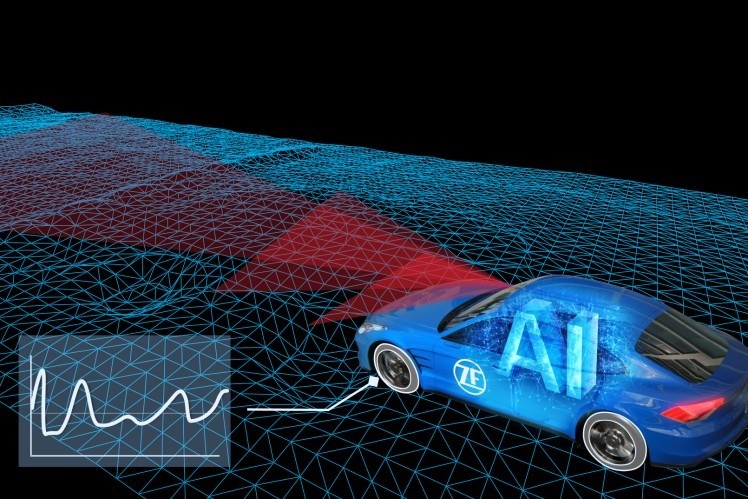
The centerpiece of ZF’s new approach is AI Road Sense. Unlike traditional suspension systems that react after a vehicle hits a bump or a pothole, this technology aims to predict the road surface ahead.
By analyzing upcoming terrain, the system makes instantaneous adjustments to the suspension settings. This allows the chassis to prepare for impact, effectively “softening” the blow before the tires even touch the uneven surface. This level of predictive adjustment aims to achieve two primary goals:
1. Enhanced Safety: Minimizing the loss of control caused by sudden surface changes.
2. Superior Comfort: Reducing the physical jarring felt by passengers.
The Competitive Landscape: Detection vs. Adaptation
The concept of “reading the road” is not new, but the industry is currently seeing a shift in how this data is utilized. Previous innovations have focused largely on data collection and sharing, whereas ZF is focusing on immediate mechanical response.
To understand the significance of ZF’s approach, it is helpful to look at how other industry leaders have tackled the problem:
- Honda Research Institute USA: Focused on a monitoring system that uses GPS and cameras to collect road data, which is then shared anonymously with road authorities to assist in long-term maintenance.
- Nexteer Automotive & Tactile Mobility: Developed software that categorizes road friction (e.g., “dry,” “wet,” or “icy”) and uploads this data to the cloud so following vehicles are alerted to the conditions.
- Jaguar Land Rover (JLR): Explored surface identification using radar and ultrasonic sensors to help drivers navigate difficult terrain without getting stuck.
The Key Difference: While Honda and Nexteer focus on informing the driver or the authorities, and JLR focuses on navigation, ZF’s system is designed to continuously reconfigure the vehicle’s physical behavior in real-time.
How the Technology Works
The intelligence behind this system is driven by ZF’s Cubix chassis software. This software acts as the “brain” of the vehicle, integrating data from existing onboard sensors to manage damping torque distribution and chassis settings.
Beyond surface detection, the software includes a Driver Behaviour Recognition feature. By analyzing how a person interacts with the vehicle’s controls, the AI can predict a specific driving style and automatically adjust comfort preferences to match the driver’s habits.
Scalable Solutions for Manufacturers
Recognizing that different vehicle types require different levels of sophistication, ZF offers three distinct configurations for car manufacturers:
- Standard: Utilizes the vehicle’s existing onboard data network to manage settings.
- Advanced: Incorporates camera-based surface detection for better environmental awareness.
- Premium: The most sophisticated tier, utilizing LiDAR scanning to create a high-resolution 3D profile of the road up to 25 meters ahead.
This tiered approach allows manufacturers to implement intelligent chassis technology across everything from budget commuter cars to high-end luxury vehicles.
Conclusion
The evolution of the chassis from a mechanical component to an AI-driven system marks a major step toward safer, more comfortable autonomous and semi-autonomous driving. By predicting road imperfections rather than just reacting to them, vehicles are becoming more intuitive partners in the driving experience.