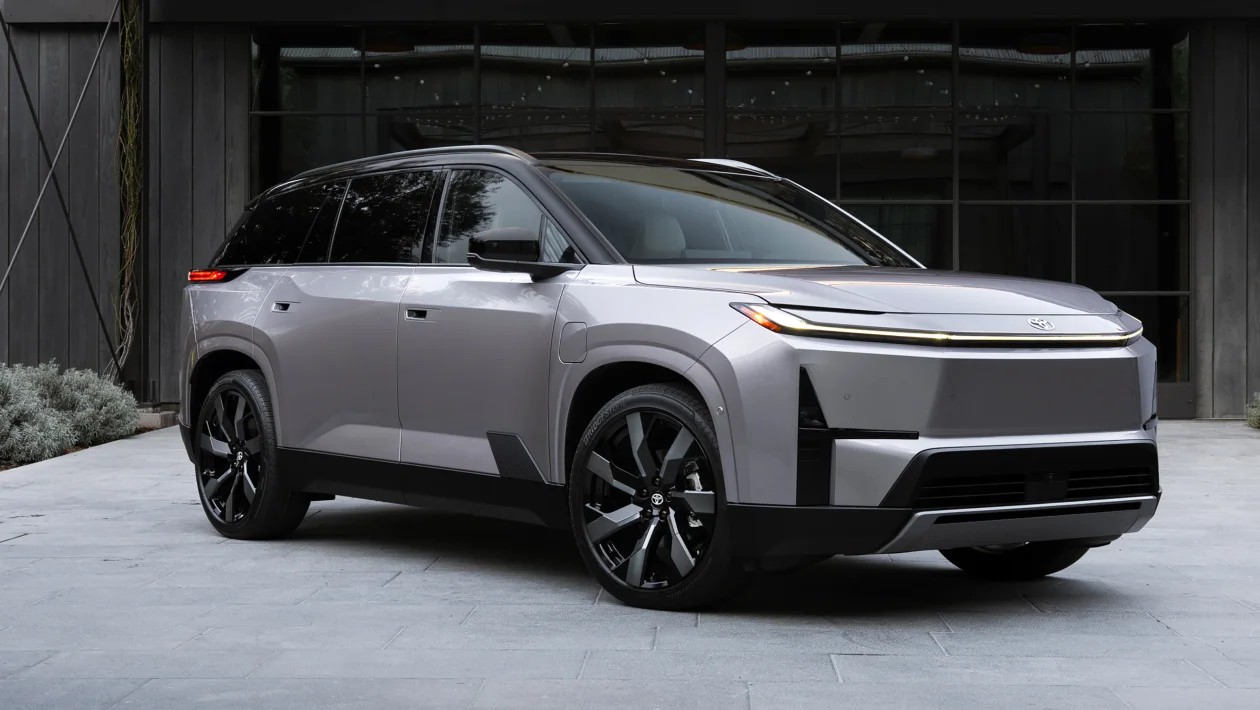
Toyota has unveiled its all-electric Highlander, a large seven-seat SUV engineered primarily for the North American market. While the electric vehicle (EV) landscape in the US is experiencing a slowdown, this model represents Toyota’s commitment to expanding its EV offerings, albeit with a geographically limited rollout.
Engineering and Platform Choices
The Highlander BEV leverages Toyota’s existing TNGA-K platform, shared with its gasoline and hybrid models, rather than adopting an EV-specific architecture like the bZ4X. This decision prioritizes cost efficiency and production scalability, but may limit the vehicle’s ultimate performance potential. The platform supports both front-wheel drive and all-wheel drive configurations, paired with either a 77kWh or a larger 95.8kWh battery pack.
Performance and Range Specifications
The base, front-wheel drive model offers up to 287 miles of range (EPA estimate) with 221 horsepower. All-wheel drive variants deliver enhanced power – 338 horsepower – and either 270 miles (with the 77kWh battery) or an impressive 320 miles of range with the 95.8kWh pack. This larger battery marks Toyota’s highest capacity offering to date, though DC fast-charging speeds remain unspecified beyond a “under 30 minute” 10-80% recharge time.
Localization and Production Strategy
A key factor behind the North American exclusivity is Toyota’s new battery-assembly plant in the US. The Highlander BEV is the first model to utilize domestically produced batteries, aligning with broader localization trends in EV manufacturing. This allows Toyota to sidestep supply chain complexities and potential trade barriers, but restricts initial availability to a single major market.
Interior and Exterior Design Updates
The Highlander BEV features Toyota’s latest interior design language, including a 14-inch touchscreen, a 12.3-inch driver’s display, and upgraded ambient lighting. Exterior styling incorporates sharper lines, boomerang headlights, and flush door handles for a more modern aesthetic. The vehicle offers flexible seating configurations – either a standard 2-3-2 layout or an optional six-seater with captain’s chairs.
Market Implications and Future Prospects
The Highlander EV fills a niche in the seven-seat EV segment, competing with models like the Hyundai Ioniq 9, Kia EV9, and Volvo EX90. Toyota’s decision to limit initial distribution to North America reflects current market conditions and production capabilities. However, if the model proves successful, expansion to other regions – including the UK, where demand for spacious EVs is growing – could follow. The Highlander demonstrates that while EV adoption may be cooling, manufacturers still see room for growth in the large SUV segment.
The Highlander BEV isn’t just another EV; it’s a strategic move by Toyota to establish a foothold in North America while navigating a shifting global EV landscape.