


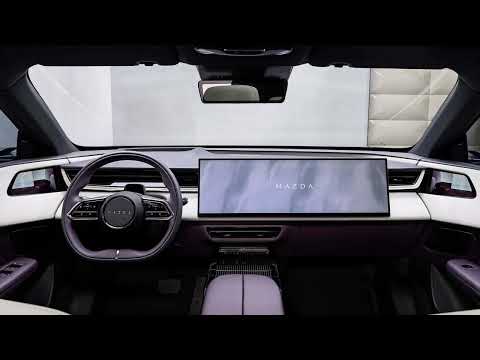
For years, Mazda distinguished itself from its competitors by resisting the “tablet-on-a-dashboard” trend. While other manufacturers moved toward massive, immersive screens, Mazda maintained a minimalist, driver-centric philosophy that prioritized physical controls and smaller, more integrated displays. However, a recent pivot in the company’s design language suggests that this era of restraint may be coming to an end.
The New Digital Landscape
Recent model launches, specifically those developed in China through Mazda’s joint venture with Changan, reveal a radical departure from the brand’s traditional aesthetic. The new 6e and CX-6e feature gargantuan infotainment systems that dominate the cabin. Most notably, the CX-6e boasts a staggering 26-inch touchscreen that extends significantly toward the passenger side.
This shift is not merely a change in hardware but a fundamental change in how Mazda views the cabin environment. Jo Stenuit, Mazda’s Design Director for Europe, defended the move in a recent interview with Autoweek, noting that larger screens offer superior clarity for information display. Furthermore, the massive screen serves a social purpose: it “invites the passenger to become part of the driving experience.”
Prioritizing the Driver Amidst the Tech
The primary criticism of large screens is the potential for driver distraction. To counter this, Mazda is doubling down on Head-Up Displays (HUD).
According to Stenuit, the brand believes a high-quality HUD is actually more critical than a traditional digital instrument cluster. The logic is that if essential data is projected directly into the driver’s line of sight, the need for traditional gauges—and the need to look down at a dashboard—is significantly reduced. By moving the primary information to the windshield, Mazda aims to keep the driver’s eyes on the road, even as the dashboard itself becomes more digital.
The Decline of Physical Controls
The transition to larger screens has coincided with a controversial move: the reduction of physical buttons. In previous models, Mazda utilized a “commander” rotary knob to navigate menus, a system designed to minimize “hands-off-the-wheel” time.
The new direction, seen in the updated CX-5, moves toward a touchscreen-centric interface. Mazda defends this transition by citing customer demand and evolving market trends:
– Market Evolution: The company acknowledges that both technology and consumer expectations have shifted.
– HMI Optimization: Mazda claims its new Human-Machine Interface (HMI) is designed to prioritize ease of use while maintaining their core safety philosophy.
– User Preference: Despite the debate over tactile feedback, Mazda suggests that modern drivers increasingly prefer a streamlined, screen-based interaction.
The Industry Trend: Screen vs. Substance
This pivot highlights a broader tension currently facing the automotive industry. As manufacturers race to compete with tech-forward brands, there is a growing trend of migrating frequently used functions—such as climate control or volume—from dedicated physical switches to digital menus.
While this creates a sleek, futuristic aesthetic, it raises a significant question: Does an all-screen interface actually improve usability, or does it simply satisfy a visual trend? For enthusiasts, the challenge will be whether Mazda can maintain its “Zoom-Zoom” driving soul in an era where the dashboard is increasingly defined by pixels rather than precision engineering.
Conclusion
Mazda is undergoing a significant identity shift, moving from a brand defined by tactile, driver-focused minimalism to one that embraces large-scale digital immersion. While the company relies on Head-Up Displays to mitigate distraction, the transition marks a definitive end to their long-standing resistance to the “screen-heavy” industry standard.


