The Lexus ES spent decades living in a coma.
Not a bad one, mind you. Buyers liked the quiet. The space. The sheer, unadulterated refusal to offend anyone.
Was it exciting? No.
Was it the choice?
Sure. For a certain demographic, the answer was an emphatic yes. Enthusiasts rolled their eyes and mentioned retirement communities. Lexus shrugged, printed money, and moved on.
Then they woke up.
Well.
Not fully awake.
But they stretched.
Lexus says the new formula is broader.
We drove the 2026 lineup in San Diego—the ES 350h hybrid, the entry EV ES 350e.
And the range-topper.
It’s a big shift.
Bigger in every direction. A new platform that supports both gas and electrons.
And for the first time?
Electricity.
The problem.
The new ES isn’t one car. It’s two different vehicles wearing nearly identical skins.
The hybrid and the EV feel nothing alike once the wheels turn.
Sitting in them?
Identical vibes.
Moving in them?
Night and day.
So we split the review.
One for the gas-electric blend. One for the battery beasts.
Did they build some soul into this thing? Or just a nicer appliance?
Keep reading.
The Look: Blown Away
Old ES owners probably couldn’t tell you which generation was which. They blended into traffic. Disappeared.
If you left an old ES at Costco, it would vanish before you forgot your coupons.
Not this one.
People looked.
A distracted Mazda driver literally stared at this Lexus instead of the road ahead. Anecdotal, yes.
But the point holds. It grabs eyes.
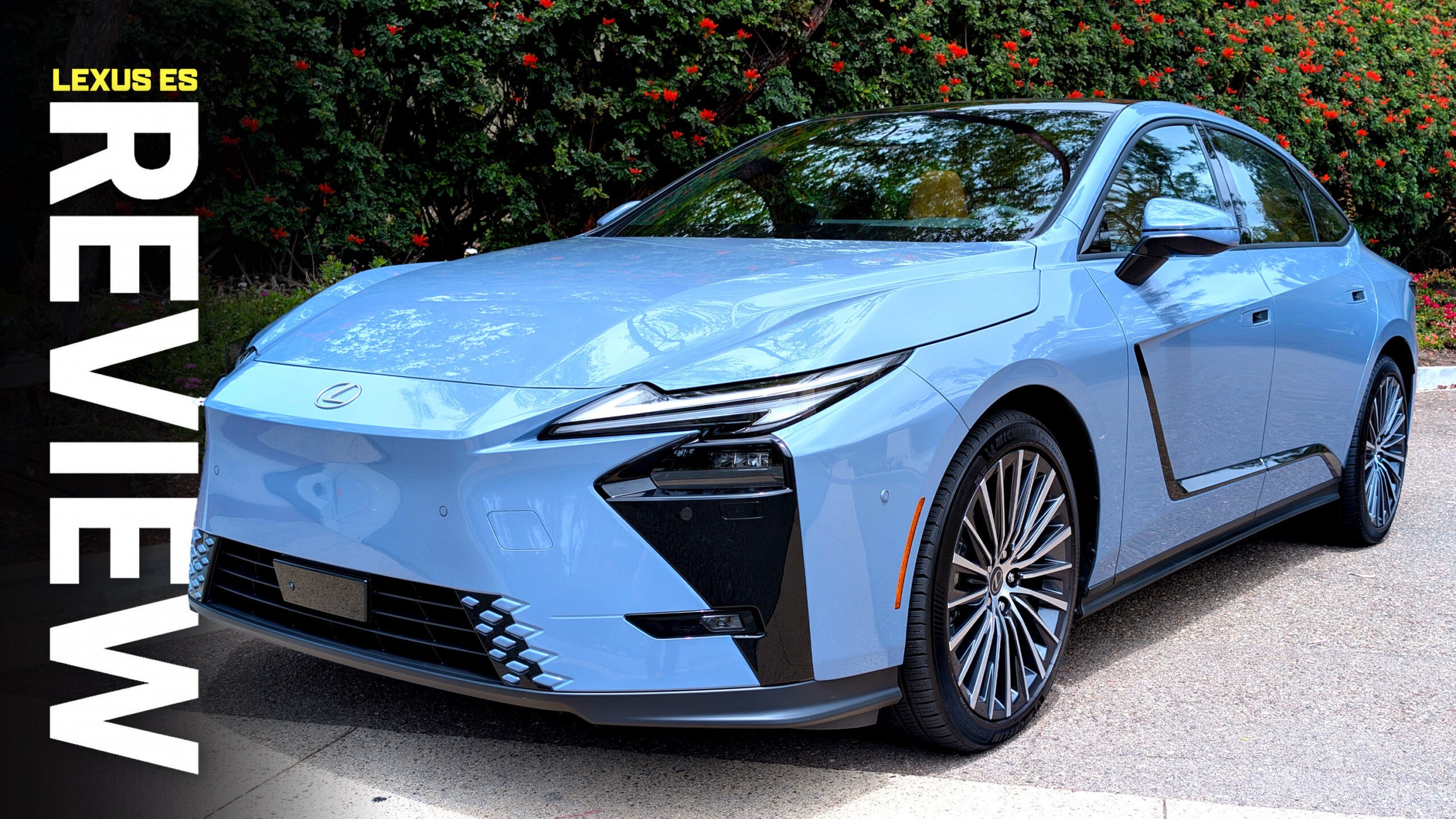
The side profile is bold.
Huge character line running through the middle. Feels very Lexus.
Reminds me of that Maxwell tape commercial guy. The one blowing the house away.
You’ll hate it. Or you’ll love it.
That’s fine.
The hood?
Wild.
Creases on creases. Surface details stacked on surface details.
Like someone asked Exhibit A for more lines, then added them again.
Is it bold?
Maybe overworked?
Probably both. It screams “we are not Toyota.”
The rear cleans it up.
Blade taillights. Clean proportions. A trunk that opens surprisingly wide.
Practical.
Big, too.
116.1-inch wheelbase. 202.4-inch total length.
It grew.
Inside: Bamboo & Bad Buttons
Step in.
Good first impression.
Seats are great.
Good bolstering. Good thigh support.
You aren’t perched on top of the world like in some trendy electric crossovers.
Massage function adds comfort for long hauls.
Fit and finish?
Solid.
Not a flagship.
But Lexus didn’t cheap out. Panels fit well.
Love the bamboo trim. Real bamboo. Not fake plastic print.
Luxury trims get it layered and lit up. Interesting texture.
Then you touch things.
Cracks appear.
HVAC controls look nice. Physical buttons. Hallelujah.
But Lexus hid them under a long rubber strip.
Feels like gaming controller plastic. Cheap.
Symbols only. No words. You glance down to guess.
If one breaks, you replace the whole strip.
Not great for long-term owners.
Steering wheel buttons? Cheap feeling.
Volume knob looks pricey, feels… meh.
Save it for the tech.
Infotainment is a winner.
14-inch screen. 12.3-inch driver display. Bright. Responsive. Intuitive.
Mark Levinson speakers rip.
Back seat gets love, too.
Executive Package adds heated/ventilated/massaging rear seats. Plus an ottoman for the passenger.
Weird. Cool.
13.3 cubic feet cargo space. Standard fare.
Legroom is king, though. I’m 6’6”.
Head barely grazes the roof. Legs? Room for days.
Comfort win.
Drive: Hybrid vs Electric
The ES 350h
This is the volume seller.
80% of buyers, Lexus claims, will pick this.
2.5-liter 4-cylinder hybrid.
244 hp. CVT.
FWD gets up to 46 MPG combined.
Range? Over 600 miles.
Our car started at 629 predicted.
Mile-crushing highway capability.
AWD drops MPG slightly to 44, but gains rear motor. 0-60 in 7.1 seconds vs 7.3 FWD.
Acceptable.
Not fast.
Town driving is dialed in. Quiet. Composed. Pleasant.
Pedals deserve praise. Hybrid regen modulation is easy to master. You can brake hard, then soften it perfectly.
One caveat.
Drive it in EV mode.
Don’t.
Just don’t.
The EVs: ES 350e & 500e
Here’s where it gets weird.
The EV feels more playful than the hybrid.
Why?
Sound.
The hybrid, by comparison, feels abnormally loud after sitting in the silent EV.
That four-cylinder? Refinement issue. Long accelerations feel noisy compared to the electric whisper.
Interior noise is in a different league.
ES 350e: 221 hp. FWD.
307-mile range.
0-60 in 7.4 seconds.
Wait.
It’s slower than the hybrid.
Leave it to Lexus.
Throttle response is better. Direct.
Regen is pedal-adjusted, no one-pedal driving toggle. Nice, but less convenient if you prefer coast-to-brake.
Then there’s the big dog.
ES 500e.
Dual motors.
338 hp.
0-60 in 5.1 seconds.
This one.
This is for drivers who want to drive.
Acceleration hits low. Punchy. Nimble.
It feels premium because it tries to compete.
Still conservative? Yes. Like Lexus got half-way to beating Germany, then panicked.
But if I choose?
Easy.
Buy the ES 500e charge at home.
NACS plug included.
Deal sealed.
Value Check
Pricing argues its case hard.
Hybrid starts around $51k.
EV starts around $49k.
Loaded 500e tops at $60k.
Compare that to the competition.
BMW i5? Starts $68k.
Mercedes E-Class? Mid-60s before you add wheels.
Numbers talk.
350h gets 600+ mile range.
EVs get 272-307 miles.
500e puts out 338hp. Fast enough. Not embarrassingly faster than German rivals, but quick enough for the segment.
Philosophy differs.
BMW and Benz sell status. Performance. Prestige.
Lexus sells quiet. Simplicity. Value.
Thousands less for similar space and comfort.
Is it enough?
Depends on you.
The Call
Old ES formula worked.
Understood its customer. Not a sports car. Not a flagship. Just comfortable.
New one adds spice without burning the recipe.
Hybrid is still the rational, logical buy.
But the EV—especially the 500e—injected personality where none existed for years.
Lexus broadened the net.
I wish they cast wider.
Still feels cautious.
Maybe next generation?
Maybe an ES 500e F?
Not F-Sport. Just F.
Hope they hear us.
Credit: Stephen Rivers / Lexus