BYD didn’t start out to build cars. It began as a battery manufacturer for electronics. Now? It is arguably the most dangerous automaker on the planet. In 2025, the Chinese giant sold over 4.55 million vehicles globally. More than 1.6 million were electrified. That number is huge. It allowed BYD to officially surpass Tesla.
Elon Musk’s company still holds the title of global leader in some metrics. But Tesla relies heavily on two specific models to carry its weight. BYD is playing a different game. It attacks every segment. It floods the market. It wins on volume.
The strategy is simple across all markets. You get a massive catalog. SUVs. Large electrified sedans. And compact cars.
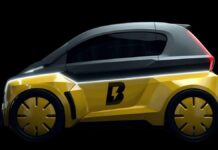
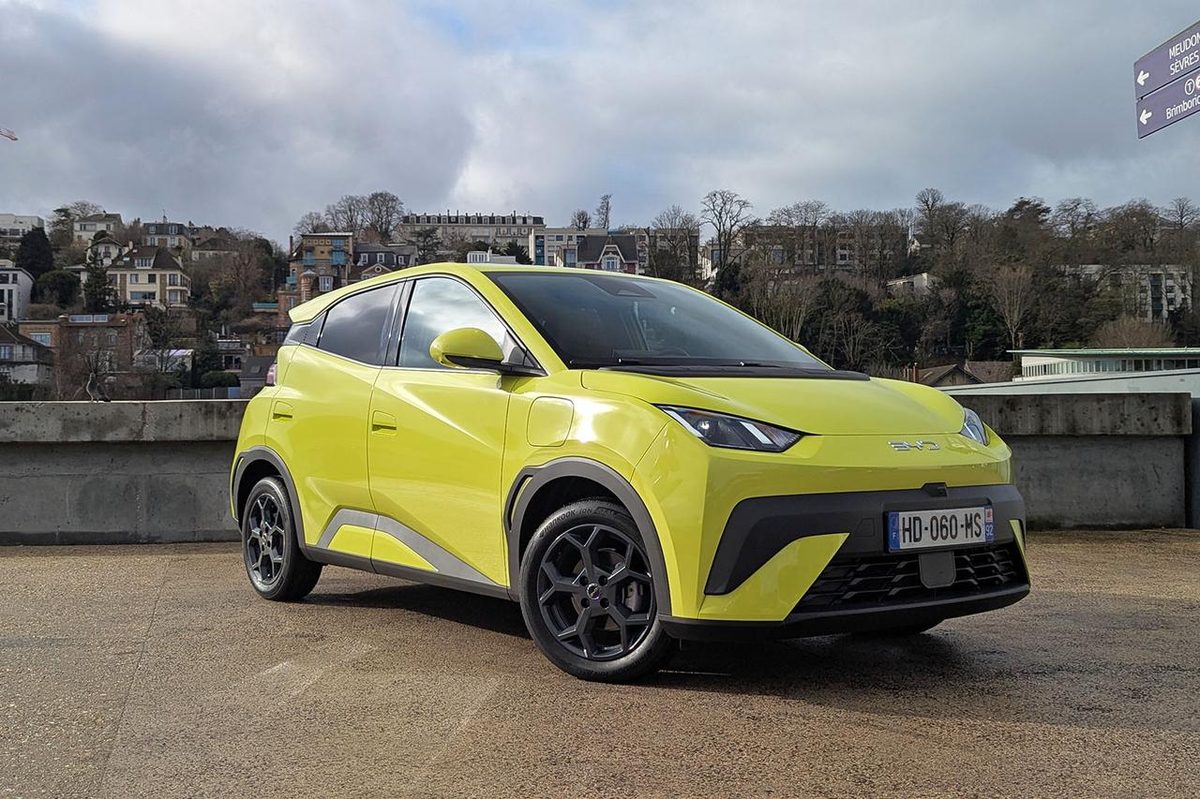
Take the BYD Seagull. In Europe, it goes by the name Dolphin Surf. This little city car positions itself as a credible alternative to the established titans of the compact segment. But does it deliver on that promise? Is it worth the hype? Or just another cheap electric vehicle?
We put it to the test.
The Underdog Enters the Ring
The Seagull (or Dolphin Surf) is small by design. It’s not trying to be a family hauler. It’s a city commuter. The price point is the main hook. It undercuts almost everyone else. But price alone doesn’t make a good car.
BYD has vertical integration. They make their own batteries. Their own chips. Their own motors. This control over the supply chain is why they can price this car so aggressively. Tesla can’t match that specific economics in the same way.
Driving Dynamics: Surprisingly Agile
You might expect a budget EV to feel plasticky. Unrefined. The Seagull defies that expectation.
The steering is light but direct. Not heavy. Not weighted. But precise. At low speeds, it’s nimble. Parking is easy. The turning circle is tight. That matters in dense urban environments.
Power delivery is linear. There’s no sudden lurch. No hesitation. The electric motor provides instant torque. But it’s tuned for efficiency, not drag racing. Top speed is adequate for city limits and highway cruising. It won’t excite you. But it won’t bore you either.
Range and Charging: The Real Numbers
Range anxiety is dying, but it’s not dead. The Seagull offers a range that covers most daily commutes. Depending on the battery pack size, you’re looking at roughly 300 to 400 kilometers (about 186 to 248 miles) on a full charge.
That’s enough for most people. You charge at night. You drive during the day. You don’t need a supercharger network to make it work.
Charging times are standard. DC fast charging allows for a significant boost in 30 minutes. It’s not the fastest in class. But it’s fast enough.
Interior: Minimalist Without Being Empty
The interior is clean. Simple. No clutter. No unnecessary screens. Just what you need.
Materials are hard plastics in some areas. Soft-touch surfaces elsewhere. It feels solid. Not cheap. The seats are
Space efficiency with a catch
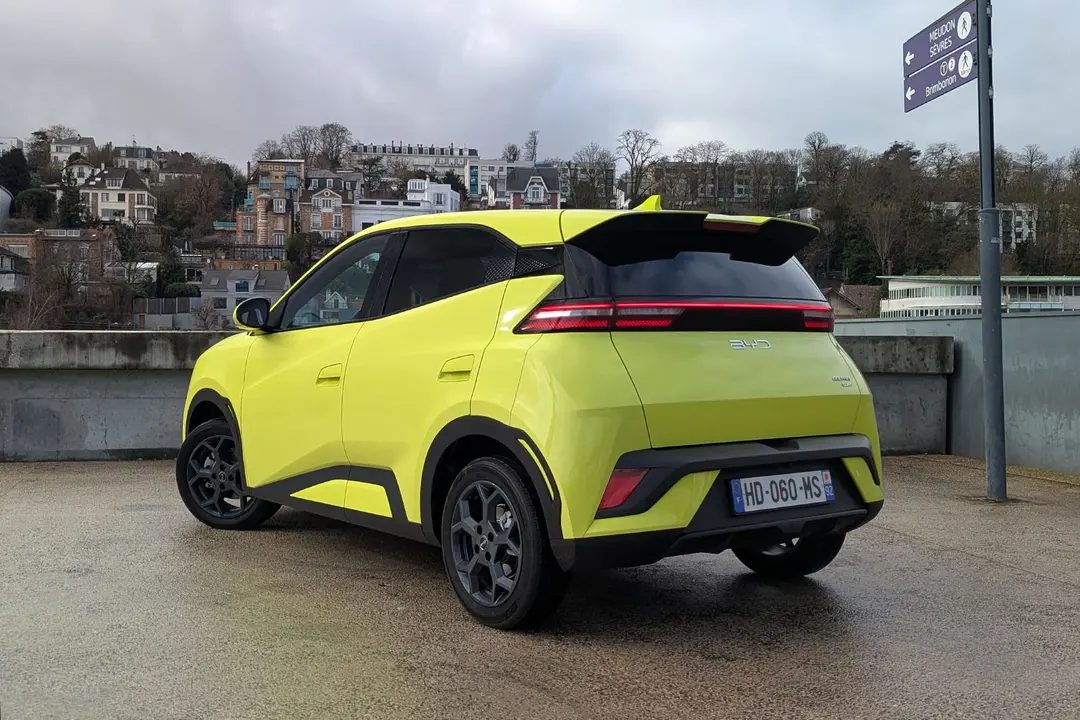
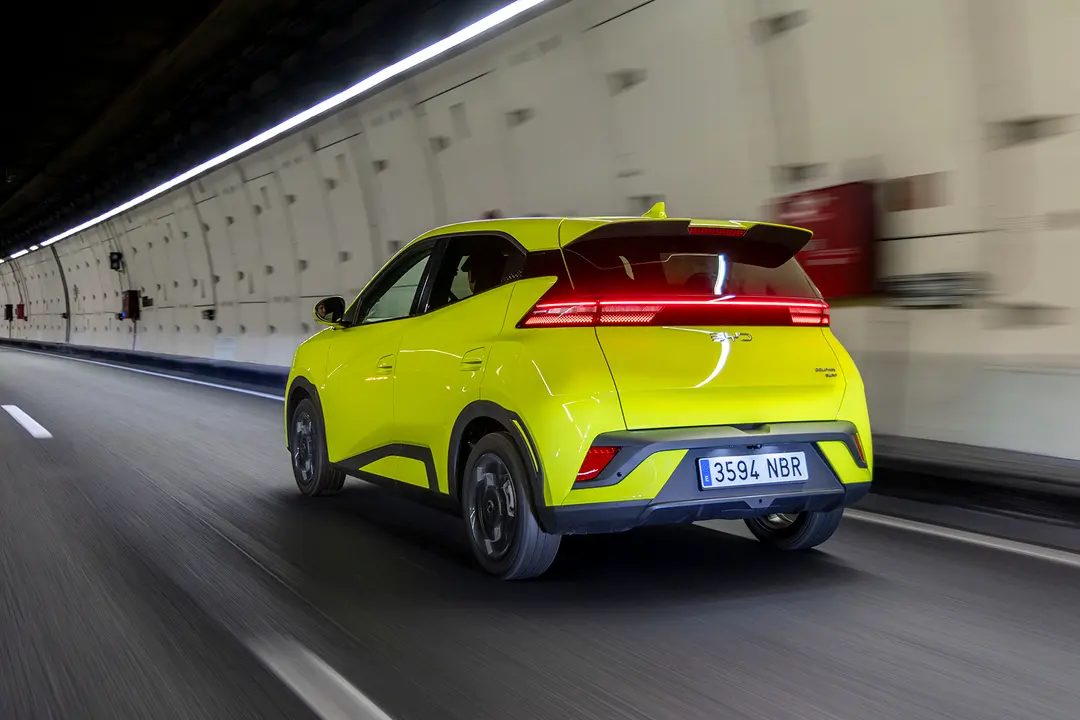
It looks like a Lamborghini. At least, that’s what the silhouette suggests if you squint. The reality is far more practical. The BYD Dolphin Surf measures just 3.99 meters long and 1.73 meters wide. It slots neatly between the Renault 5 E-Tech and the Citroën ë-C3. The Citroën might look more muscular, but it doesn’t take up more footprint on the road. That compact profile helps the Chinese EV save energy. Aerodynamics matter.
But size is a double-edged sword. To pass European crash standards, BYD stretched the wheelbase by 21 centimeters. The result is a 2.5-meter wheelbase. That’s generous for this class. Rear legroom is surprisingly good. Headroom is also solid, thanks to a roof height of 1.59 meters. You won’t feel cramped.
There’s a catch. Only two seats are available in the back. This is unusual. Most rivals in this segment are homologated for five passengers. The Dolphin Surf breaks that mold. It’s the only real downside. The knee room and head clearance are convincing, but you can’t fit a family of four back there comfortably.
Then there’s the trunk. Volume is rated at 308 liters. That’s average. Nothing special. It’s enough for city running. You can’t take a trip to IKEA though. Underneath the floor, there’s a large storage compartment for hiding cables. It’s useful. But the modular design is basic. The floor isn’t perfectly flat when seats fold. Plastic covers block part of the space. You don’t get every last cubic centimeter.
Why compact dimensions matter
Smaller cars often have an edge in efficiency. The Dolphin Surf knows this. Its narrow width reduces drag. It helps with consumption figures. This is a key factor for urban EVs. Buyers care about range. They care about charging costs. The trade-off? Less interior space.
The rear seats are the compromise. Two seats mean more legroom per person. But it limits utility. Is it better to have five cramped seats or two spacious ones? It depends on who you ask. Most competitors offer five seats. The BYD chooses comfort over capacity.
The trunk volume of 308 liters is standard. It doesn’t stand out. It’s functional. The under-floor storage adds flexibility. But the lack of a flat load floor is a letdown. You can’t haul long items easily. The plastic covers restrict usable space. It’s a practical limitation.
Comparing to rivals
How does it stack up against the Renault 5 E-Tech? The Renault offers five seats. The Citroën ë-C3 also offers five. The BYD Dolphin Surf offers two. It’s a different proposition. It’s not trying to be a mini-MPV. It’s trying to be a comfortable city car.
The wheelbase is the hero here. 2.5 meters. That’s long for a sub-4-meter car. It makes the cabin feel bigger than it is. The rear passengers get a treat. But the trunk suffers. 308 liters is mediocre. You’ll need bags if you go shopping. Or you’ll use the under-floor bin.
This isn’t about luxury. It’s about smart packaging. BYD stretched the car
The “Full Option” Front Seat
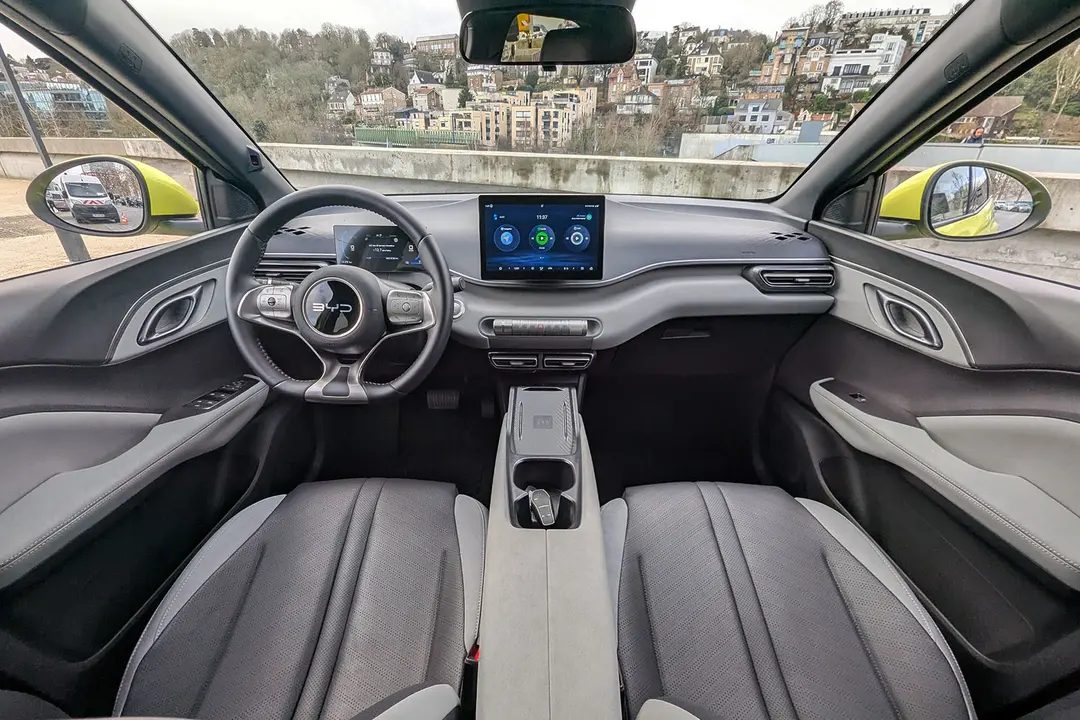
Up front, the BYD Dolphin Surf holds its own. It doesn’t quite hit the premium polish of the Renault 5 E-Tech, but the cabin ambiance is genuinely seductive. The trim level hits a sweet spot. Unlike the quirky, polarizing interior of the BYD Atto 3, the driving position here is specific yet sensible. No eccentric gadgets for the sake of it.
There is one gimmick. The 10.1-inch central screen rotates with a single touch. Users will likely stop spinning it once they find the right angle. In practice, the horizontal landscape mode wins out. It stays out of your line of sight. It also enables Android Auto and Apple CarPlay mirroring. These smartphone integrations are annoyingly disabled when the screen is vertical.
Handling the display is pleasant. The resolution is sharp. Text is readable despite the size. But the infotainment software underneath is messy. You have to dig through layers of menus to find basic driver aids. The car tries to help with a row of physical buttons. They are small. The coating is slippery. Adjusting the climate comfort becomes a guessing game. The gauge uses a red-to-blue color scale without showing actual Celsius degrees. You are left to guess the temperature.
Standard Equipment Generosity
Consistent with most Chinese EVs, the BYD Dolphin Surf is loaded with standard gear. This is the BYD Dolphin Surf equipment list definition of value. The entry-level Active trim includes all those functions, but it locks you into a weaker motor.
The mid-range Boost trim is where the value proposition shifts. It adds a new electric powertrain. You get 16-inch wheels. Electric seats become standard. Rain sensors are included. It feels like a significant step up.
At the top of the tested range, the Comfort trim adds serious amenities. A 360-degree camera system is included. Heated seats appear. An inductive charger is built into the console. Tinted windows come standard. This is equipment usually reserved for larger, more expensive cars.
There is one notable omission. There is no heat pump. Don’t panic. A heat pump only helps during long, steady highway drives. Without it, the car relies on a resistive heater for the first several minutes of use. The energy draw in winter is identical whether you have the pump or not. The initial warm-up penalty remains the same.
Urban Comfort Meets Surprising Highway Poise
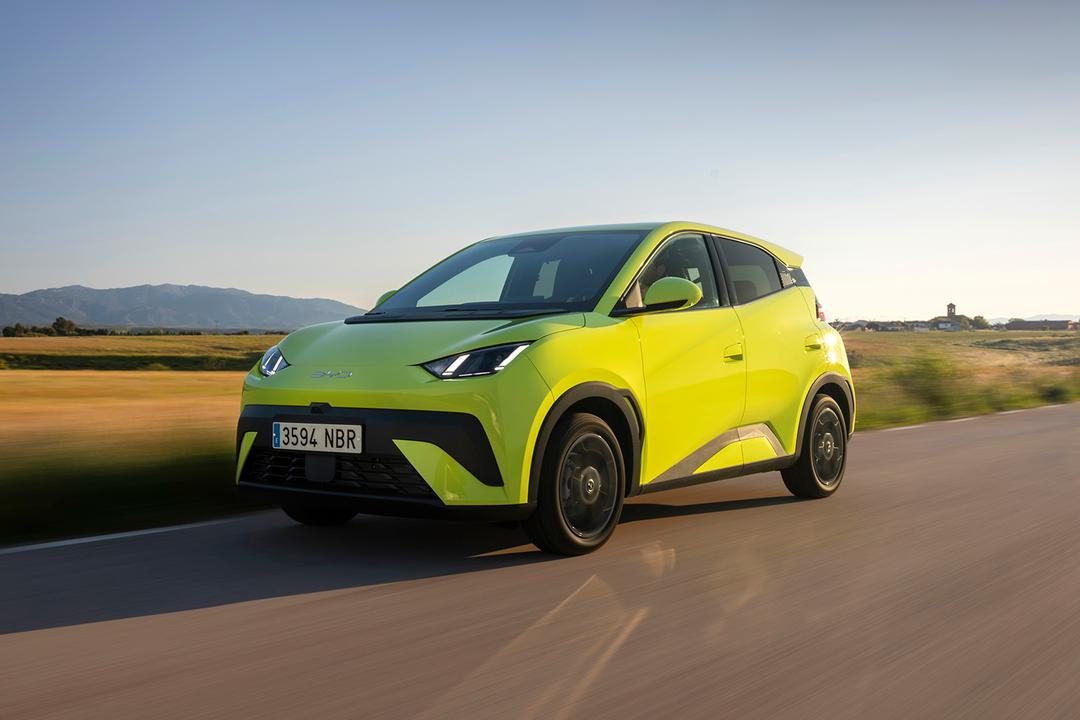
The Dolphin Surf has a commanding presence. High seating position. Large glass surface. It’s a compact footprint with a commanding view. You aren’t squinting to see out; the vision is open. In the city, this setup pays off immediately. It’s comfortable. The sound deadening is deliberate, cutting out the urban noise. The suspension handles potholes and cobblestones with surprising competence.
Braking is linear. You can modulate it easily. But hardcore EV purists might blink at the regen options. There are only two levels. No One-Pedal driving. If you like coasting to a complete stop without touching the brake, this isn’t it.
Under the hood, the specs shift dramatically depending on the trim. The entry-level model offers a modest 88 hp. The Comfort trim tested here is different. It pushes 156 hp and 220 Nm of torque. That is a lot of power for a car this small.
Launch control? Not quite. The electronics manage torque delivery to prevent wheel spin, but don’t expect perfection. On wet surfaces or loose gravel, traction can slip. Fortunately, the test car came with Hankook iON tires. These are better than the standard Linglong rubber found on base models. They provide grip. The body roll is controlled. The ride remains compliant.
Push harder. The suspension stiffens slightly. It doesn’t break, but it gets firm.
On the highway, the compact car settles in. Noise is managed well. It doesn’t feel small or insecure at speed. Standard semi-autonomous driving aids are included. They work. Some rivals would kill for this level of tech out of the box.
Power Delivery and Traction Management
The jump from 88 hp to 156 hp changes the character of the Dolphin completely. The entry-level motor is efficient but lazy. The 156 hp version is punchy. 220 Nm of torque arrives quickly. It makes urban overtaking effortless.
But power is only half the equation. Traction control matters. The system intervenes smoothly at low speeds. It doesn’t jerk the car around. However, physics still applies. Wet roads reduce friction. The front-wheel-drive layout can struggle if you floor it too early.
The choice of tires makes or breaks this dynamic. Hankook iON tires are designed for EV weight and torque delivery. They offer better lateral grip than the budget-friendly Linglongs. You notice the difference in corners. The car stays planted.
Ride comfort is prioritized, but not at the expense of stability. The damping is tuned for daily driving. It absorbs bumps without wallowing. At higher speeds, the chassis feels more connected. The steering adds enough feedback to feel engaged.
It’s a well-rounded package. Not sporty, but competent. Reliable. Easy to live with.
Real-world efficiency and the thermal throttling reality
The base model BYD Dolphin comes with a 30.0 kWh pack. You get 220 kilometers of claimed range on paper. The top-tier Surf trim gets a bigger 43.2 kWh battery. That pushes the WLTP estimate to either 322 or 310 kilometers depending on the specific wheel size and trim.
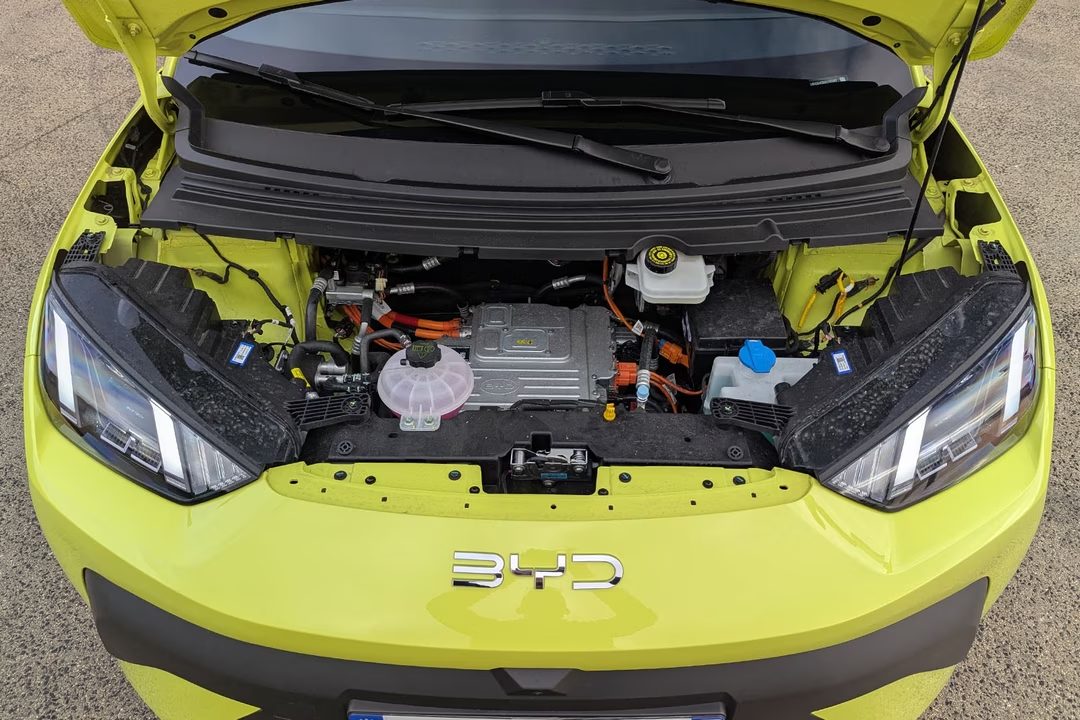
Technically, it uses BYD’s prismatic Blade cells. They are packed tightly using a Cell-to-Pack architecture. No separate modules. Just cells squeezed into the floorpan.
“Despite its frail appearance and reduced mass, the city car presents quite high consumption levels.”
The battery capacity looks small on the spec sheet. In reality, it provides decent range if you drive conservatively. But the Dolphin is not efficient. It drinks electricity.
BYD Dolphin energy consumption breakdown
City driving keeps things moderate. Expect around 13.0 kWh per 100 km. That is average. Nothing special.
Open the highway. The numbers jump. You are looking at 15.5 kWh per 100 km on secondary roads. On the autoroute? Expect 24 kWh per 100 km.
That is a massive drop in efficiency.
Real-world range at average French temperatures looks like this:
– Urban driving: ~300 km
– Highway driving: ~180 km
The aerodynamic drag hits hard at speed. The modest battery capacity means range anxiety kicks in faster than you might expect on long trips.
Charging speeds and thermal limits
Slow charging is handled at 11 kW AC. That is faster than the Dacia Spring or Renault Twingo. You can fill the battery in about five hours from a wallbox or public AC station.
Fast charging claims 85 kW DC. BYD says you can go from 10 to 80 percent in 30 minutes.
It does not work like that in practice.
The BMS is aggressive. When cell temperatures rise during fast charging, the system throttles power immediately. It is overly cautious.
You will not sustain 85 kW for long. The curve drops off sharply. This is a common BYD trait. They prioritize cell longevity over peak charging speed. If you are in a hurry, you will lose patience.
The Price of Premium Urban
The BYD Dolphin Surf is undeniably fun. It looks sharp inside and out, packs enough punch for city duties, and comes loaded with standard tech. On paper, it offers one of the best price-to-equipment ratios among small EVs. It ticks every box for the average commuter.
But there is a catch.
To get under the €20,000 mark, you have to choose the entry-level version. It’s stripped back. Limited range. Limited utility. It’s not the car you actually want.
The model tested here, the BYD Dolphin Surf Comfort, sits at €25,990. That is steep. Especially since it currently receives no government purchase incentives. Why? Because it is built in China.
This changes soon. Production is moving to Hungary. Once that happens, the tax breaks will follow. Then, and only then, will the Dolphin truly “surf” the market wave.
For now? You are paying a premium.
At €25,990 with bonuses applied, the Dolphin Surf costs the same as a fully loaded Renault 5 E-Tech 120 Techno.
Which one do you choose?
The BYD offers more space. Better tech. A smoother ride. But the Renault 5 has French subsidies. It has heritage. It has brand recognition in Europe.
The Dolphin is the better car on its own merits.
But in the real world, subsidies dictate reality. Until Hungarian production starts, the Dolphin remains a “nice to have.” Not a “must have.”
Until then, it’s an expensive compromise.