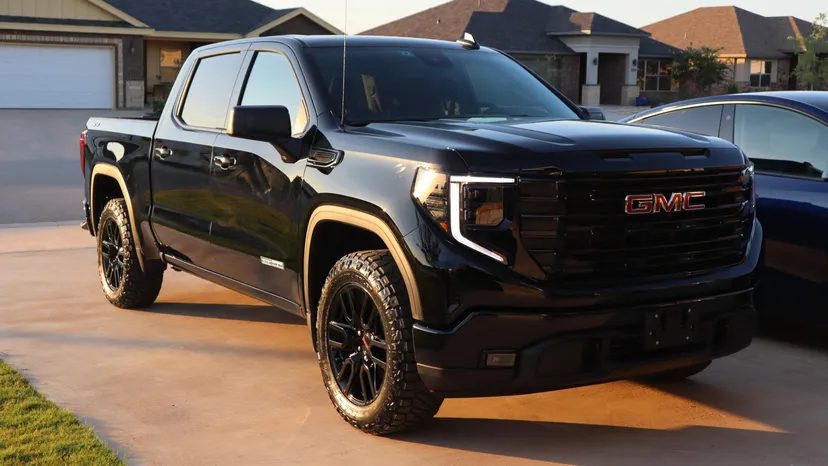
You need to know exactly how much weight your truck can pull before you hook up a fifth-wheel trailer or a boat. It isn’t just about the big number in the brochure. It’s about the specific configuration of your 2023 GMC Sierra. Whether you’re looking at the heavy-duty HD or the standard 1500, the math changes based on engine, transmission, and hitch type. Getting this wrong leads to safety issues and poor fuel economy.
Which Engine Powers Your Towing Capacity?
The heart of the towing equation is the engine. For the 2023 Sierra HD, you have two main choices. The first is the 6.6L V8 L8T gasoline engine. The second is the 6.6L V8 L5P turbodiesel Duramax. Both are built to handle serious weight, but their combustion efficiency affects how much torque is available at low speeds.
In the Sierra 1500 lineup, you see different options. The 6.2-liter V-8 makes 420 horsepower and 460 lb-ft of torque. That is a lot of grunt. It is the go-to for heavy loads. Then there is the 2.7L Turbo High-Output Engine. It puts out 310 horsepower and 348 lb-ft of torque. If you are pulling lighter equipment or a smaller camper, this engine is more than enough. It saves fuel and keeps the truck responsive.
Matching the engine to your actual load is the first step to safe towing.
How Does the Transmission Affect Towing?
The gearbox matters just as much as the engine. The Sierra Heavy Duty uses a 10-speed Allison transmission. This is a significant upgrade from the older 6-speed automatic. The closer gear ratios mean the truck stays in its power band longer. You get more on-demand power when you are already moving at highway speeds with a heavy trailer.
The drivetrain also plays a role. You can choose RWD, 4WD, or AWD depending on the model. Four-wheel drive adds traction and stability. When you are hauling heavy loads, that extra grip helps keep the truck planted. It affects the overall weight capacity you can safely tow.
Ball Hitch vs. Gooseneck: Which Fits Your Load?
Your hitch choice defines your limit. The Sierra HD offers two distinct setups.
- Conventional Ball Hitch: This is for standard trailers. Think boat trailers, utility boxes, or smaller campers. The max ball hitch capacity for the Sierra HD is 18,500 pounds.
- Gooseneck/Fifth-Wheel: This is for the big stuff. Horse trailers, large RVs, and livestock trailers. The Sierra HD can handle up to 20,000 pounds with a fifth-wheel setup.
The gooseneck hitch moves the weight over the rear axle rather than behind it. That changes the load distribution entirely. It allows the truck to tow heavier weights safely because the trailer weight sits directly on the chassis.
Why Wheel Size and Maintenance Matter
Larger wheels improve traction. They help manage the high pound-feet of torque these engines produce. Stability is key when you are dragging tons of weight. But hardware only works if it is maintained. Regular inspections of your brakes, cooling system, and hitch are non-negotiable.
Consult your owner’s manual. Do not guess. The payload ratings and vehicle loading capacities vary by model and trim. Knowing your specific 2023 GMC Sierra towing capacity ensures you aren’t straining the drivetrain or risking a breakdown on the highway.
Ball Hitch vs. Fifth-Wheel Ratings on the Sierra 2500 HD
You need to know which hitch you’re running before you look at the numbers. For the 2023 GMC Sierra 2500 HD, the standard ball hitch setup tops out at 18,500 pounds. That rating applies to Crew Cab models equipped with the L5P diesel engine. If you opt for 18-inch wheels, that ceiling drops to 12,000 pounds. Swap in 20-inch wheels, and you’re looking at 5,443 kg.
Fifth-wheel or gooseneck setups push that number slightly higher to 18,510 pounds. It’s a small difference, but it matters if you are right at the limit. The 2500 Crew Cab also carries a maximum payload of 4,178 lbs.
Sierra 3500 HD: Where the Real Heavy Lifting Happens
The Sierra 3500 HD is a different beast. With a standard ball hitch and the L5P diesel, it can tow 16,010 lbs (7,262 kg). But the headline number isn’t the ball hitch rating. It’s the gooseneck/fifth-wheel rating, which climbs to 36,000 lbs. That is a massive jump. The 3500 also handles a maximum payload of up to 7,290 lbs.
If you are hauling a massive livestock trailer or a large construction rig, the 3500 is the only one in this lineup that fits the job. The ball hitch rating is lower than some might expect because the truck is built for that fifth-wheel leverage.
Sierra 1500 Engine Options and Towing Nuances
The 2023 GMC Sierra 1500 offers four engine options. The specific towing capacity depends heavily on which one you pick and how the truck is configured. The 6.2L V8 and the 3.0L Duramax turbo-diesel are the heavy hitters here.
With the 4WD Crew Cab, Short or Standard Bed, 3.0L Duramax Turbo diesel engine, and Max Trailering Package, the 6.2-liter V-8 engine provides an impressive towing capacity of up to 13,000 pounds.
Wait, that sentence in the source data is a bit tangled. Let’s clarify. The 6.2L V8 can tow up to 13,000 pounds in specific configurations. The base engine and the 3.0L Duramax have their own distinct ratings found in the owner’s manual.
Sierra 1500 Ball Hitch Capacities by Package and Wheels
For the Sierra 1500 ball hitch towing, the differences are subtle but real.
- SLE and SLT packages: 13,000 pounds
- AT4 and Denali packages: 13,200 pounds
- 17-inch wheels: 13,000 pounds
- 20-inch wheels: 13,200 pounds
- 2WD configuration: 13,000 pounds
- 4WD configuration: 13,200 pounds
Why does 4WD tow more? Usually, it’s because the heavier drivetrain changes the weight distribution on the axle, allowing for a higher gross vehicle weight rating in these specific trims. It’s not a universal rule, but for the 2023 Sierra 1500, the data points that way.
Sierra 1500 Fifth-Wheel and Gooseneck Limits
Here is where the Sierra 1500 gets confusing. The 5th wheel or gooseneck capacities are significantly lower than the ball hitch numbers for specific off-road models.
- Sierra 1500 AT4: 7,400 pounds / 3,357 kilograms
- Sierra 1500 AT4X: 4,900 pounds / 2,223 kilograms
If you are looking at the AT4 or AT4X for towing a fifth-wheel trailer, you are looking at these lower figures. This is likely due to the suspension and drivetrain components designed for off-road use rather than straight-line towing efficiency. Check your specific trim level before assuming the 13,000+ pound rating applies to your setup.
Where Your Weight Actually Goes
Payload is not just about what you put in the bed. It is the total weight added to the truck: passengers, gear, and the tongue weight of the trailer pressing down on your rear axle. Most people ignore this until the rear suspension sags or the truck feels nose-heavy at speed.
Distribution matters more than total mass. Put 60% of your cargo between the hitch point and the trailer axles. Keep the remaining 40% toward the back. This keeps the center of gravity stable. If you load everything in the back, the trailer will fishtail. If you load everything in the front, the hitch ball will push down too hard on your truck’s frame, compromising steering and braking.
Check the sticker on your driver’s door. It lists your Gross Vehicle Weight Rating (GVWR) and payload capacity. Subtract your truck’s curb weight, plus everyone and everything in the cab and bed. That remainder is your actual available payload. Do not guess. Weigh your loaded truck at a scale before you head out if you are anywhere near the limit.
Maintenance That Protects Your Towing Rating
Your GMC Sierra 1500 or Sierra HD is built tough, but towing puts stress on components that regular commuting does not. The engine oil, transmission fluid, brakes, and tires all degrade faster under load.
Service intervals are strict. Check these four areas at least every year or every 10,000 miles, whichever comes first. Transmission fluid gets hot fast when you are pulling heavy loads, especially in stop-and-go traffic. Old fluid breaks down. That leads to slipping gears or overheating. If you tow frequently, consider changing fluids more often than the manual suggests.
Tire pressure is often wrong when you load up. Cold pressure is not the same as loaded pressure. Check the door placard for the maximum load rating, then add air. Under-inflated tires overheat and fail.
How to Drive Differently When Towing
Physics does not care about your horsepower. A fully loaded trailer makes your truck longer and heavier. Your stopping distance doubles. Maybe more.
- Brake earlier than you think you need to.
- Take corners wider. Your trailer swings wide on the right when you turn left.
- Stay in the right lane on highways. You need space to escape if the trailer starts to wander.
- Downshift to decelerate. Let the engine slow you down instead of scrubbing speed with the brakes. This saves your brake pads and rotors from thermal runaway.
Why downshift? Because kinetic energy has to go somewhere. If you only use the brakes, they get hot and fade. If you use engine braking, the transmission dissipates that energy mechanically. It is safer and more predictable.
Why the Owner’s Manual Still Matters
You can find the exact towing capacity for your specific configuration in the “Towing” section of your manual. This number changes based on your engine, transmission, axle ratio, and frame options. A Sierra 1500 with the 6.2L V8 and a tow package can tow significantly more than a base model with the 2.8L EcoDiesel, even if they look similar.
Do not rely on marketing numbers. Those are maximums. Your actual capacity is limited by the weakest link in the chain: your hitch rating, your trailer brakes, and your payload. If your manual says 12,000 lbs but your trailer weighs 10,000 lbs and your payload is maxed out, you are overloading.
The manual also details the specific hitch hardware you need. Class III, IV, or V. You cannot just bolt a heavy load to a light hitch. The frame rails will bend.
Final Thoughts
Maximizing your GMC truck’s towing potential is not about pushing the number higher. It is about knowing where the number ends and sticking to it. Load it right. Maintain it regularly. Drive it like it is a train, not a sedan.
You will not feel like a hero when the trailer is stable and the brakes are cool. You will just feel like you got home safely.