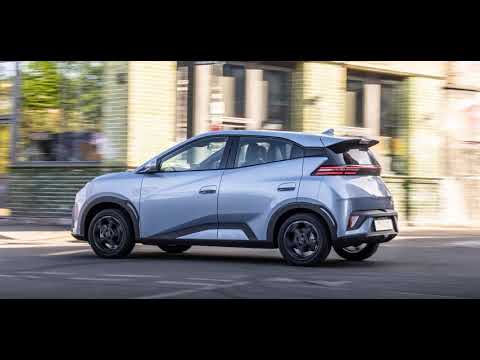
The arrival of the BYD Dolphin Surf in Europe marks a significant moment in the shifting landscape of the automotive industry. While American manufacturers watch Chinese expansion with growing concern, BYD—the world’s largest EV producer by volume—is making its move into the heart of the European market with its most affordable offering yet.
The Strategy: Value Over Verve
The Dolphin Surf is a “supermini,” a vehicle segment that has defined European urban mobility for decades. At roughly 157 inches long, it fits the physical requirements of city driving perfectly, though its design leaves much to be desired. Unlike established European rivals like the Renault 5 or Fiat’s Grande Panda, which lean on decades of stylistic heritage, the Dolphin Surf feels like a product designed for a different market entirely. Its proportions feel tall and narrow, lacking the sophisticated “chic” expected by European urbanites.
However, in the EV world, aesthetics often take a backseat to economics. BYD is playing a high-speed game of iteration: they are releasing products quickly, gathering data, and refining them even faster.
Performance and Practicality
BYD offers the Dolphin Surf in three distinct trims: Active, Boost, and Comfort. The pricing strategy is aggressive, ranging from £18,650 to £23,950. While not the absolute cheapest EV on the market (a title held by the Dacia Spring), it undercuts many mainstream competitors while offering significantly more technology.
The Technical Breakdown
- Battery & Range: The base model features a 30-kWh battery, while higher trims move up to 43 kWh. While the official WLTP range is rated at 200 miles, real-world testing suggests closer to 150 miles. This makes the car an excellent urban runabout but less ideal for long-distance travel.
- Powertrain: The “Boost” model delivers 87 horsepower, resulting in a 0–62 mph time of 12.1 seconds. It is sufficient for city streets but struggles to maintain momentum at highway speeds.
- Platform: Underneath the skin, the car is highly advanced. It utilizes BYD’s e-Platform 3.0, which integrates the cobalt-free “Blade battery” as a structural component of the chassis. This architecture is the same one used in BYD’s more premium models, like the Seal.
Interior: High Tech, Low Polish
The interior is a study in contradictions. On one hand, the equipment levels are impressive for the price point. Drivers benefit from:
– Cloud connectivity for automatic software updates.
– Adaptive cruise control and a digital key.
– A 10.1-inch rotating touchscreen.
– Power front seats (available on the Boost trim), a rarity in this price bracket.
On the other hand, cost-cutting is evident in the “scratchy” plastics, the lack of a rear wiper, and the absence of a parcel shelf. The user interface can also be frustrating; small touchscreen icons are difficult to navigate while driving, and the driver-assist systems (ADAS) can feel intrusive or unrefined, occasionally scolding the driver unnecessarily.
The Driving Experience
The Dolphin Surf is best suited for the “urban grind.” It is easy to maneuver and handles city traffic with ease. However, the driving dynamics are unrefined. The suspension is stiff, and the rear torsion-beam setup can lead to a “tipping and rocking” sensation on uneven roads. Combined with sharp steering that doesn’t quite harmonize with the chassis, the car can feel disconnected and tiring on longer journeys.
The Bigger Picture: A Warning to the Establishment
The Dolphin Surf is effectively “Version 1.0.” It is a testing ground for BYD to gauge its footing against European incumbents. While current models like the Volkswagen ID.2 or Renault Twingo may not feel immediate pressure, the speed at which BYD iterates means that the “next” version could be much more polished.
BYD isn’t just trying to sell cheap cars; they are aiming for the mainstream market by offering better equipment and more integrated technology than traditional budget brands.
Conclusion: The BYD Dolphin Surf is a pragmatic, value-driven city car that prioritizes advanced battery technology and high equipment levels over driving dynamics and design. While it currently lacks the refinement of European rivals, its arrival signals a new era of rapid, high-tech competition in the European EV market.