For over a century, the hydraulic brake has been the undisputed king of automotive safety. It is a simple, robust, and reliable system that has defined how cars stop. But that era may be coming to an abrupt end.
Brembo, the Italian braking giant, has begun large-scale production of Sensify, a groundbreaking electromechanical braking system that completely eliminates hydraulic fluid. While Brembo is bound by strict non-disclosure agreements (NDAs) to keep the identity of its partner secret, they have confirmed that a “global leading manufacturer” will equip its new models with this technology as standard.
This isn’t just a minor upgrade; it is a fundamental shift in vehicle architecture. By replacing fluid lines with electric actuators and software algorithms, Sensify represents the first major departure from traditional braking physics in decades.
How Sensify Works: Software Over Fluid
Traditional braking systems rely on brake fluid to transmit pressure from the pedal to the calipers at each wheel. This method is effective but limited. It applies pressure relatively uniformly across wheels and requires regular maintenance, such as fluid changes, to prevent leaks or degradation.
Sensify flips this model on its head.
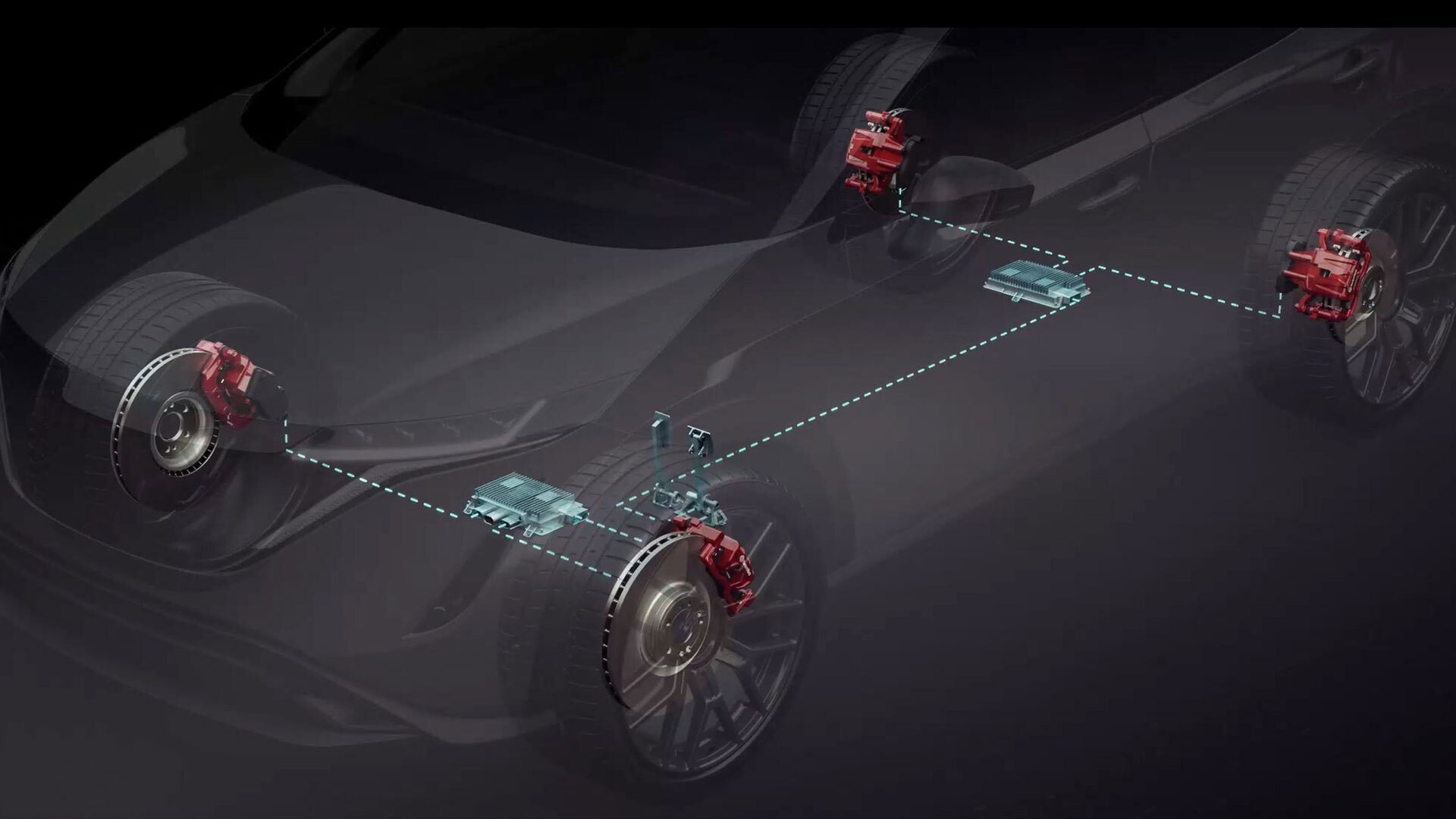
The system uses an “electromechanical architecture” that combines familiar hardware—like calipers and discs—with advanced software and electric actuators. Instead of pushing fluid through pipes, the system sends electric signals to actuators that apply precise mechanical pressure to the brake pads.
This shift allows for independent control of each wheel. In a traditional hydraulic setup, if one wheel needs more braking force than another, the system has to compromise or rely on complex anti-lock braking systems (ABS) to modulate pressure. Sensify can adjust braking force in real-time for each individual tire, creating a level of precision previously impossible with fluid-based systems.
Why Precision Matters: Stability and Safety
The primary advantage of Sensify is not just novelty, but enhanced vehicle stability.
As Brembo explains, road surfaces are rarely uniform. Even on what looks like a smooth highway, grip levels can vary significantly between the left and right tires, or between the front and rear axles. Traditional brakes struggle to account for these micro-variations instantly.
Sensify’s software continuously monitors these conditions and adjusts braking force accordingly. This offers two critical benefits:
1. Optimal Grip Utilization: The system maximizes the traction available at each wheel, potentially shortening stopping distances.
2. Improved Handling: By independently controlling wheel torque, the system can prevent yaw (unintended rotation) and understeer (the car sliding wide) during cornering or emergency braking.
“Controlling the braking action on each wheel… positively impacts vehicle stability and handling, preventing yaw or, when cornering, the classic understeer under braking.” — Brembo
The Hidden Agenda: Why Keep It Secret?
The fact that the automaker is remaining anonymous is significant. In the automotive industry, first-mover advantage is crucial. By hiding behind an NDA, the manufacturer is likely protecting a competitive edge while the technology matures.
However, the implications extend beyond just better braking. Electromechanical brakes are a key enabler for autonomous driving. Self-driving cars do not have a human foot to press a pedal; they rely on software commands. A brake-by-wire system like Sensify integrates seamlessly with autonomous driving stacks, allowing the car’s computer to control braking with millisecond precision and without the lag associated with hydraulic systems.
Furthermore, the removal of hydraulic fluid eliminates the risk of leaks and reduces maintenance costs for owners. It also simplifies the vehicle’s underbody, freeing up space for battery packs in electric vehicles (EVs) or other components.
A Mass-Market Shift
Brembo has indicated that this is not a niche experiment. With “hundreds of thousands of vehicles per year” expected to feature Sensify in the near future, this technology is poised to become mainstream.
The mystery automaker is just the beginning. As the supply chain adapts and costs decrease, we can expect other major manufacturers to adopt similar brake-by-wire systems. The century-old reign of the hydraulic brake is ending, replaced by a smarter, faster, and more adaptable electronic system.
In short, the car of the future doesn’t just drive itself—it stops itself, with a level of intelligence that hydraulic fluid could never provide.