You’ve seen it too. An SUV on a trailer, a sedan towed with a hard bar, and a luxury truck on a platform. This is not just an aesthetic preference. This is a mechanical requirement. If you consider that each vehicle being towed like a dead weight behind the truck, the transmission is one bad mile away from failure.
The question is not why there are so many ways. This is why someone thought it was a good idea to drag the transmission over the pavement.
The Transmission Trap
Let’s put physics aside. When you tow a vehicle with the drive wheels on the ground, the wheels turn the drivetrain. In rear-wheel drive or front-wheel drive configurations, this rotates the internal parts of the transmission. But here’s the problem. The transmission uses a pump that circulates fluid for cooling and lubrication. The pump is driven by the engine.
If the motor is turned off, the pump also stops. Gears and bearings rotate without lubrication, and no cooling. Heat builds up. Metal to metal grinding. Transmission dies.
Four-wheel-drive systems make the situation even worse. Every wheel is a drive wheel. Spinning any of these puts pressure on the center differential, transfer case and rear differential at the same time. If these components cannot be isolated, expensive repairs are required.
Safe choice: Flatbeds
What is the easiest solution? Keep all four wheels off the ground. Flatbed trailers completely eliminate the drivetrain issue. There is no rotary pump. No heat build-up. Load your car, secure the straps and drive.
This is the safest option. Also, often the most are usually the most expensive or the hardest to get. What if you don’t have a flatbed?
Trailer: Two-Wheel Compromise
Tow dollies lifts its two front wheels off the ground. This works for rear-wheel-drive vehicles The rear wheels (drive wheels) are on the ground, but the transmission is not turning because the engine is turned off. Wait. No.
When a rear wheel drive vehicle (front wheels on) is towed with a trailer, the rear wheels are in contact with the ground. The transmission rotates. Gear pump stops. There is a risk of damage if the drive shaft is not removed.
If you have a front wheel drive vehicle, the dolly lifts the drive wheels. The rear wheels can rotate freely. Normally this is safe for the transmission, but be careful of the rear wheels aren’t binding. Still, to be really safe, many rear-wheel drive cars have the drive shaft removable. This is additional work. Additional steps. An extra chance to mess things up.
Tow Bars: Four Wheels Down
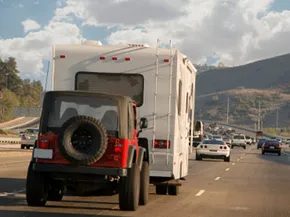
The towbar is a rigid triangular frame that connects the ball hitch of the towing vehicle to the front bumper of the towed vehicle. All four wheels roll. It is very convenient. You don’t need to load the car. You don’t need a dolly. You just hook up and go.
But the transmission is spinning again. In two-wheel drive vehicles, you rely on the transmission in neutral and hope that the fluid circulation is sufficient for short distances at low speeds. This is dangerous for unmodified four-wheel drive vehicles.
Four-wheel-drive solution: manual transfer case and hub
If you own a four-wheel drive vehicle, your options change. Manufacturers design these systems with specific towing protocols in mind.
The Ideal Setup:
If your 4WD has a manual transfer case and manual locking hubs, you can safely tow all four wheels down. Here’s how it works:
1. Unlock the hubs (disengaging the front axle from the drivetrain).
2. Shift the transfer case to neutral.
The engine’s rotation isn’t connected of the wheels. The drivetrain is isolated. Tow as far as you need without damaging the gearbox or transfer case.
Modern reality:
Most modern 4x4s do not have manual hubs. They have automatic locking hubs, or worse, a permanent four-wheel drive system with no neutral option. Towing with all four wheels down causes the entire driveline.
The Fix: Drive Shaft Couplings
Enter drive shaft coupling. This device is mounted on the rear driveshaft. You can disconnect the rear differential from the transmission/gearbox assembly from the driver’s seat.
- Driving mode: The coupling engages the shaft. Power is transmitted to the rear wheels.
- Towing mode: The clutch is disconnected from the shaft. The rear differential rotates freely, but is disconnected from the rest of the transmission.
This is the perfect solution for 4×4 vehicles without a manual neutral option. Immediately. This is reversible. Save money on shipping.
Golden rule: Check the user manual
Every car is different. Some manufacturers specify a maximum towing speed. Some prescribe the exact steps to go neutral. Some cars cannot be towed with all four wheels down, no matter what modifications you make.
Ignoring the instruction manual is an invalid gamble. The cost of a new transmission is negligible compared to the cost of a trailer or clutch.
Frequently asked questions about four-wheel drive trailers
Can it tow a 4×4 vehicle?
Yes, but all four wheels are not on the ground all the time. If your 4WD has a manual transfer case and manually locking hubs, you can safely tow all wheels down. If not, you need a drive shaft coupling or a trailer/flatbed.
Will it get damaged if towed in the park?
Yes. Automatic transmissions have a parking bar that locks the output shaft. Forcing the wheels to spin while parked can destroy this mechanism. Always shift into neutral before towing.
Can I tow my car with the handbrake on?
I don’t. The handbrake locks the rear wheels (usually). If you pull it, you can damage the brake disc and brake pads. If you need to lower the rear wheels to tow, make sure the handbrake is fully released.
Can you tow a 4×4 without tires?
It can be towed by a trailer or wagon. Of course, if the tire comes off. However, if you’re asking, “Can you tow a vehicle with bad tires?”, the answer is no. You need working tires for rolling. If tires or wheels are damaged, use a Flatbeds.
Do I have to remove the drive shaft when towing?
Yes, if you have a rear wheel drive car. Mere neutrality is not always enough. Removing the drive shaft prevents the gear pump from rotating without lubrication. In four-wheel drive vehicles, the same effect can be achieved more easily with a coupling device.