You’re the one who lands butter-side-up. Green lights greet you every morning. The universe seems to conspire in your favor. But optimism doesn’t stop a trailer from detaching at 60 mph.
Most drivers keep a spare tire. They toss an umbrella in the glovebox. They prepare for the rain. Why ignore the risk of a catastrophic hitch failure? Towing safety cables (also called safety chains) are the non-negotiable backup plan. Federal law mandates them in most states for a reason. Perfection doesn’t exist. Mechanical failure will happen. When the primary connection snaps, these cables are the only thing standing between you and a highway pileup.
The Anatomy of a Towing Failure
Let’s skip the basics. You know how a trailer hitch works. The receiver mount bolts to the vehicle frame. A drawbar or ball mount slides in, secured by a locking pin. The ball on top fits into the trailer’s coupler. This is the primary connection. It bears the weight. It handles the steering input.
But it is not infallible.
Vibration loosens pins. Corrosion weakens couplers. Impact damage compromises the hitch ball. If that primary link breaks, the trailer becomes an independent, uncontrolled projectile. It doesn’t just detach. It swings. It jackknifes. It endangers lives.
Why Safety Chains Are Legally Required
The Department of Transportation doesn’t mandate towing safety cables for your convenience. They mandate them because statistics show that a broken hitch without a backup results in severe accidents. Without chains, a detached trailer can cross multiple lanes, strike other vehicles, or roll over. With chains, the trailer remains tethered. It drags. It slows. It stays on the road shoulder.
This isn’t about “just in case.” It’s about survival. The cables absorb the kinetic energy of a separation. They keep the trailer tongue from whipping around and damaging other cars. They buy you time to react. They prevent a minor mechanical glitch from becoming a fatal crash.
How Towing Safety Cables Function
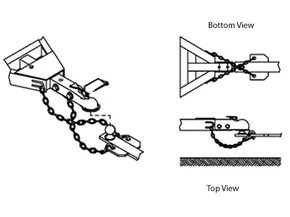
Safety chains are simple. Steel cables with hooks or eyes on each end. They cross in an ‘X’ pattern under the trailer tongue. Why cross them? If the coupler fails, the ‘X’ configuration prevents the trailer tongue from dipping to the ground. It keeps the tongue elevated enough to maintain visibility and control. It also distributes the load across both sides of the hitch receiver, reducing the chance of a single-point failure pulling the entire assembly apart.
The chains must be rated for the trailer’s Gross Vehicle Weight Rating (GVWR). Lighter chains snap under stress. Heavier chains add unnecessary weight and swing. Proper sizing matters. Proper routing matters. Proper attachment points on the trailer frame matter. You don’t clip them to the bumper. You don’t loop them loosely. You anchor them to reinforced points designed to handle sudden, massive loads.
The Hidden Cost of Skipping Chains
Many drivers skip chains. They assume their hitch is secure. They trust their coupler. They think they’re being efficient. Efficiency costs lives. The financial cost of a single accident—medical bills, legal fees, vehicle damage, increased insurance premiums— dwarfs the price of a set of safety chains. The human cost is immeasurable.
If you’re
Choosing Between Towing Safety Cables or Chains
It really doesn’t matter if you pick heavy-duty metal links or durable steel cables for your trailer. The goal is consistency and proper usage. People often use the terms interchangeably, but the physical difference is obvious. One is made of interlocking metal links. The other is a woven steel cable. Both serve the same critical function.
They act as a backup when the primary connection fails. If the hitch ball detaches from the coupler, these tools catch the falling trailer tongue. You route them in an X-pattern under the coupler. This crossing point keeps the trailer from sliding away completely. They attach to the tow vehicle’s frame. In a worst-case scenario, they prevent the trailer from spinning into oncoming traffic. They aren’t designed to tow the trailer for miles. They just stop it from hitting the pavement hard enough to cause a disaster. This gives you time to pull over. You can then figure out why the load came undone.
Sizing and Class Ratings
Weight is the deciding factor. You need to match the equipment to your gross trailer weight (GTW). This is the total weight of the loaded trailer. Your safety cables or chains must exceed this number. Just like your hitch, they have specific class ratings. These range from Class I up to Class V.
- Class I: Up to 2,000 lbs (907 kg) GTW
- Class V: Up to 10,000 lbs (4,536 kg) GTW
Using a Class II loop for a 5,000-pound boat is useless. The hardware will snap. You need to check the rating on the loops or brackets welded to your vehicle or trailer. If they don’t exist, you need to weld them on. Ensure the attachment points can handle the stress.
Hook Types and Attachment
The way you hook them up matters. S-hooks are the most common. They look like a curved ‘S’. They are simple. But they can bounce open on rough roads. You need rubber keepers to stop the hooks from slipping out. Slip hooks lock shut. Quick links also close securely. It doesn’t matter which you choose. What matters is that they stay fastened. If they bounce loose, your safety net is gone.
Adjusting Slack
Once everything is attached, check the tension. You want Goldilocks slack. Not too tight. Not too loose. Just right. If they are too tight, you won’t be able to make a full turn without bending them or breaking them. If they are too loose, they will drag on the road. Dragging chains lose their ability to catch a falling tongue quickly. Too much slack renders them ineffective.
Towing isn’t the place to gamble. You don’t want to be on the losing end when things go wrong. Whether your state mandates it or not, this is your backup plan. It’s the difference between a scary moment and a fatal accident. Keep them crossed. Keep them tight enough to work. Loose enough to turn. And check them before every trip.