The romance of the long-haul life is often painted in broad strokes: endless horizons, the steady hum of tires on asphalt, and a radio that crackles with static. It’s a narrative of freedom, where daily meals are bought on the road and the world shrinks to the size of a windshield view. But strip away the poetry, and you’re left with a brutal economic reality. Trucking is the backbone of the global supply chain. If the wheels stop turning, the shelves empty.
This dependency creates a precarious existence for owner-operators and small fleets. Their profit margins are razor-thin, and fuel costs are the enemy that eats them alive. Look at the chaos of May 2008 in Europe. Diesel prices skyrocketed to over $11 per gallon—a 40% jump year-over-year. The result wasn’t just higher bills; it was paralysis. Strikes erupted across Spain, Portugal, and beyond. Independent drivers couldn’t make the math work. The consequences were immediate and violent to the economy.
When fuel prices spike, trucking profits collapse, and the entire supply chain snaps.
Auto manufacturers in Western Europe shuttered their plants because parts deliveries stalled. Groceries vanished from shelves. For five days in the spring of 2008, the trucking industry proved exactly how integral it is: by stopping, they crippled the economies of interconnected nations. Governments scrambled to lower fuel costs, but one designer looked at the problem differently. Why subsidize expensive gas? Why not build a truck that simply doesn’t need as much of it?
Enter Luigi Colani.
The Aerodynamic Revolution in Heavy Transport
Colani wasn’t interested in tweaking the grille or adding spoilers. He wanted to reinvent the 18-wheeler from the ground up. The traditional semi-trailer is a brick. It pushes through the air with brute force, battling drag that wastes massive amounts of energy. Colani’s approach was biological, not industrial. He studied nature to find shapes that moved efficiently.
His designs focused on reducing the frontal area and smoothing the airflow around the cab and trailer. In an era where fuel efficiency was secondary to cargo volume, Colani argued that aerodynamics was the only way to survive the volatile fuel market. He didn’t just draw curves; he created a philosophy where the truck’s shape was dictated by fluid dynamics.
The goal was clear: slash the fuel consumption of semis. If a truck could cut drag by even a small percentage, the savings over hundreds of thousands of miles would offset the cost of a more complex, expensive body. This wasn’t just about being eco-friendly; it was about staying in business when diesel costs hit triple digits.
Colani’s vision challenged the status quo of truck manufacturing. While competitors focused on engine tweaks and transmission gears, he looked outward, at the air itself. His work raised a simple question: if we can design planes and cars with such precision, why are we still pushing boxy metal cubes down the highway? The answer lay in the willingness of the industry to invest in radical design over incremental improvement. And that investment was waiting to happen.
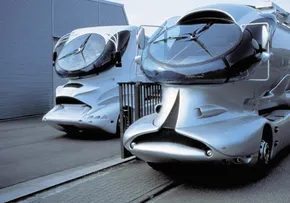

The Evolution of Luigi Colani’s Fuel-Efficient Truck Designs
The parallels between the 1970s oil crisis and the 2008 fuel price spike were stark. In both instances, gas prices hit levels not seen since the OPEC embargo era. That volatility triggered a shift in perspective for German designer Luigi Colani. He had originally sketched streamlined truck concepts decades prior, but they remained theoretical until the 2008 crisis made fuel economy a desperate necessity rather than just an aesthetic preference. Over the intervening forty years, Colani didn’t just sit on his ideas; he refined them.
Colani refers to his design philosophy as biodynamic concepts. It’s a worldview that pulls organic curves and rounded angles from nature and applies them to everything from furniture to heavy machinery. He views himself as a “three-dimensional philosopher of the future,” and his truck designs are the physical evidence of that claim. When high gas prices led to driving bans and economic strain, he turned his full attention toward making semis greener.
Aerodynamics and Engine Tweaks
Making a lumbering semi efficient starts with fighting the air. Traditional trucks have wide, flat grilles and boxy shapes, making them aerodynamic nightmares. Once a vehicle hits 50 mph, aerodynamic drag —the pressure force opposing motion through air—skyrockets. The engine must work harder just to maintain speed, burning more fuel.
Colani’s first approach was to smooth out the exterior. He added sweeping contours to replace sharp edges, reducing wind resistance and shaving 25 percent off fuel consumption. He also looked under the hood. By modifying a 2005 Mercedes-Benz semi with a direct-injection, turbo-charged diesel engine, he boosted horsepower by nearly 150 while cutting fuel use by 30 percent.
Still, he wasn’t done. Collaboration with Siemens led to a radical 2007 prototype that looked less like a truck and more like a cockpit. The driver’s compartment is raised above the frame, housing a single operator who controls the vehicle via joystick instead of a steering wheel. The silhouette mimics the head and beak of a predatory bird in flight. This iteration achieved a 50 percent reduction in fuel consumption. And here’s the kicker: that efficiency came entirely from the exterior shape, with zero modifications to the engine itself.
The Cost Barrier to Adoption
If these designs are so effective, why aren’t they rolling down highways? The answer is money. The Siemens-collaboration concept cost $1 million to build. Compare that to a standard new 2007 International 9900 semi, which sells for around $100,000. For Colani’s biodynamic trucks to hit the road in volume, a major manufacturer needs to mass-produce them, driving down unit costs.
Colani is an independent designer, but he isn’t a stranger to corporate production. Ferrari and Dodge have previously built vehicles based on his concepts. With fuel prices climbing and truckers increasingly vocal about economic pressures, it’s plausible that a manufacturer like Peterbilt or Mack will eventually join that list. The technology works. The question is whether the market can afford to adopt it.
Related Resources
HowStuffWorks Articles
- Will car repairs in the future financially cripple you?
- How Horsepower Works
- How Clean Diesel Fuel Works
- What if I put diesel in an automobile that required unleaded fuel only?
- How Biodiesel Works
More Great Links
- FutureCar on Discovery Channel
- Gas Buddy.com
- Colani Official Site
Sources
- Crumley, Bruce. “Think gas is high? Try Europe.” Time. May 28, 2008.
- Filipponio, Frank. “Radical semis by Luigi Colani.” Autoblog. January 2, 2007.
- Patterson, Brett. “Luigi Colani: Translating Nature.” BusinessWeek. June 15, 2007.
- Patton, Phil. “Colani’s concepts make concept cars look tame.” New York Times. March 4, 2007.
- Cummins. “Cummins reveals secrets to great mpg.”
- Discovery Channel. “Future Car: The Extremes.” February 7, 2007.
- Associated Press. “Merchants say Spain returning to normal on 5th day of truckers’ strike.” June 13, 2008.