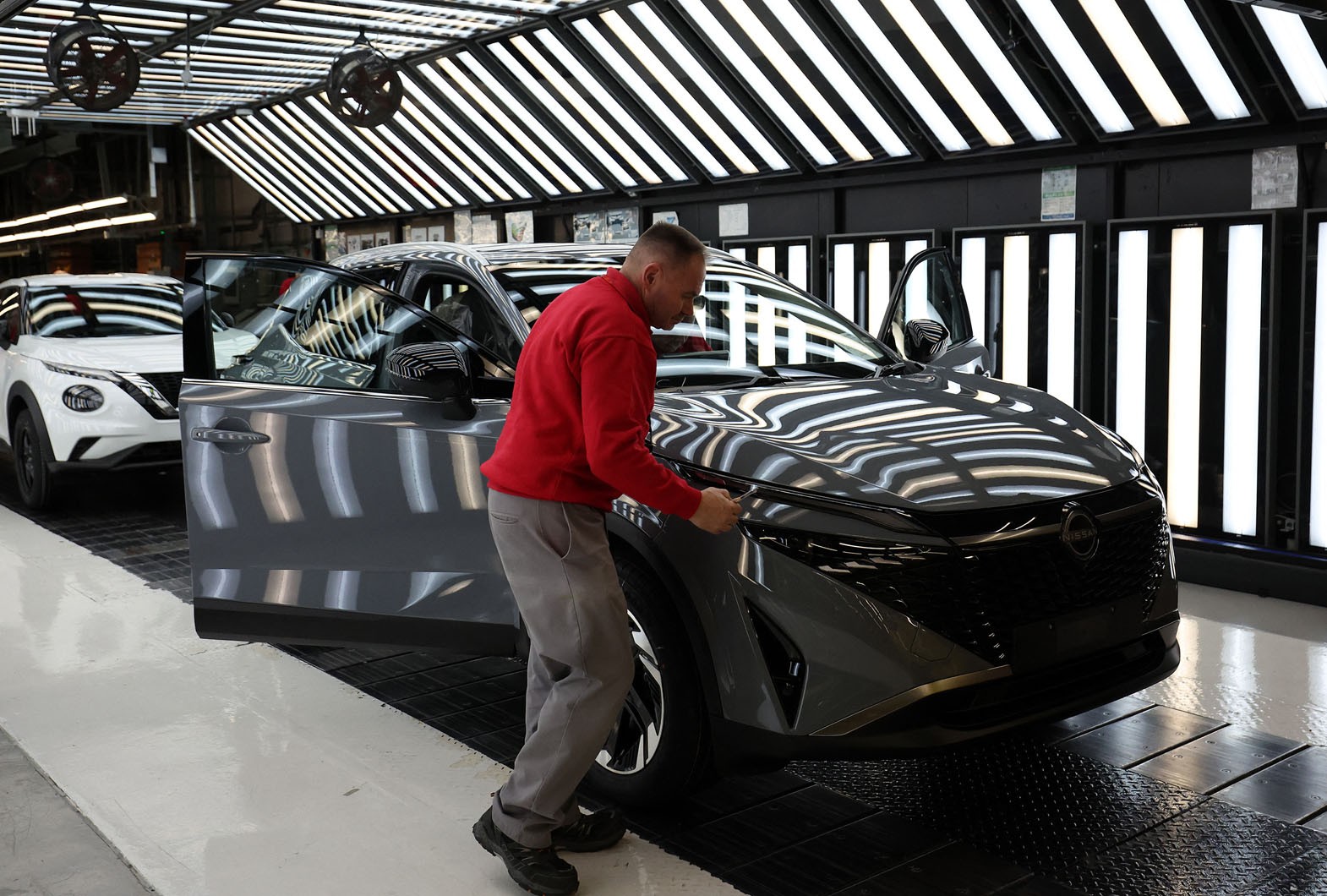
Nissan is consolidating its manufacturing operations at its UK flagship plant in Sunderland, closing one of its two production lines as part of a broader strategy to cut costs and streamline its European business. This move comes with the elimination of 900 jobs across Europe, although Nissan has confirmed that no positions will be lost at the Sunderland facility itself.
The decision marks a significant shift for the Japanese automaker, which is struggling to maintain its market foothold in Europe against aggressive competition from Chinese manufacturers.
Consolidation at Sunderland
The Sunderland plant, Nissan’s only manufacturing site in Europe, currently produces the electric Leaf, the Juke, and the Qashqai. Under the new operational model, all three models will be manufactured on a single production line.
To compensate for the loss of capacity from the closed line, the remaining line will operate on a three-shift schedule. The closure is scheduled for the second half of the year. While Nissan has guaranteed job security for Sunderland workers, some roles within the UK division may be affected as part of the wider 900-position reduction across the continent.
“Any reduction in capacity is bad news for Nissan and bad news for Sunderland,” said former Nissan executive Andy Palmer, who began his career at the plant.
A Decline in Production Volume
The consolidation reflects a steady decline in output at the Sunderland factory. Production figures have dropped significantly from their peak:
* Peak Output: Over 500,000 cars annually.
* Last Year’s Output: 273,174 cars.
This downward trend underscores the challenges Nissan faces in maintaining high-volume manufacturing in Europe. To mitigate the impact of the line closure, Nissan is actively seeking to attract a second car manufacturer to take over the vacated “Line One.” Reports suggest that Chinese automakers Chery and Dongfeng are potential candidates for the site. Nissan stated that successfully leasing this capacity would help preserve jobs and boost overall production levels at the facility.
The Rise of Chinese Competitors
Nissan’s operational restructuring is driven by intense market pressure, particularly from Chinese brands that have rapidly gained traction in Europe. In the UK market, Nissan’s share has contracted sharply:
* 2016: 5.6% market share.
* First four months of 2026: 3.7% market share.
In contrast, Chinese manufacturers are expanding their presence. According to data from the Society of Motor Manufacturers and Traders (SMMT), Chery captured nearly 5% of the UK market through April, driven by the popularity of its Jaecoo, Omoda, and Chery brands. Other Chinese-backed brands also outperformed Nissan:
* MG: 4% market share.
* BYD: 3.45% market share.
This shift indicates a fundamental change in consumer preference and competitive dynamics, forcing legacy Japanese manufacturers to adapt quickly or risk further marginalization.
Global Cost-Cutting and Strategic Shifts
The Sunderland changes are part of a global turnaround plan led by CEO Ivan Espinosa, aimed at restoring profitability after Nissan reported a £3.8 billion loss in the financial year ending March 2025.
To achieve a “leaner, more resilient business,” Nissan is implementing several measures beyond the UK:
* Plant Closures: Seven manufacturing plants have been shuttered globally.
* Logistics Optimization: Partial closure of its parts warehouse in Barcelona.
* Sales Model Adjustment: Transitioning to an importer model in Nordic countries.
These efforts are compounded by external pressures, including heightened competition in China and increased import tariffs on vehicles exported to the United States.
Conclusion
Nissan’s decision to close a production line at Sunderland is a defensive maneuver in a rapidly evolving automotive landscape. By consolidating operations and seeking new manufacturing partners, the company aims to survive the squeeze from Chinese competitors and global economic headwinds. While job losses are contained at the UK plant, the broader reduction in European headcount and production capacity signals a difficult period of adjustment for the brand.