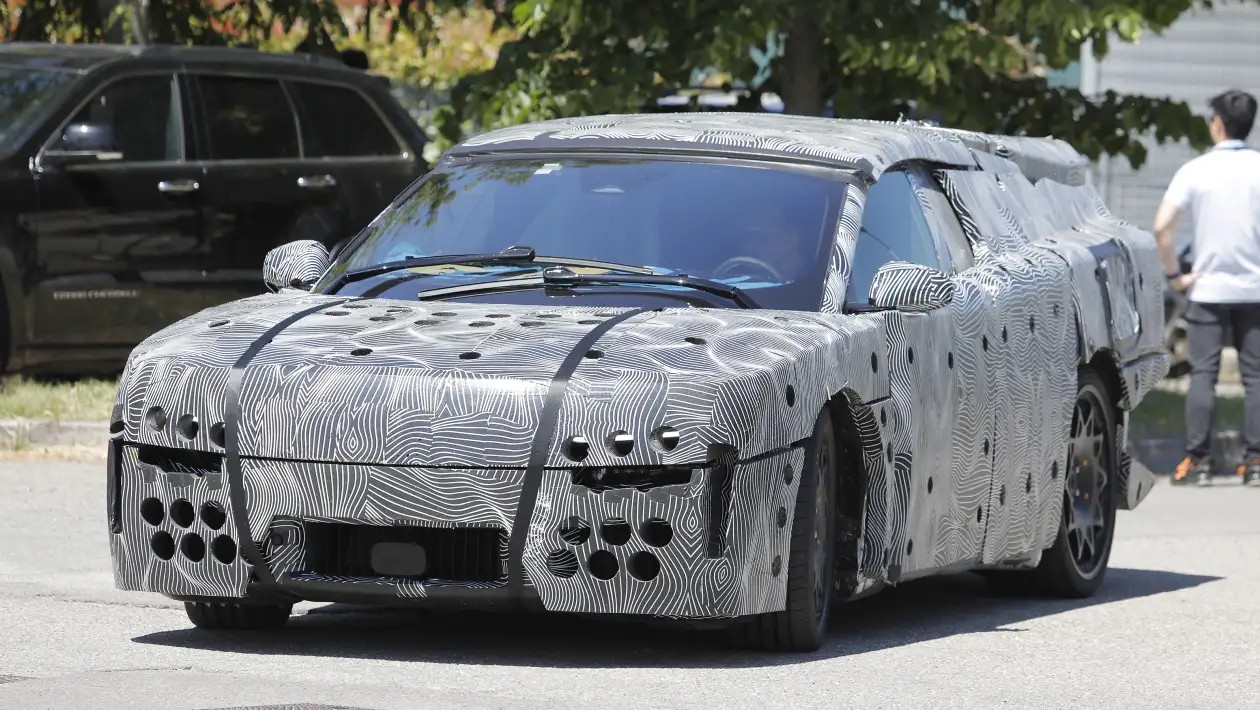
It’s hiding no longer. Spotted behind factory gates. Final calibrations underway.
The Ferrari Luce has worn many faces over the years, this covered prototype is finally letting the cat out of the bag. It looks less like the Ferrari we know and love today and more like a ghost from the 2000 past. Three bumper openings. Slim lights. Air curtains disguised as upright slits. It’s aero management disguised as retro styling.
It doesn’t look like a new Ferrari. It might just be an old one in electric drag.
The bonnet stays flat. Low. The windshield is raked back, forward-sitting like every mid-engined masterpiece that came before. The rear is short. Tapered. No complex diffusers here, just clean lines.
Then there are the tail lights.
Double roundels. A nod to the classic era, confirming what the interior hinted at. This car is a time capsule wired with fiber optics.
Not Made by Flavio
Ferrari handed the pen to outsiders. Not their in-house team led by Flavio Manzoni, but LoveFrom. Johnny Ive and Marc Newson’s consortium. They probably designed your phone and your furniture, and now they’re redesigning your dream car.
They started with the steering wheel.
Nardi-inspired. Exposed aluminum. Analog buttons on the upper spokes, stark against the chaos of current Ferrari wheels. Behind it? A binnacle attached to the column. Two layered OLED screens create a 3D effect, moving with you so the perspective never shifts. Watch-like clarity. Retro dials, modern tech.
The center screen swivels on a ball joint. It points at the driver, or the passenger, whichever one cares enough to look. A palm rest sits below it, alongside a mechanical multigraph—a real clock with physical hands layered over a touchscreen. It’s bizarre. It’s elegant. It’s exactly the kind of weirdness only an Italian EV could pull off.
The key? Crystal. Glass. It has an E-ink display that wakes up only when docked, saving battery. No need to panic-charge a key fob, a lesson Ferrari learned while watching BMW fumble theirs.
The software is contemporary, but the vibe is pure heritage. The dashboard is brutally clean, a shift away from the button-cluttered cabins of recent years. We find out if this extends to the exterior in May. Until then, we guess.
If you’re tired of guessing, a used California T is waiting. Under £80,000 says Auto Express. But let’s stick to the future.
The Muscle
Four motors. Two per axle. Just like the Rimac Nevera or BMW’s VDX concept. The Luce makes over 1,000 bhp. About what the 849 Testarossa pushes out with its hybrid V8. But torque?
11,500 Nm when Launch mode kicks in. That is absurd. 0 to 62 mph in 2.5 seconds. Top speed around 193 mph.
The motors themselves are compact, born from Formula One tech. Water-cooled. Thermally conductive resin distributes the heat. And here’s a trick: the front motors can disconnect entirely.
When cruising on the highway, traction isn’t the priority. Efficiency is. A device disengages the front axles in 500 milliseconds. It saves weight. It saves range. When you need all-wheel drive again, it’s back online before you blink.
Three modes control the flow. Range. Tour. Performance. You switch them using an e-Manettino dial. Torque vectoring handles the corners, manipulating each wheel’s speed to make a 2.3-ton brick feel like it’s 1.8.
Shift Paddles for What?
Why do you need shift paddles in a car that doesn’t have gears?
Engagement. That’s it. Hyundai tried it. Genesis tried it. Ferrari calls theirs Torque Shift Engagement.
Pull the right paddle, get five progressive steps of power delivery. It mimics the snap of a petrol engine, a theatrical flourish for an instantaneous force. The left paddle? Fake engine braking. It helps you slow for corners without actually having an engine to brake against.
It’s theater, but necessary theater. You need the connection.
The Soundtrack
Ferrari refuses to fake exhaust pops. They’re done with artificial noise.
Instead, they built an accelerometer into the rear e-axle casing. It listens to the vibrations of the electric motor, picks up the hum, and pumps it into the cabin.
Think of an electric guitar. The pickup senses the string, the amp broadcasts it. Same idea. It’s a unique sound. A mystery we haven’t heard yet, because normal driving remains silent for relaxation’s sake. No artificial revs. No hot-hatch crackle. Just the raw vibration of the machine itself.
Built for Comfort, Driven for Speed
The chassis is recycled aluminum. Saves 6.7 tons of CO2 per car, Ferrari says.
The battery lives underneath, dropping the center of gravity 80 mm lower than a gas-powered equivalent. Low and mean. This allows the suspension to evolve from the Purosange SUV to the F80 hypercar specs.
They lengthened the screw in the dampers by 20 percent, letting them eat up potholes better. An electric motor controls the pitch. At the back, a single hollow subframe reduces noise without adding bulk. Wheels turn slightly for agility.
And because regenerative braking alone (up to 0.68 G, which is impressive) wasn’t enough to convince them, Ferrari slapped on carbon-ceramic Brembo brakes. Massive discs. Six pistions in the front. Heavy hardware for heavy stops.
The driver sits far forward. Close to the wheels for feedback, but high enough for comfort. A hybrid of racing car precision and GT convenience.
Range Anxiety
Here’s the catch. The battery is 122 kWh. Ferrari claims it’s the most energy-dense EV unit ever. They stacked modules, squeezed them under seats, used tall pouch cells instead of cylindrical ones to save weight.
Result? More than 330 miles.
In an age where BMW’s smaller iX3 does 493, this number underwhelms. But the Luce has twice the motors and drives differently. It’s meant to be pushed. Hard. And it charges fast—350 kW tops out to nearly full in 30 minutes. Maybe less.
Why Now?
Lamborghini waits until 2028 for its EV. Aston Martin dangles a “before end of decade” promise. Ferrari isn’t waiting.
They waited until the tech was ready to deliver what a Ferrari owes its clients: driving thrill. Vigna, the chief designer, put it simply. They wanted to prove they could harness electric technology for emotion, not just efficiency. They also wanted to tap a new market. The ones who will only buy red if it has no exhaust.
Did you know you can also sell your old gas guzzler through Auto Express?
Maybe.