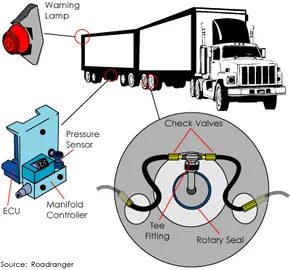
Dana Corporation didn’t just tinker with tractor trailer tires. They built a full “smart” system called the Tire Maintenance System (TMS). It’s designed to monitor pressure and inflate tires on the fly. The air source? The trailer’s brake supply tank. No external compressors. No external air lines. Just pure pneumatic efficiency.
The system measures tire pressure using a series of air pulses in the air lines. If the target pressure in the line is not reached after a certain amount of time, the system begins inflating the tire(s) until the correct pressure is reached.
This isn’t a toy. It’s industrial-grade hardware with three main components working in tandem.
The Hardware Breakdown
First, you have the tire hose assembly. This is the physical route for the air. It features check valves. Why? To stop air lines and seals from needing constant pressurization. When the system isn’t checking or inflating, those valves hold the line. Less pressure on the seals means less wear and tear. That’s longevity.
Next is the rotary joint. This is where the physics get interesting. It connects the air hose from the non-rotating axle to the rotating hubcap. It’s a mess of air and oil seals and bearings. The air seals stop leakage. The oil seal keeps contamination out. The rotary hub also has a vent. It releases air pressure trapped inside the hubcap. Without that vent, you’d have a pressure cooker spinning down the highway.
Finally, the manifold. This is the brain’s heart. It houses the pressure protection valve. This valve ensures the system doesn’t suck air from the brakes if pressure drops below 80 psi. It also holds an inlet filter for clean air, a pressure sensor to read tire stats, and solenoids that control airflow to each tire.
The Electronic Control Unit
Like any complex CTIS (Central Tire Inflation System), the Tire Maintenance System relies on an electronic control unit. This ECU runs the show. It runs diagnostics. It checks for operational integrity.
If a tire’s pressure drops more than 10 percent below normal, the ECU triggers a warning light on the trailer. This light is visible through the driver’s rear-view mirror. You don’t need to crawl under the trailer to know something’s wrong.
The Cycle
How does it work in real-time? The system starts with an initial pressure check. It adds air to any tire that’s low. The check valves in each tire hose ensure that while one tire is being inflated, the others don’t lose pressure. That’s critical. You can’t fix one tire by deflating the rest.
After that initial check, the system depressurizes. It relieves pressure from the seals. Then, every 10 minutes, it pressurizes the lines again. It rechecks tire pressures.
It’s a loop. A constant, quiet audit of your trailer’s contact patches.
How AIRGO Fixes Leaks Without Touching Your Brakes
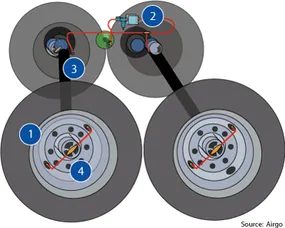
Most trailer air systems borrow air from the braking circuit. That is a problem. You do not want to bleed your brakes to keep a tire inflated. The AIRGO system avoids this entirely. It is a constant monitoring setup designed to catch pressure drops before they cause a blowout.
The mechanism relies on a series of check valves. These are not just simple one-way gates. They work in sequence to detect a loss in air pressure at specific points in the system. Once a leak is detected, the magic happens. The system draws fresh air from the vehicle’s pneumatic system rather than the brake lines.
This air travels through the axles. If the axles are pressurized, the air flows through the metal itself. If they are not, it moves through dedicated tubing. The destination is the hubcap assembly. From there, it routes directly into the tire that needs inflation.
The Warning Light Logic
You will know the system worked because of the warning light. It sits on the trailer body. It is positioned so you can see it through the driver’s rearview mirror. The light illuminates only after the system has successfully inflated the tire. This feedback loop confirms the action was taken.
This constant operation comes with a cost. The seals endure significant wear and tear. Rubber would fail quickly under this cycle. AIRGO uses carbon-graphite and case-hardened steel for its seals instead. They last longer. They resist the friction of constant cycling.
Other Systems to Consider
If AIRGO is not your preference, other solutions exist. They operate differently.
- PressureGuard : This system routes air from the trailer’s main air supply. It travels through the axles. Then it goes to the hubs. Finally, it reaches the tire valves. It is a direct path.
- TIREMAAX : This system maintains a specific inflation level using the trailer’s air tank. It detects low pressure. It signals the operator. Then it directs air to the tire. It is proactive rather than reactive.
Each system has its own logic. The choice depends on your trailer’s design and your maintenance preferences. The technology keeps getting better. But the basic physics of air and rubber remain the same.