Chrysler’s 1934 Airflow was a commercial disaster in the United States. It seemed ahead of its time. The style is polarizing. The design is solid. But US buyers aren’t ready yet.
Peugeot sees things differently.
The French car manufacturer does not believe that a loss is coming. They looked at the plan.
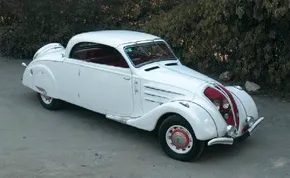
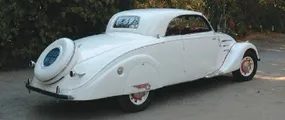
This is a 1938 Peugeot 402 B retractable hardtop. This is a direct tribute to the American experiment. Peugeot took the aerodynamic car design concept and perfected it. Suitable for European roads. they make it beautiful.
The French interpretation of simplicity
Peugeot is the second oldest car manufacturer in the world. Their headquarters are in Paris. The company’s main production facility is located in Sochaux, near the Swiss border. By the mid-1930s, they had decades of engineering experience.
In late 1935 they introduced the 402 model. This is their answer to Airflow.
Design choices are special. The front end is rounded. Includes a waterfall grill. This is not just an aesthetic imitation. This is a functional adaptation.
Peugeot went further than Chrysler. They removed the running boards completely. This reduces drag. The silhouette of the car also becomes sharper.
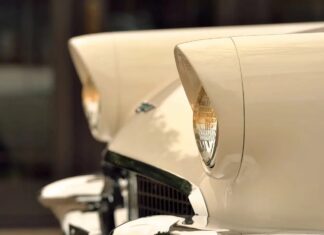
They hid the headlights behind the grill. In 1935 this was a dangerous practice. Most cars had bare headlights. Peugeot has integrated them into the body of the car. As a result, the air flow over the bonnet is more even.
Aerodynamic advantages
Streamlining doesn’t just mean faster rendering. It’s about efficient movement.
Less wind resistance means better fuel economy. The engine doesn’t have to work as hard to push the air. This means better performance at cruising speeds.
The 402 B’s retractable hardtop embodies this philosophy. It combines the structural elegance of a coupe with the open-air experience of a roadster. The mechanism is complex. Aerodynamics are precise.
Peugeot proved that the Airflow idea was right. They just apply it more repressively. The result is a car that appeals to multiple markets.
The 402 B is a testament to this adaptability. It shows how European designers refined American concepts. They don’t just copy looks. Improved functionality.
There’s a certain poetry to it that a “failed” American car inspired one of the most stylish French designs of the decade. Chrysler bet on the future, but lost to the present. Peugeot borrows from the future to create the present.
402 B still stands out. Not because it looks like air flow. But that’s because it looks like a Peugeot that knows its style.
The Lion’s Head Latch and Eclipse Hardtop
Peugeot doesn’t just stick a logo on the nose. The streamlined grille lion mascot is very practical. Also works as a hood latch. If you look closely, you can see another stylized lion on the rear fender. Subtle brand reinforcement.
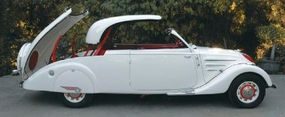
Sedans make up the majority of production. There are also coupes and convertibles. However, the Éclipse is stood out. It is a retractable hardtop. Not a fabric soft top. Metal.
This mechanism is very clever. The hard top flips over and slides under the trunk lid. You can open-air motoring without noise or weather, without the noise or weather exposure of a convertible. Lift it up and it becomes a coupe. Solid. Secure.
Early models used an electric motor to lower the roof. Fine for luxury. But in 1937 things changed. Peugeot replaced the electrical system with a simpler mechanical system. Maintenance becomes easier. operable by one person. No team needs to fold that metal roof.
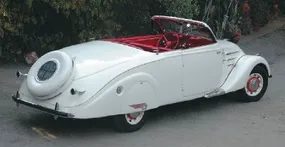
Peugeot’s retractable hardtop was the unicorn of the 1930s. This is not just a trick. It is a fully equipped convertible with a steel top that blends into the frame. Decades later, Ford tried to repeat this strategy with the Skyliner. The car failed. It wasn’t until the 2000s that the concept took off commercially. Mercedes-Benz SLK. Volkswagen Eos. Pontiac G6. These cars proved the reliability of retractable hardtops. But Peugeot played this game in the 1930s.
Engineering Over Flash
It also looks futuristic. Not so in technology. This is traditional. Peugeot sticks to what it knows. Durable material. A reliable mechanic. They are not trying to reinvent the wheel. They only made wheels that could be hidden.
The result was the Éclipse. A large car. A heavy car. You need all kinds of space.
Wheelbase compromises
Space is the enemy of the retractable hardtop. Requires a roof. You need a trunk. With the roof down, you need a parking spot. Eclipse solves this problem with brute force. It stretched out to a massive 130-inch wheelbase. This is not luxury for luxury’s sake. This is necessary. The back cover must be long enough to swallow the collapsible hard drive. And it has to be wide enough to be comfortable.
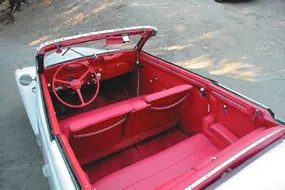
Peugeot didn’t skimp on the seats. There are 6 passengers. Six. On a wide bench. Families can stay together. Or the whole team. Inside the car, the roof is missing.
Why it matters now
We see retractable hardtops everywhere today. The engineering has improved. This mechanism is faster. However, the basic problem still exists. Where should the roof be placed? Peugeot has spent a century solving this problem. They started with a long wheelbase. In the end, they came up with a solution that worked. The Éclipse was the prototype for modern comfort. This shows that you don’t have to settle for a hardtop convertible. It could be the right car.
The legacy isn’t just in the specs. It’s in the idea. That you can have style. And space. All at once. Peugeot shows us the way.
The dashboard shifter is weird
The front suspension is independent. This setting helps improve driving comfort. It also maintains sharp handling. The engine is a 2.1-liter 4-cylinder OHV. The power is 63 horsepower. That is modest. But it is reliable.
Transmission options are standard. A traditional three-speed gearbox is included in the package. This is where it gets weird. The shift lever does not lift off the floor. It grew out of the dashboard. Yes. The dash.
Why install the gear selector on the dashboard? It creates a strange visual effect. The position of the hands also changes. Drivers had to reach up. Not down. This layout is unusual. It gives the interior a unique atmosphere. Some find it attractive. Others found it distracting.
The engine has no power. But the chassis felt planted. Independent front suspension allows each wheel to move independently. This reduced body roll. The steering remained responsive. Although the horsepower is low.
63 horsepower moves a car. You just need to be patient. A 3-speed manual transmission keeps engine speeds low. Drivers shifted often. The gear selector mounted on the dashboard enhances the experience. It forced engagement.
The combination of these features defines the driving experience. The engine provided basic mobility. The suspension provided confidence. The gear lever is a conversation starter.
The Vanishing Point
The numbers are tough. When the plant closed in 1940, less than 500 Eclipse sedans rolled off the assembly line. That’s not a ton of production for a brand trying to break into the US market, but it’s nothing either. That’s enough to create a vacuum in today’s used car market.
Let’s face reality here. 14-30 examples are believed to survive.
Think about it. If you’re looking for a 1930s Chrysler Eclipse, you’re not looking for a project car in the barn. You are looking for a museum piece. Or a very expensive garage queen. The odds are heavily stacked against you. Most of these cars were damaged by rust in the 1940s and 1950s, war scrap drives or everyday driving.
“Finding the Eclipse while it was running was even more miraculous than finding the car, as there were only about 20 survivors.”
This scarcity drives the collector market into rarefied air. When one does pop up, it’s not just another vintage Chrysler. This is a piece of Art Deco car history that survived the Great Depression and World War II unscathed. The sleek torpedo styling of the Eclipse was a step up from the boxy designs of the late 1920s, but its demise came too early to prove its long-term viability.
If you’re serious about tracking one down, you are in a niche area. You don’t always see these cars at swap meets. They belong to private collections and are preserved by experts who understand the intricacies of pre-war technology. Its value is not only in the metal. It’s in the survival rate. Such a rare and historic car is practically untouchable.