You probably know the four-stroke diesel engine. It’s the workhorse under the hood of your pickup truck or the engine block of your sedan. It breathes in, compresses, fires, and exhales in a rhythmic four-part dance. Then there’s the two-stroke engine you might recognize from the shrill whine of a chainsaw or the thrum of a jet ski. These small engines are simpler, lighter, and fire on every other revolution.
But what happens when you scale that two-stroke efficiency up to the size of a house?
You get the behemoths that keep global trade moving. The massive diesel engines powering locomotives, container ships, and even large-scale power generation facilities don’t just use diesel fuel. They often combine the combustion efficiency of diesel with the rapid cycle of a two-stroke engine. This hybrid approach creates some of the most powerful mechanical devices ever built.
We’re going to dive into how these giant two-stroke diesels actually work. It’s not just a scaled-up version of your car engine. The physics, the engineering, and the sheer scale are in a different league entirely.
The Mechanics of the Giant Cycle
To understand why these engines are different, you have to look at the cycle itself. In a standard four-stroke diesel, the piston moves up and down twice for every power stroke. Intake, compression, power, exhaust. It’s reliable. It’s mature. But it’s also limited by how many times you can move that piston in an hour.
A two-stroke engine cuts that in half. One up, one down. Power on every revolution.
For a chainsaw, this means more power for less weight. For a 60-ton ship engine, it means continuous, relentless torque without the complexity of overhead valves and camshafts in the traditional sense. But there’s a catch. How do you get fresh air in and exhaust out if the piston is doing all the work?
The answer lies in scavenging.
“Scavenging is the process of removing exhaust gases from the cylinder and replacing them with fresh air.”
In small two-strokes, this is often done via ports in the cylinder wall. The piston itself acts as the valve. As it moves down, it uncovers the exhaust port. As it moves up, it covers the intake port. It’s crude. It’s messy. It wastes some fuel. But for massive engines, the simplicity outweighs the inefficiency.
However, these aren’t just big chainsaws. They are precision instruments. The size changes everything. A 9-cylinder two-stroke diesel can be as tall as a three-story house. The piston alone can weigh several tons. And they operate at speeds far slower than your car engine, often turning at less than 100 RPM.
Why Two-Stroke? Why Now?
You might wonder why manufacturers didn’t stick with four-stroke engines for everything. After all, four-strokes are more efficient in terms of fuel consumption per mile in smaller applications. They have better emissions control. They’re easier to tune.
So why go two-stroke for the giants?
Torque.
Ship engines don’t need to rev high. They don’t need to shift gears. They need to push
Why Diesel Beats Gas in Two-Strokes
If you already know the basics of how two-stroke engines work, you probably know the headline stat: they fire the spark plug twice as often as a four-stroke. Once per crankshaft revolution. This theoretical potential means a two-stroke can pump out twice the power of a comparable four-stroke. But there is a catch.
The traditional gasoline two-stroke sucks in a pre-mixed air-fuel charge. That cycle is messy. A chunk of unburned fuel leaks out every time the cylinder recharges. It wastes fuel and pollutes.
Enter the diesel approach.
Diesel engines compress pure air first. Then, they inject fuel directly into that hot, compressed air. This method is a far better fit for the two-stroke cycle. Because you aren’t pumping raw fuel out the exhaust, efficiency skyrockets. Emissions drop. That is why major manufacturers of large diesel engines use this layout to build high-power monsters.
The Anatomy of a Two-Stroke Diesel
Look at the layout of a typical two-stroke diesel engine. It looks nothing like what you’d find under the hood of a car.
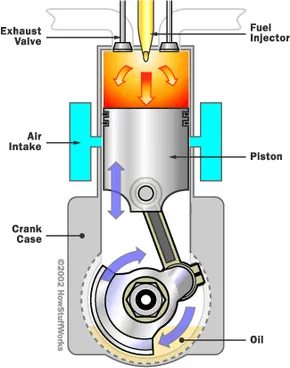
At the top of the cylinder sit two or four exhaust valves. They all crack open simultaneously. Right there too is the diesel fuel injector (highlighted in yellow in diagrams). The piston is elongated. This extra length lets the piston itself act as the intake valve. At the bottom of its travel, the piston uncovers ports for air intake.
The intake air is pressurized by a turbocharger or supercharger. The crankcase is sealed and holds oil, just like a standard four-stroke.
Here is the two-stroke diesel cycle in action:
- The piston sits at the top of its travel. The cylinder contains highly compressed air. The diesel fuel injector sprays fuel into the chamber. Heat and pressure ignite it instantly. Same ignition physics as a standard diesel.
- Combustion pressure drives the piston down. This is the power stroke.
- Near the bottom of the stroke, all exhaust valves open. Exhaust gases rush out, relieving pressure.
- At the bottom, the piston uncovers the air intake ports. Pressurized air floods in, forcing out the remaining exhaust fumes.
- Exhaust valves close. The piston moves back up, covering the intake ports and compressing the fresh air. This is the compression stroke.
- Near the top, the cycle repeats.
The difference from a gasoline two-stroke is stark. Only air fills the cylinder. No unburned fuel leaks out. No environmental nightmares. But there is a trade-off. A diesel two-stroke needs a turbo or supercharger. That adds cost and complexity. You will never find a diesel two-stroke in a chain saw. It would be overkill. And way too expensive.
General Motors EMD Engines
The General Motors EMD engine line defines the two-stroke diesel breed. Introduced in the 1930s, these giants power a huge portion of the diesel locomotives running on U.S. tracks.
There have been three successive series: the 567, the 645, and the 710. The numbers refer to cubic inches per cylinder. A typical setup has 16 cylinders. Total displacement? Around 10,000 cubic inches. Consider that a 5-liter (305-cubic-inch) engine is considered massive in a car. An EMD engine is a different species entirely.
Take the EMD 645E3. Here are the specs:
- Cylinder diameter: 9-1/16 inches
- Piston stroke: 10 inches
- Displacement per cylinder: 654 cubic inches
- Cylinders: 16 or 20
- Compression ratio: 14.5:1
- Exhaust valves per cylinder: 4
- Weight (16-cyl): 34,526 lbs (15,661 kg)
- Weight (20-cyl): 40,144 lbs (18,209 kg). Note: The oil pan alone weighs over a ton.
- Idle speed: 315 rpm
- Full speed: 900 rpm
- Horsepower: ~4,300 hp
That is not a car. That is a moving power plant.
For more on diesel two-strokes and other engine architectures, check the links on the next page.