Toledo, Ohio, in the late 1940s was a place defined by a strange dual identity. On one hand, there was the roar of victory from a war just won. On the other, a heavy fog of uncertainty about what to build next. This was the home of Willys-Overland. The company had survived the Great Depression and the war machine, but the road ahead was unclear. And inside the corporate offices, clarity was in short supply.
It wasn’t just confusion. It was a full-blown power struggle.
At the top sat CEO Ward M. Canaday. He had pulled the company out of the bankruptcy hole during the Depression. His strategy was simple: low-priced small cars. They worked. They kept the lights on. They built a reputation for no-nonsense, affordable transportation.
Then came Joseph Washington Frazer.
Frazer arrived in 1939. He wasn’t a car guy in the traditional sense. He was a salesman. A former sales chief for Chrysler Corporation. He knew how to move metal. He knew how to market. And he didn’t like Canaday’s approach.
The Willys 77 was already on the road. It was funny-looking. It was compact. It was reliable. Under Frazer’s influence, it got a makeover. The “Slip-stream” design smoothed out the edges. The interior got nicer. The engine improved. It was a better car. But Frazer wanted more. He didn’t just want to tweak the existing lineup. He wanted to redefine the brand.
This tension between the steady hand of Canaday and the aggressive vision of Frazer would eventually split the company. But before the split, before Jeep became the singular focus of Willys-Overland’s postwar identity, there was a different path. A path that looked fast, sleek, and expensive.
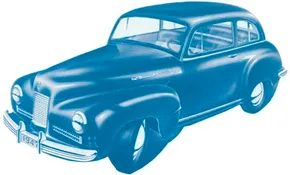
It was the 1940s Willys 6/66 concept car.
A concept that might have led to a very different outcome. Instead of just an off-road icon, Willys could have been known for something else entirely. Something with more chrome and fewer leaf springs. The 6/66 was the physical manifestation of that disagreement. It was the answer to the question: what happens when a salesman takes the wheel?
The answer was a car that never made it to production. A ghost in the showroom. But it existed. And it changed the conversation.
The Jeep Windfall and the Postwar Split
Toledo’s Americar was a hard sell. By late 1941, it offered Ford-esque styling and a sub-$1,000 price tag, but buyers weren’t biting. It didn’t matter much when George Frazer pulled Willys-Overson out of the financial mud. He didn’t just help; he almost single-handedly secured the contract for the Army’s general-purpose vehicle. The result? The Jeep.
Willys didn’t just survive the war. It thrived. Sales exploded from $9 million in 1939 to a staggering $212 million in 1944. That wasn’t just revenue. It was a literal fortune built on the back of the rugged “Willeeze.” Soldiers loved it. The Jeep’s wartime exploits turned into legend before the ink was even dry on the surrender documents.
But victory didn’t smooth over the cracks inside the company. It widened them. The postwar direction became the flashpoint between Frazer and Canaday. Joe Frazer wanted to pivot. He saw the Americar’s failed light-car prototype, codenamed “6/66,” as the obvious next step. His vision was clear: a lightweight, roomy, and thrifty low-priced car. He wanted to replicate the success Studebaker had found with its 1939 Champion. Canaday disagreed. The rift was forming right then.
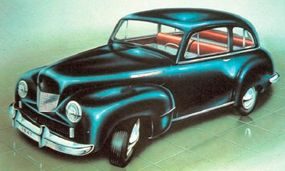
The exterior might have been wrapped in fresh Brooks Stevens styling, but the 6/66 was hardly a blank slate. It was more of a facelift job on a proven platform. Under the skin, the bones were familiar. The wheelbase stayed locked at 104 inches. The powertrain didn’t get an overhaul either.
Sticking with the Side-Valve Four
Willys wasn’t betting the farm on innovation here. The heart of the 6/66 was the same 148.5-cubic-inch side-valve four-cylinder engine that had powered the old Americar. It was a workhorse engine. Old school. Simple. Reliable? Sure. Exciting? Not really.
It pushed out a modest 66.5 horsepower. That’s not much by modern standards, and even for the late 1940s, it was on the lower end for a compact sedan. But it worked. It moved the car. It kept costs down. And it fit the budget-minded ethos Willys was trying to project with this concept.
Why This Matters for Vintage Car Enthusiasts
If you’re hunting for 1940s Willys 6/66 concept car details, this is the crux of the story. It wasn’t about speed. It was about packaging. Stevens could make the old geometry look sleek, but the mechanicals remained conservative. This approach highlights a specific era in automotive design where styling often outpaced engineering.
“The 6/66 owed much to the old Americar.”
That quote says it all. It was a study in restraint. A look forward, powered by yesterday’s tech.
Comparison: Concept vs. Reality
You might wonder how the 6/66 differed from the production models that followed. The concept was a showcase. The production cars, like the Jeepster or later Willys sedans, had to cut corners the concept didn’t. The 104-inch wheelbase remained a constant though. And that side-valve engine? It stayed in production for years. Long after the concept car faded into showrooms and memory books.
This isn’t a story of radical change. It’s a story of evolution. Of taking what works and making it look good enough to sell. The 6/66 proved that a new suit could make an old car look new. But underneath, the engine just kept chugging along.
Independent Suspension and Cost-Conscious Drivetrain
The 1940s Willys 6/66 concept wasn’t just another body-on-frame experiment. It borrowed technical DNA from Studebaker, specifically the Planar independent front suspension engineered by Delmar G. “Barney” Roos. Roos had developed this geometry while at Studebaker for the Champ truck, and its appearance here signaled a serious attempt to improve handling without blowing the budget.
The rear axle told a different story. It used a swinging independent, semi-floating wheel bearing setup. This likely meant a solid axle design rather than true independent rear suspension with half-shafts. Half-shafts would have been too expensive for a product aimed at the mass market. The goal was clear: keep costs down while offering decent ride quality.
Power delivery was straightforward. The standard transmission was a three-speed manual with column shifting. But Willys had bigger plans for those willing to pay extra. Optional overdrive was on the table. There were also rumors of an automatic transmission, though the design was never finalized. Whether undecided or simply not yet developed, the automatic remained a promise rather than a reality.
Design Variations and the Hudson Comparison
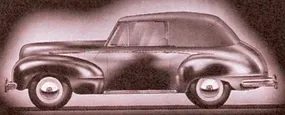
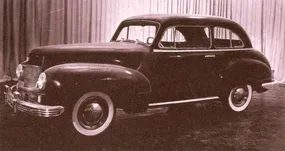
Only one prototype was ever built. It was a two-door sedan that looked like a smaller version of a mid-1940s Hudson. The proportions were tight. The styling was conservative but functional.
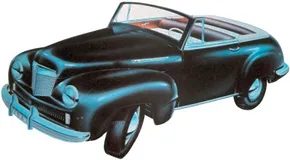
Designer Stevens sketched a convertible version with a blind-quarter cabriolet top. This was a fashionable choice at the time, offering open-air driving without the complexity of a full soft top. But the drawing board never turned into steel. The convertible remained a concept.
Stevens also explored numerous trim variations. These sketches showed how the car could be adapted for different markets. The Willys 6/66 was flexible in theory. In practice, it stayed a prototype.
The Train Wreck and the Wrong Timing
The front end of the Stevens prototype was a study in minimalist geometry. A trim die-cast grille sat beneath a sharp, “coffin nose” hood that recalled the legendary Cord 810 and 812. It was a look that screamed pre-war sophistication. Many of Stevens’ renderings and factory photos of the lone prototype even featured “1947” license plates. This detail suggested the team had their sights set on a 1947 launch. They wanted it cheap, too. The target base price was a suspiciously round $666.
But names changed. Somewhere in the planning phase, the “6/66” moniker was dropped for “Model 6-70.” This shift appeared on general specifications dated April 17, 1945. It was the same car underneath, just with a new label. That continuity, however, became its undoing.
John Canaday never trusted the design. His doubts turned to dread when the prototype met a train during a trial run. The accident killed the test driver’s wife. It was a tragedy that should have been the end of the project. Joe Frazer refused to back down. He stuck to his vision. Canaday did the same, standing firm against it. The partnership fractured. Frazer left Willys in mid-1944 to join Graham-Paige, entering a brief and chaotic alliance with Henry John Kaiser.
Looking back, Willys made the right call by stepping back from the compact market in 1947. The demand for small cars was thin, even if they were affordable. The public wasn’t ready. Had the 6/66 launched, it would have felt dated before it even hit the showroom floor. The styling was too tied to a past that was already closing.
The machine survived the wreck, but the momentum didn’t. Without Frazer, the project lost its primary champion. The specs from April 1945 sat on a desk, unused. The “Model 6-70” remained a ghost car, defined more by what almost happened than what did.
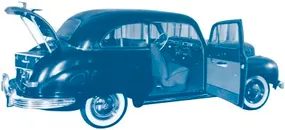
The civilian car division didn’t just pay the bills—it printed money. Willys finally had the cash and time to build something that wasn’t a utility tool. They waited until 1952 to launch the Aero-Willys. It was a serious departure from the boxy open-top reputation. The styling was sleek. The engineering was modern. For a brief window, it seemed like a legitimate passenger car competitor.
Sales spiked in 1952. Then they crashed.
The Aero-Willys was gone by 1955. Three years. That’s all the time it took for a promising sedan to fade into obscurity. Toledo was forced back on its core strength: Jeeps. It was a retreat, sure. But was it a defeat?
The Willys nameplate didn’t survive much longer. It vanished completely by 1970. Kerman-Motor Company took over, then American Motors. The badge itself died. But the vehicles kept moving. Toledo never stopped manufacturing the Jeep. The legacy stuck. Many enthusiasts still refer to older models as “Willys Jeeps.” That’s not a marketing error. That’s cultural retention. For a defunct nameplate, being remembered as the origin of an icon is a solid exit strategy.
For more on concept cars and the production models they forecast, check out:
-
Concept Cars
-
Future Cars
-
Consumer Guide auto show reports
-
Classic Cars