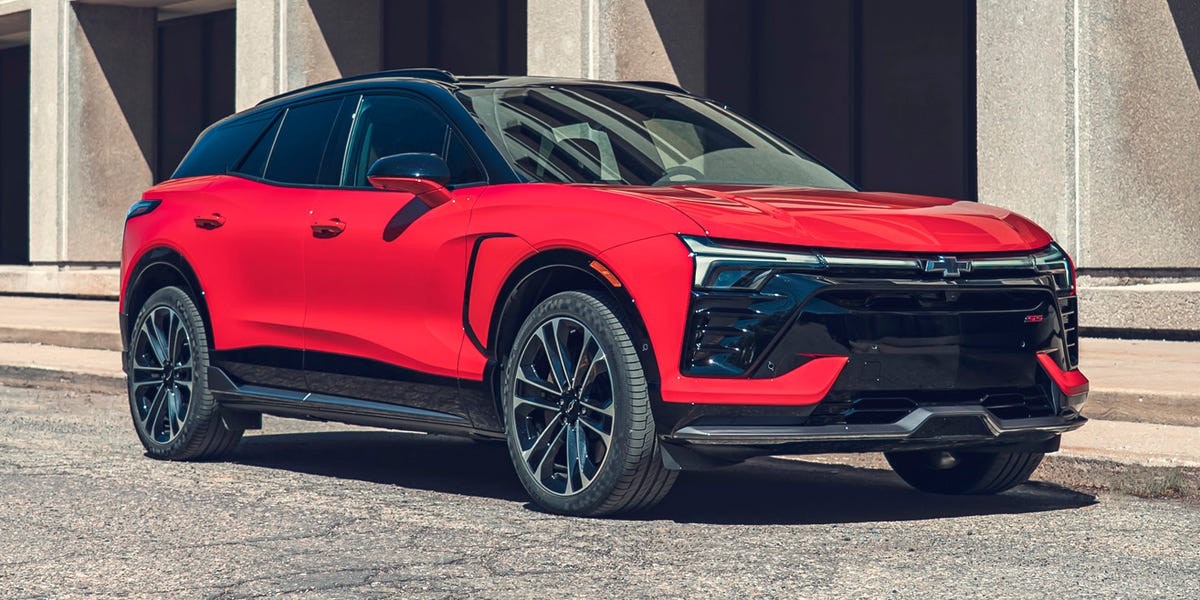
It doesn’t change much when you aren’t trying to hide the fact that it was barely touched. The 2027 Chevrolet Blazer rolls in on the exact same treads as 2024, 2025, and 2026. No major software updates. No revised suspension. No surprise Easter eggs under the hood.
You get what you already know.
And if you like what you know? Cool. If you want new? Look elsewhere.
The Performance Spectrum
Chevrolet didn’t pick a lane. They built a whole highway.
The entry-level LT is polite. Very polite. It has 220 horsepower, front-wheel drive, and enough chill to match the color of a rainy Tuesday. You get it because you care about range, not speed. It boasts up to 312 miles per charge, which is impressive. Most other electric mid-size SUVs can’t touch that number without sacrificing some dignity.
Then there’s the top-shelf SS.
615 horsepower. Three-point-three seconds to 60. It tears the asphalt. The blower isn’t real, but the noise it makes in your ears when you mash the pedal feels loud enough. This thing leaves everything behind in the mid-size segment. The Kia EV9? Slow. The Toyota bZ4X? Cute.
If you want something in between, there’s a 300-horsepower option. A compromise for the indecisive.
Money Talk: The RS Makes Sense
Skip the base model. Skip the SS unless money grows on your driveway trees.
Take the RS. It hits the sweet spot.
It comes standard with 21-inch wheels that look good, not just functional. You get a power liftgate that opens when you wave your butt at it, heated seats, and ventilated ones for the hotter days. Even the steering wheel has a bowtie logo that glows. Tacky? Sure. Effective? Also sure.
The RS is available in front- or all-wheel drive, but there is a catch.
Go FWD, you keep the range. Go AWD, you get more power but burn that range like dry wood. Which do you need more? A fast trip or a long one? Think about it.
The RS gives you the attitude of a performance SUV without demanding you empty your wallet for the badge.
Inside: Big Screen, No CarPlay
You sit inside and the first thing you notice is the size. The 17.7-inch infotainment screen is huge. It’s angled toward you. That’s nice.
Physical knobs for climate control and volume sit below it. Thank goodness. We didn’t ask to play Minesweeper every time we wanted to adjust the AC. There’s a secondary 11.0-inch cluster for the driver, keeping the gauges readable.
But here is the dealbreaker for some.
Google Built-In runs the show. You have Spotify. You have Waze. You have maps. What you don’t have is Apple CarPlay or Android Auto. Some people won’t care. Some of our editors cried about it. It happens. The Google system works well enough, giving range estimates and charging suggestions, but if you live in your iPhone or Android shortcuts, this omission might annoy you.
The interior design varies by trim. RS and SS models sport black-and-red interiors. Two-tone. Bold. The lower trims offer monotone options. Practical. Boring? Maybe. Safe? Definitely.
Real World Range and Charging
Specs look pretty. The road fights back.
In our 75 mph highway range tests:
- The SS lasted 250 miles. Not bad for 615 ponies.
- The LT AWD made 210.
- The RS AWD tapped out at 200.
Charging speed? From 10 to 90 percent takes 57 minutes on a DC fast charger. It isn’t the fastest in the business, but it beats waiting three hours. The EPA rates the efficient front-wheel-drive versions as high as 114 MPGe in the city. That’s the beauty of going lightweight.
The Driving Feel
It handles better than a van. Worse than a Porsche.
Body roll is managed. Brakes are firm. You don’t panic when you tap the pedal. Steering feedback is thin. It feels electronic. Isolated. Like talking to a robot customer service agent who knows exactly what it wants to tell you.
One-pedal driving is an option, though the highest regen setting still feels slightly less aggressive than rivals like the Hyundai Ioniq 6.
What You Miss Out On
The warranty leaves some people wanting. Three years / 36,00 miles for the basic limited coverage. Eight years for the battery. That’s standard, sure. But it lags behind Hyundai’s promises.
Also, the cargo space. Twenty-six cubic feet behind the second row. It expands to 60 cubic feet when folded. A flat floor makes loading bikes and boxes easier, but it isn’t a cavern. The Kia EV9, by contrast, offers more space if you’re hauling humans or IKEA furniture.
Final Take
The 2027 Blazer EV exists. It is competent. It can be fast, or it can be efficient. It just can’t be new.
We like the RS for the balance. We respect the SS for its brute force. But if you are looking for a car that has evolved, stayed at the starting line.
Does a two-year-old car in a five-year-old market feel fresh?
Maybe.