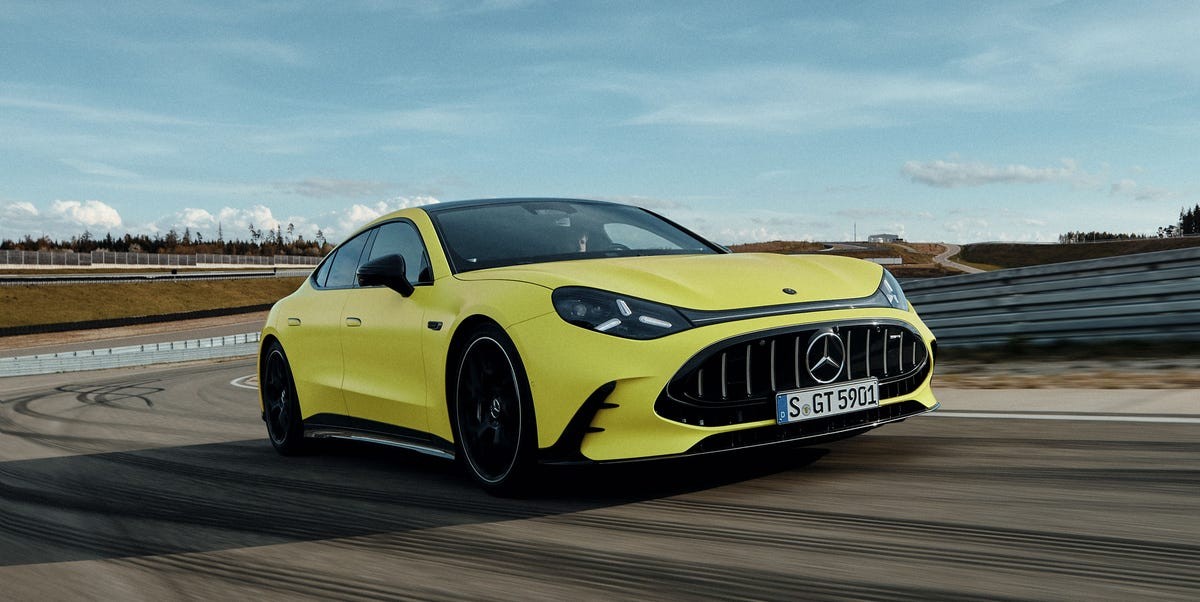
Electric vehicles are getting the axe across the industry. Billions in losses. Cancelled projects. Silence. Mercedes-AMG, however, refuses to quit.
They just unveiled a ground-up electric sports sedan.
The 2027 Mercedes-AMP GT 4-Door.
It is built for speed, noise, and straight aggression against the Porsche Taycan. Most brands are scaling back their EV bets. AMG is doubling down. They are introducing a new AMG.EA platform designed from the wheel out for high-performance driving.
The Motor Problem (Solved)
Forget traditional radial-flux motors. The GT uses three axial-flux electric motors.
Why does it matter? The magnetic fields run parallel to the axis, not at right angles. This design is shorter, lighter, and insanely compact. The front motor is just 3.5 inches thick. The two rear motors sit separately behind each wheel.
Separate rear motors mean incredible torque vectoring.
- Front: 176 pounds, single-speed spur-gear.
- Rear: 309 pounds combined, single-speed planetary gears.
AMG keeps the rear-bias identity of the brand. The rear motors do the heavy lifting.
The specs are brutal:
- GT55: 805 horsepower. 1,328 lb-ft torque. 0-60 in 2.4s.
- GT63: 1,153 horsepower. 1,475 lb-ft torque. 0-60 in 2s.
Two seconds to 60. That is supercar territory. The GT63 might even break the record held by the Taycan Turbo S.
The front motor only kicks in for traction or maximum performance.
Battery Tech From F1
The powertrain sits in a boxy, structural aluminum housing. Inside? 2660 cylindrical nickel-cobalt-manganese-aluminum cells.
These are the longest cylindrical cells AMG has used. 105mm long.
The real trick is cooling. F1 engineering helped design it. A central spine carries non-conductive oil. It flows into the battery modules from the inside out.
- Oil enters hot.
- It flows outward to the outer cells.
- The passages get wider as they move out.
Why?
To ensure uniform cooling. If one cell runs hotter, the whole pack’s power limit drops. The outer cells see more surface area exposure to compensate for the warmer oil returning from the center. That oil then hits an oil-water heat exchanger that dumps 20 kilowatts of heat.
The result is a 106 kWh battery. It runs on an 800-volt system.
- Charge rate: Over 600 kW.
- Time 10% to 80%: 11 minutes.
That is fast. Really fast. If the charging infrastructure actually catches up to the hardware. Range sits at 300+ miles on EPA estimates (WLTP claims 470).
Sound. Lots of Sound.
It’s an EV. So, it doesn’t need sound. But AMG decided it’s missing something without the rumble of internal combustion.
Enter AMGFORCE Sport+ mode.
It doesn’t just play noise from speakers. The seats have “shakers.”
Physical transducers installed in the upholstery to simulate the vibration of a V-8 engine. When you hit the shift paddles (simulated gears, obviously), the audio syncs. It’s eerie how real it sounds. A low idle. A crisp blip of the throttle.
Subtlety isn’t the goal. It is theater.
Aerodynamics and Ride
The drag coefficient is a slick 0.22.
But it gets more complex at speed.
- > 50 mph: Active rear spoiler deploys.
- > 75 mph: Underbody elements engage for downforce.
- Option: Aerokinetics rear diffuser extends 8 inches out from the rear bumper.
It looks mean when it’s on the move.
Inside, it’s a Mercedes interior. You’d expect that. Nice finishes, bolstered seats, screen tilted toward the driver. But here’s the kicker. The back seat has legroom.
Actually usable space.
How? The battery housing has a cutout for the rear footwells. It is taller and longer than a Taycan. You can fit an adult back there and not feel crushed.
Price and Availability
Mercedes hasn’t dropped a firm number yet. But we expect the GT55 to start around $150,000.
The GT63? Expect significantly more.
If you love loud V-8s and fast lap times but also want to drive home with the family in the back seat without caving in the roof… this is the car.
Or is it just a very expensive distraction?