Few of us think about the speakers in our cars. We just hit play. Maybe the setup in your basic sedan is anonymous, or maybe the tweeters in your luxury SUV physically rotate toward your head like theatrical spotlights. You rarely notice the tech. You only notice when the song ends.
Behind that invisibility sits a giant: Harman International.
They own Bowers & Wilkins, Infinity, Mark Levinon, Lexicon, Polk, AKG, Harman/Kardon, and JBL. That’s just the list I could recall off the top of my head.
The stats are stark. Harman builds roughly half of all car audio systems on Earth. In the US, it’s virtually certain that the sound coming from your dashboard, your amp, your speakers—all of it—is made by one of their brands.
I wanted to see where this magic happens. I flew to Harman’s HQ in Northridge, California. It’s also the heart of JBL operations.
JBL’s Northridge campus serves as both a showroom for the massive Harman catalog and a serious R&D lab, though it’s surprisingly not the center of automotive engineering.
The place sits in the San Fernando Valley, just north of LA. Old JBL production bones remain, wrapped in new glass and tech.
But here’s the twist. This campus isn’t really where they build the car systems. It’s where they build the speakers you buy online or see at a concert. JBL still maintains its own team for research here.
Their DNA is pro audio. Concerts. Studios. Movie theaters. Huge horn-loaded speakers for stadiums. Spatial audio for your living room. Studio monitors for mixing engineers.
The argument goes like this. All that professional expertise bleeds into the cars.
But let’s be real. Car audio is a completely different beast.
” It’s the hardest part of our business. “
A JBL rep told me that. He wasn’t complaining. He liked the puzzle. But he paused, emphasizing the weight of the statement.
“Cost targets are incredibly tight. So are the weight and durability limits. It would be a nightmare if it weren’t so engaging.”
Think about it. Your car is a hostile environment. It vibrates. It roasts in 110-degree heat. It freezes in the dead of winter. Coffee spills. Dust accumulates.
Acoustics are a mess too. A studio is a treated room. Surfaces absorb or diffuse sound perfectly.
A car is a glass box filled with hard plastics. Reflections bounce everywhere. Road noise howls. Engine roar fights with your vocals.
Harman solves this with math.
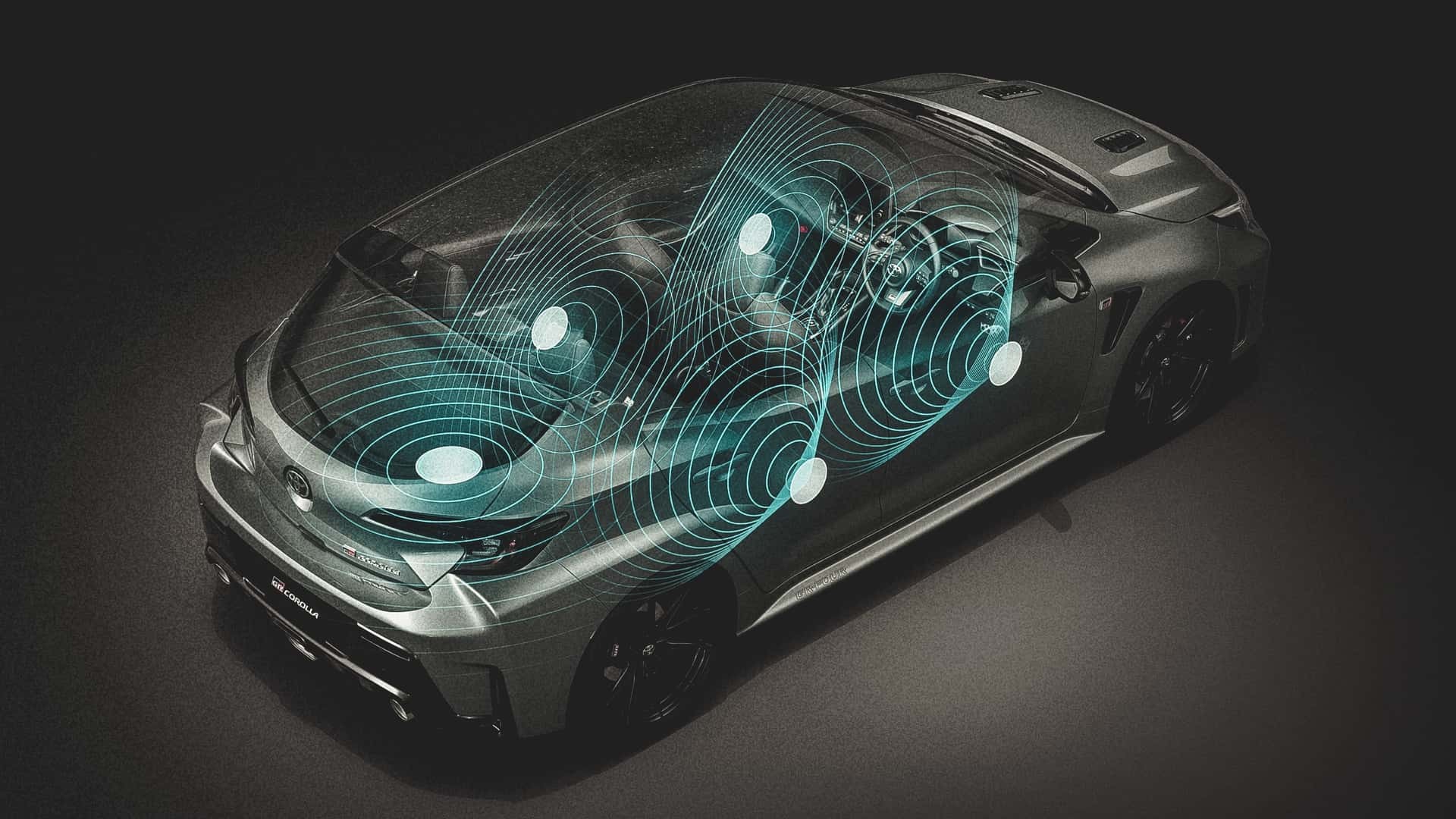
They model the interior of the vehicle in software. They time each speaker’s output to within hundredths of a second. This forces the sound waves to arrive at the driver’s ear in sync. Active noise cancellation silences the rumble.
Even then, the challenge remains.
The same JBL amp can go into three different car models. One has cloth seats. Another has leather. A third has a panoramic glass roof. The sound changes for every material. Toyota tunes the JBL systems to match those specific quirks. It’s not one-size-fits-all.
Still. Let’s keep perspective.
This isn’t Bang & Olufsen. This is for a Toyota, not a Rolls-Royce. The goal is good audio for the money. Not perfection. Not knocking your socks off. Just clarity. Just rhythm.
I tested it out.
First, the Toyota GR Corolla. Tight. Bright. Bass was thin. Clarity was high. Then the Land Cruiser. More body. Warmer tone. Expensive comfort translated to richer sound.
Then there is Mark Levinson. That lives in Lexus. Now we are talking serious fidelity. Now the money talks.
You get what you pay for. Always.
But consider the engineering required even for the “basic” stuff. Making a speaker loud is easy. Stick a subwoofer in a trunk. Done.
Making a speaker sound good in a noisy, shaking metal tube? That requires precision. It requires software tweaking. It requires understanding how a wave travels through cloth versus plastic.
We forget the effort. We forget the tuning.
So next time you turn the key. Listen.