The top dog is gone.
The Skoda Karoq’s 140 TSI Sportline 4×4—that expensive flagship everyone mostly talked about but few actually bought—is dropping from the model year 27 lineup. Good riddance? Maybe. You can still get most of the nice toys on the cheaper cars now though.
Here’s how the lineup looks for MY27. Two trims only. 110 TSI Select at $38,900. 110 TSI Sportline at $44,900. Those are before on-road costs, obviously, and both prices went up by a flat $500 compared to last year. Standard equipment didn’t change. The options menu got shuffled, that’s where the news is.
Pick and mix
The base Select trim used to feel bare. Now you can slap an optional Signature Pack on it for $2,900. Is it worth it? You tell me, but it adds the stuff that usually screams “premium”: hands-free power tailgate, keyless entry, privacy glass in the back. It gives you chrome roof rails, front door scuff plates, a USB port in the mirror (weird but yes), a heated steering wheel with paddle shifters.
Safety tech gets included too. Emergency Assist. Traffic Jam Assist. Travel Assist with adaptive lane guidance.
The Ultimate Pack, which used to be the exclusive playground of that defunct 4×4 model, moved down to the Sportline trim. That costs $3,900 extra. You get leather or leatherette upholstery, power-adjustable “Comfort” front seats that remember where you like to sit (with lumbar support), and auto-dimming side mirrors. A panoramic sunroof stays separate. Another $2,000 if you want to stare at the clouds while stuck in traffic.
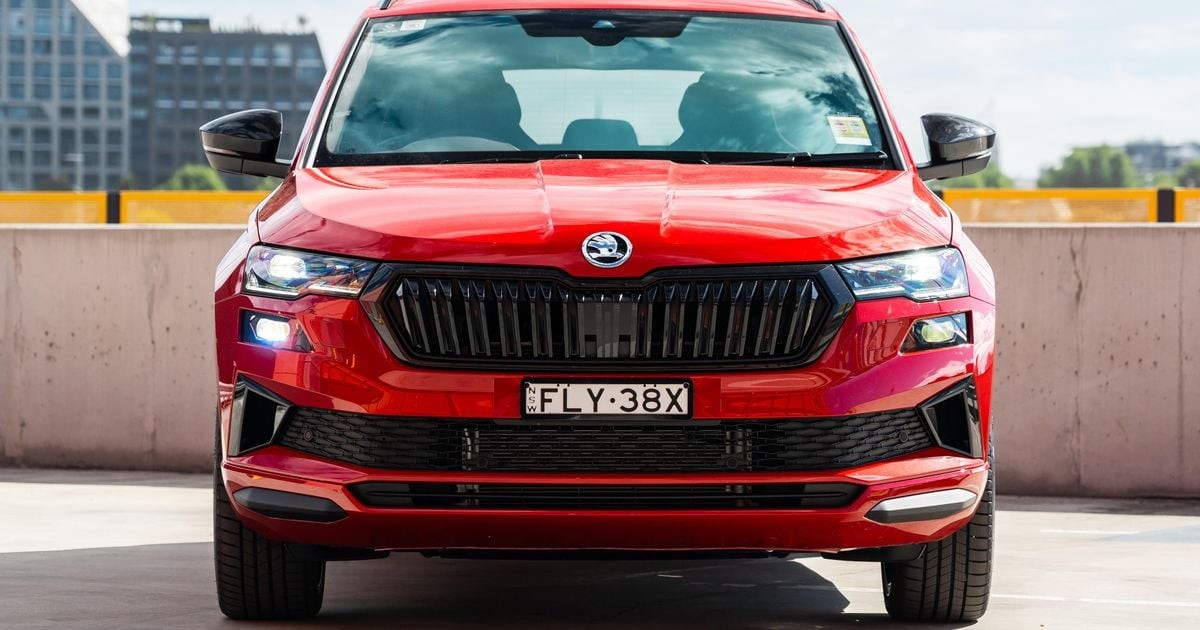
Paint costs money. Mostly. Steel Grey (solid) and Moon White (metallic) come standard. Everything else is a hit. Black Magic Pearl, Graphite Grey, SmokeySilver, and Race Blue add $300. If you’re feeling bold—or regretful later—Phoenix Orange and Velvet Red metallics will set you back $770.
Size matters. Or doesn’t.
Let’s talk about physics. The Karoq positions itself as a Toyota RAV4 competitor. In spirit, perhaps. On the tape measure, absolutely not. At 4390mm wide and 1841 high over a 2638 wheelbase, this thing is small. Actually smaller than most of its rivals.
In Australia, the closely related Cupra Ateca gets classified as a small SUV because the numbers just don’t add up for “mid-size”.
Skoda brought a bigger car here last year. The electric Elroq. We assumed that would kill the Karoq. Burn the old bridge, walk away with a clean EV conscience. Local execs said otherwise though. They want a new-generation combustion Karoq. It wouldn’t be unusual for Volkswagen Group brands to grant their aging cars a stay of execution. Seat did it with the Arona and Ibiza in Europe. Volkswagen is likely to do the same for the Polo.
This isn’t the first time a platform gets squeezed out. The Karoq launched in 2017. Came to Australia in 2019. Got a face-lift in 2022 (the article text said 2018 for arrival but 2022 for facelift, wait, the source says arrived in 2018). Anyway, it’s one of the old timers. One of the oldest names in this specific segment.
And the numbers are ugly.
Up to the end of June? Skoda sold 137 of these beasts. That is down 48 per cent compared to last year. The EV Elroq? It outsold it comfortably, pulling 302 deliveries. The Karoq sits at the very bottom of the mainstream segment charts. Only the Peugeot 3000 (92 units) and KGM Korando8 (87 units) sold less among models available all year. Even the Cupra Ateca beat it with 110.
Is a facelift enough to save a dinosaur?
Or are we just waiting for the electric tide to wash this compact SUV completely off the map.