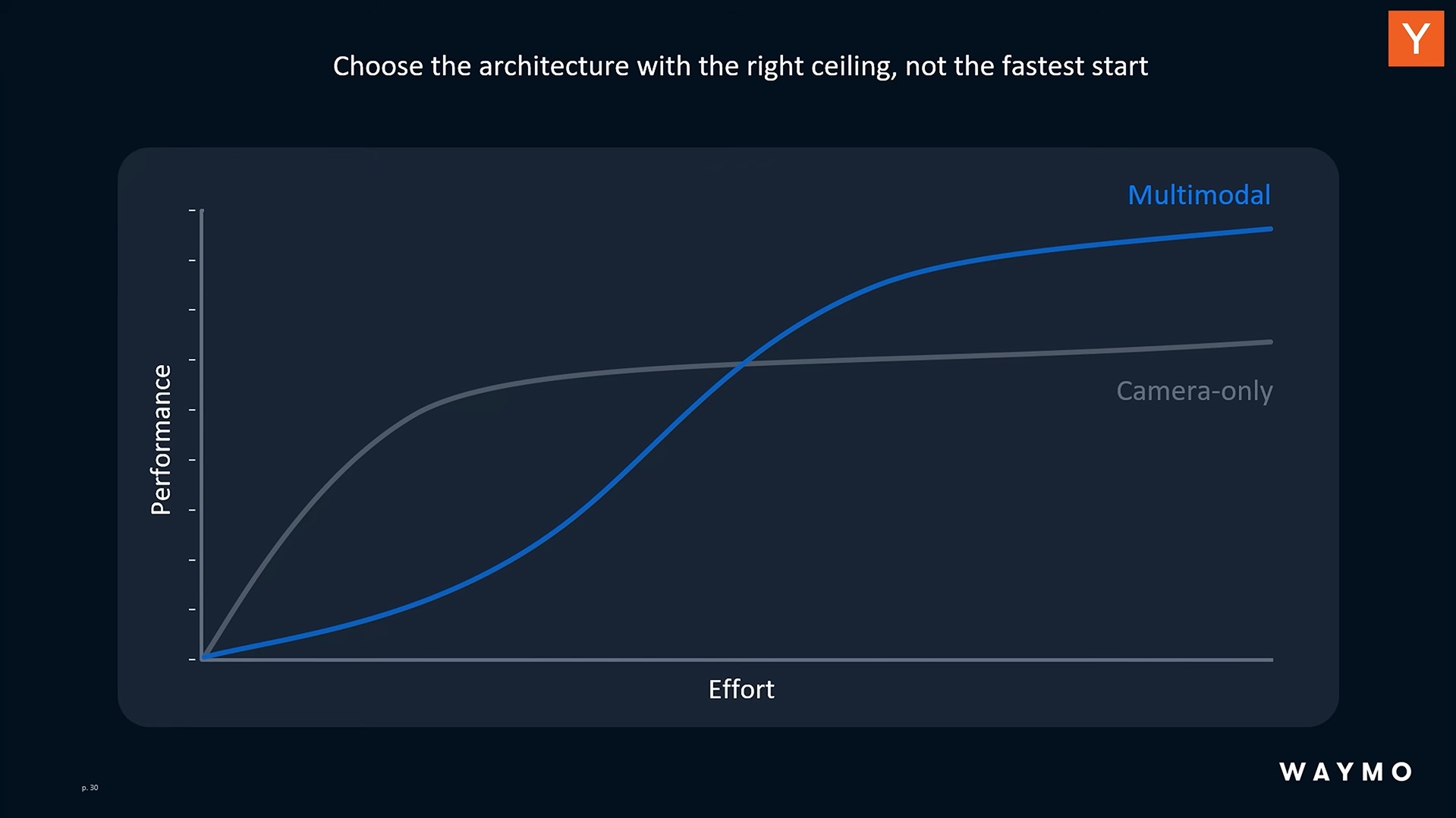
Waymo co-CEO Dmitri Doliov didn’t mince words. During a recent appearance at Y Combinator’s Startup School, he argued that camera-only autonomous driving systems hit a hard safety ceiling. The target was clear. He didn’t say Tesla’s name. He didn’t need to.
Elon Musk has called lidar a “fool’s errand” since 2019. Musk called sensors “expensive and unnecessary.” He declared any company relying on lidar was “doomed.” Human drivers use two eyes. Humans also have brakes and steering wheels in their limbs. That logic does not scale to self-driving cars.
Dolgov disagrees with that simplification. Humans drive with eyes. If the goal is to build a driver-assist feature that roughly matches human performance, cameras might suffice. The problem starts when you want full autonomy. You need strongly superhuman performance. Weak sensing leads to a safety curve that flatlines way too early.
The Physics of Bad Weather and Blackouts
Cameras provide high-resolution color data. They see what the world looks like. They do not measure distance directly. Lidar maps the 3D world. Radar measures velocity directly. These two technologies also function in darkness. They work in glare. They cut through fog, rain, and snow where optical sensors fail.
Waymo fuses all three. The processing systems are separate. Data merges into a complete environmental picture later. This isn’t just redundancy for the sake of it. Each sensor type brings unique physics to the table.
Consider a Phoenix dust storm. Cameras barely see anything. Lidar identified pedestrians clearly. The car saw the threat. The camera blind spot became a life-or-death situation.
“If the goal were to just approximately match… human performance… that’s a very reasonable way to go.” — Dmitri Dolgov
This distinction matters. It separates assisted driving from true robotaxis. Tesla bet the company on pure vision. Wayme bets on sensor fusion. The results in extreme conditions tell the story.
The Exponential Ladder Of Nine-Nines
Reliability in autonomous driving is not linear. It is exponential. Dolgov describes an “exponential ladder of nine-nines.” Each additional nine requires ten times more effort.
A system that works 99% of time looks great in a demo. It fails in the real world at scale. That 1% error rate produces hundreds if not thousands of crashes. Real roads are not controlled test tracks. Humans make mistakes. So do machines. But autonomous vehicles cannot afford the margin of error that human drivers get.
Tesla might prove the skeptics wrong. Simplicity can be powerful. Fewer moving parts often means lower cost. But the safety argument is becoming louder. The tech that wins the demo may not keep the passengers safe. Time will tell which approach survives.
Photos: WAYMO