Japan used to own the luxury MPV game. If you wanted to glide around in private-jet comfort, you bought a Lexus LM, an Alphard, or maybe a Vellfire. They were the icons. But times change. China is pushing into the space now with aggressive models from Denza, Nio, Zeekr, and others. Enter the GAC M8.
I spent a week with one in Australia to see if the hype holds water. The goal? To see if it rivals those Japanese stalwarts. It didn’t disappoint. Not even close.
How Much Does The 2026 Gac M8 Cost Compared To A Lexus?
Price is where the story gets juicy. The M8 is a plug-in hybrid MPV that undercuts the competition significantly. There are just two trims in Australia right now.
- Premium: Starts at AU$76,595 ($53,000 USD approx).
- Luxury: The model I tested, starting at AU$83,895 ($58,000 USD approx) before on-road costs.
Compare that to the VW ID. Buzz (AU$87,995) or the Kia Carnival (ranging up to AU$79,450). The M8 is competitive. But the real shocker? The Lexus LM 500.
A Lexus LM 350h starts at AU$147k. The LM 500i h kicks in at AU$199,805 before on-roads. For the price of one Lexus LM 500, you can park two GAC M8s in your driveway and still have over AU$26,000 left over for coffee. That is not a typo. That is a staggering amount of money.
And this leads to a key question many users search for: is the GAC M8 worth half the price of a luxury Lexus MPV? Based on my drive? Surprisingly, yes. In some ways.
Is The GAC M8 Plug-In Hybrid Right For Australian Drivers?
It’s the only PHEV MPV in the Australian lineup. It uses a 2.0-liter twin-scroll turbo four-cylinder paired with a 25.74 kWh battery and an electric motor. Output is listed at 219 kW (294 hp) and 550 Nm.
That sounds quick, right?
In theory.
In practice, it doesn’t feel as peppery as the spec sheet suggests. Drive goes exclusively to the front wheels via an automatic. GAC claims a 0-100 km/h sprint of roughly 9.7 seconds. From the driver’s seat, it feels… polite. Reluctant even, until you stomp on the throttle. Then, the electric motor handles city speeds, and when the turbo wakes up, it kicks.
Despite the power, there is no understeer chaos. And thanks to the PHEV torque management, wheel spin off the line in wet or cold conditions is minimal. You don’t feel like you’re wrestling an animal.
The ride is where it truly shines. Big vehicles like this usually float around like they’re on air mattresses, bouncing over every crack. The M8 does not do that. The suspension is tuned for a surprisingly athletic feel for a boat of this size. It flattens itself out. The steering feels weighted and direct for an electric setup. It doesn’t feel like a bus in corners. It’s impressive engineering for a sub-$100k package.
The Interior: Jet-On-Wheels Luxury For A Fraction Of The Price
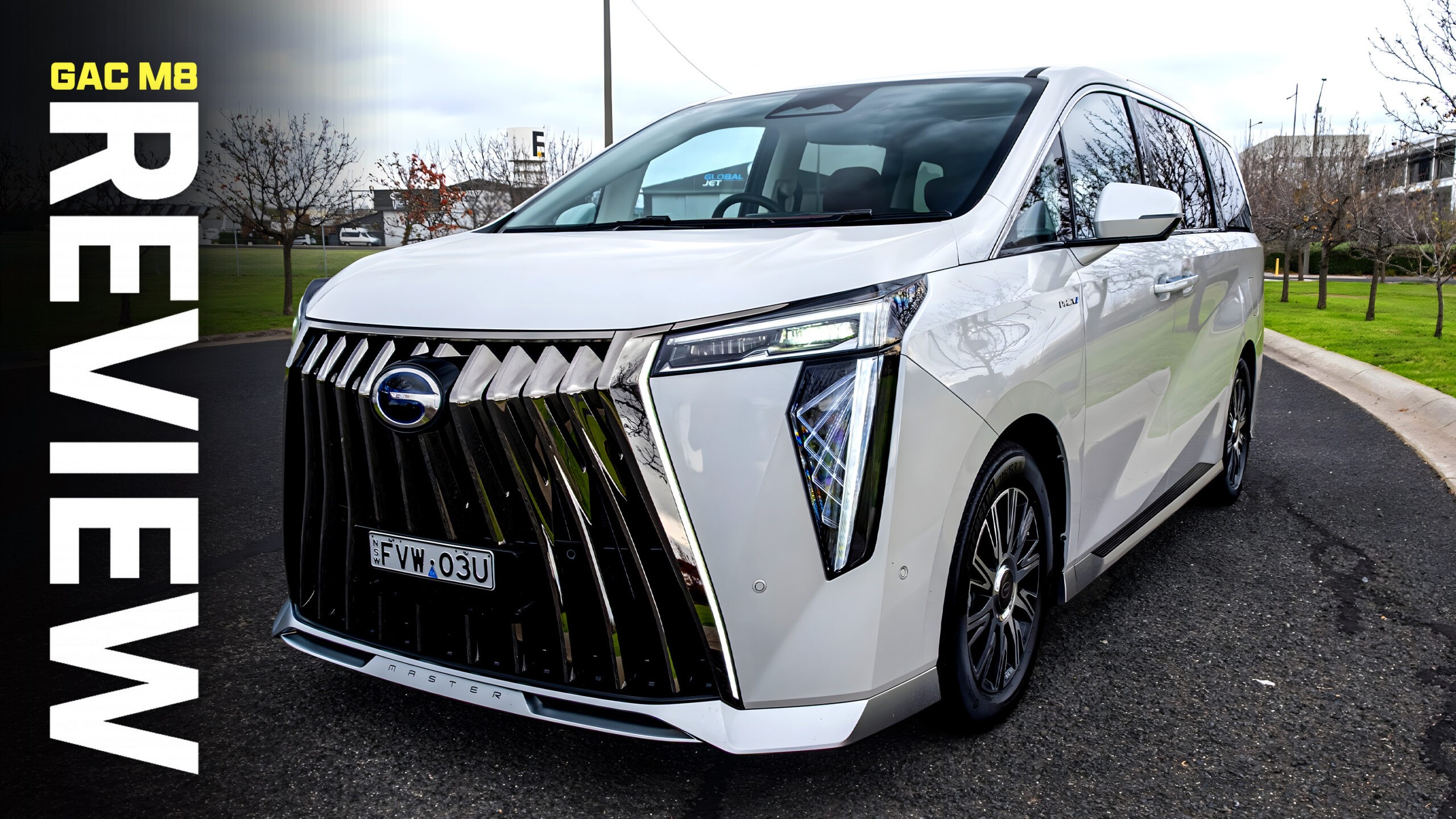
The design language is bold. Some might call it aggressive. I’ll stick with bold. The chrome grille is massive. The headlights are intricate. It turns heads. A lot of heads.
Inside, the layout is traditional, which is refreshing. No floating tablets screaming for attention. Instead, you get a 12.33-inch driver cluster and a 101-inch center touch display. The materials? Soft-touch leather on the dash, doors, and wheel. It feels substantial.
The Good: First-Rate Second Row
This is the money row. GAC knew exactly what buyers wanted. You get two captain’s chairs with massage functions (finally), a dedicated touchscreen on the side of the console, heated/cooled cup holders, and footrests that pop out from beneath the seats. There are tray tables folding out of the front seatbacks, too.
It feels premium. Really premium.
Add to that electric sliding doors, ambient lighting, a suede headliner, and two panoramic glass roofs. One looks like a sunroof; the other looks like a giant window directly behind the second row. It floods the cabin with light and makes the cabin feel airy, not claustrophobic.
The Bad: A Glare-Prone Screen And Tight Rear
Let’s talk about the middle console. A sea of piano black. It attracts fingerprints. It attracts dust. It’s hard to ignore.
Then there’s the infotainment angle. The 10-inch screen tilts. When the sun is high, it’s a glare fest. I spent more time squinting at a reflection than I cared to admit. I couldn’t set an automatic brightness mode, so I was playing whack-a-mole with the slider all afternoon. It’s a simple fix by GAC. Too late, but simple.
And the front seats? They have heat and ventilation. No massage up front. Missed opportunity for a luxury car.
Ugly Truth: The Third Row
Here is where the “luxury” label hits a wall. The third row is cramped. Shockingly tight.
Adults can fit there. But only for very short trips. And only if they have no legroom preferences. Headroom is tight too. Because of this layout, the M8 struggles to be a true family hauler for five or six adults. It becomes more of a chauffeur car for VIPs in rows 1 and 2. Row 3 is for kids. Or cargo. But not a fourth adult on a cross-country drive.
Performance And Efficiency In Real World Use
GAC lists a WLTC electric range of 155 km (96 miles) on paper. In the real world? My testing yielded less, but still usable for daily city runs. The battery charges at 6.6 kW slow and 74.3 kW DC. The DC charge isn’t world-beating speed-wise, but it’s adequate.
Fuel economy was where I was skeptical. Given the 2,077 kg (4,580 lb) kerb weight?
My average? 4.8 liters per 100 km combined. Over 22 miles per US gallon equivalent.
That is respectable for a 2-ton van. GAC claims better figures under strict conditions, but my real-world driving in the mix of highway and city streets felt efficient without being sluggish.
Final Thoughts On GAC’s Ambitious MPV
Is the GAC M8 perfect? No.
The third row is impractical for many families. The glare on the screen is annoying. The looks are polarizing—you either love the chrome dominance or hate the extravagance.
But ask yourself this: when was the last time a $75,000 car offered this much technology, ride comfort, and refinement without feeling cheap?
You’d have to look at used Lexus LMs costing twice as much. And even then, used prices vary wildly. The M8 new offers a complete package. It’s quiet. It’s quick enough. It’s comfortable.
For the executive who wants a first-class experience on wheels, or the small business needing a premium shuttle that doesn’t drain the wallet like the Japanese incumbents, this is a contender.
It won’t replace a Toyota Kluger if you need three rows for five screaming kids every day. But if you’re looking for luxury with space, and you’re willing to compromise on the very back row, it punches far above its price range.
China’s automotive industry isn’t just catching up. They’re overtaking in segments that Japan held sacred for decades. And with a vehicle like this? It’s going to be an expensive few years for Lexus in the luxury minivan segment.
The M8 doesn’t feel cheap. It feels like a serious challenge to the Japanese dominance in the premium MPV sector.
It’s not a perfect car. It has flaws. But for the price? It’s an incredible proposition. One you’re going to have to test drive to believe. Because reading the spec sheet just doesn’t prepare you for the silence, the ride quality, and the sheer value for money.
The question is no longer can Chinese brands compete? The question now is: can the legacy brands keep up with the pace?