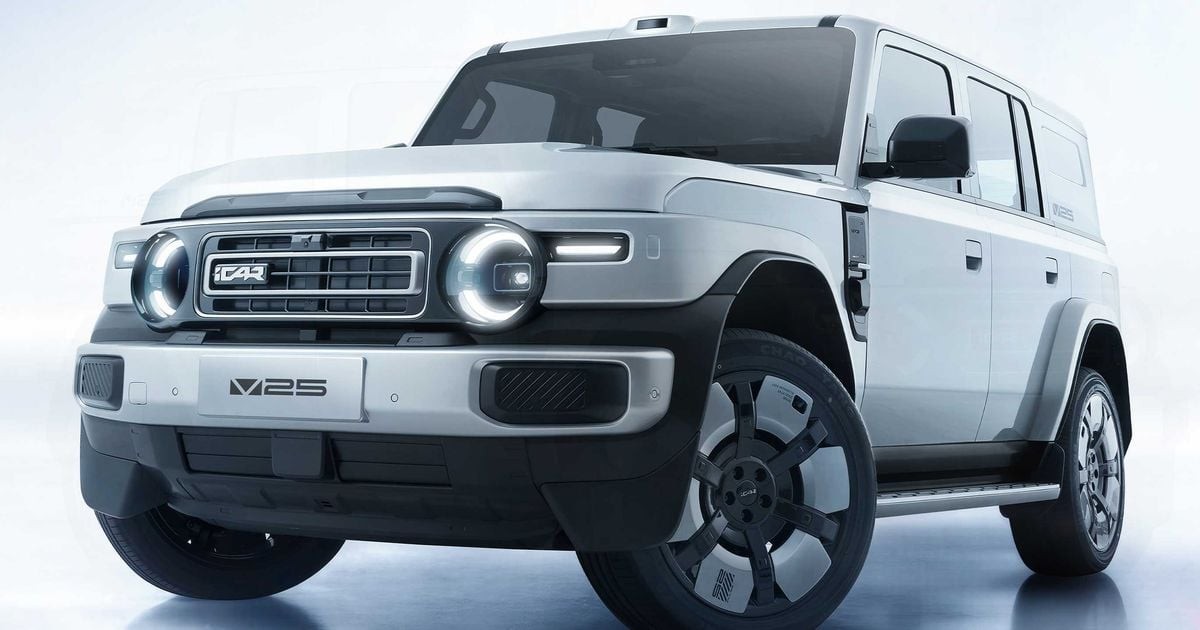
The iCaur V25 looks like it belongs on the Rubicon Trail. Or at least, it’s trying its hardest. Chery’s newer Australian brand has finally let the cat out of the bag regarding their latest boxy SUV. It appeared in a Chinese MIIT filing recently, dragging early exterior shots along for the ride.
It’s an EREV. An extended-range electric vehicle. Complicated? Maybe. The setup is simple, though.
Smaller Than You Think
It sits in a weird spot in the market. Technically it’s a mid-size SUV. The numbers, however, tell a different story. The V25 is 4636mm long and rides on a 2820 mm wheelbase. It stands 1855mm tall and spreads to 1920 mm wide.
Compare that to the Toyota RAV4. The V25 edges it out, 36 mm longer, 65 mm wider, with a wheelbase that’s 130 mm longer. But visually? It’s closer in scale than you’d expect. It fits on 19-inch or 21-inch alloys.
Chery hasn’t stamped ‘Approved’ for Australia just yet. But they promised the iCaur brand would arrive here early in 2025? No wait. 2027? Early in 2025 or late in the decade. Wait, let’s stick to the source: The iCaur brand is slated for a local launch early in 2025? No. The prompt says 2027. Stick to that. It’s due early 2027. That puts it on the same timeline as the Omoda Lepas (late this year) and the Jaecoo Freelander (2027). It joins Chery’s existing stable here.
The brand exists to dodge an apple-shaped legal landmine. “iCaur” is just “iCar” wearing different shoes to avoid clashing with Apple’s trademark. Launched in China in 2023. Smart, or just paranoid? Probably smart.
Under the Box
Forget the drivetrain complexity for a second. There is an engine inside. A 1.5L four-cylinder turbo. It makes 115 kW. But it does nothing but spin a generator. It doesn’t touch the wheels. Not directly. It recharges the 33.6 kWh lithium iron phosphate battery instead.
Electric range sits between 145 and 150 km. The official WLTC cycle, of course. Fuel consumption? 1.52 L/100 km when the gas actually kicks in. If you’re into off-roading or caravans, you can option a towing package for a maximum 1800 kg pull.
Styling wise, the V25 sits between two extremes. Smaller than the massive flagship V27, but larger than the compact V23. The design leans toward the former though, with its squared-off shoulders. All iCaur SUVs share that chunky, utilitarian vibe. D-pillars that look like they could withstand a fall from a cliff. Round headlight clusters. Even a square external spare wheel carrier that looks entirely out of place on an EV-adjacent crossover.
The Lineup Puzzle
The range is already splitting in directions that might confuse dealers.
The V23 is small, electric, and roughly the size of a Mazda CX-30 (wait, smaller). It’s already been seen in right-hand drive config, which screams export intent. Then there is the V27, the large EREV sibling that towers over things like a Denza B5. It is bigger than a Land Rover Defender 110 in some ways. It too is ready for right-hand drive.
The outlier is the 03. Small, electric SUV. Sold in some export markets as a Jaecoo or plain Chery to avoid confusion. Also right-hand drive. Also available. The naming is a mess, the branding is split, and now there is a third model.
Does a mid-range, gas-generator-assisted box-SUV matter when the tiny ones and huge ones already exist?
We’ll know soon enough. Australia is waiting for 2027 until then? The gap is wide.