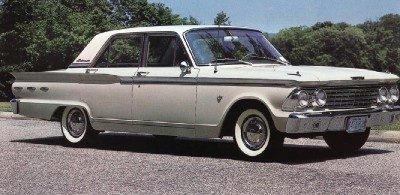
Ford didn’t stumble into the intermediate segment by accident. The planners in Dearborn had a few divergent paths available to them for the early Sixties lineup. They could have stretched a small car. Or they could have squeezed a big car. Instead, they built something new. When the first true intermediate car rolled out of the factory, it was obvious that every decision from concept to execution was calculated.
The result wasn’t just another model year update. It was a class-defining vehicle that balanced price, size, and performance in a way Detroit hadn’t seen before.
Why the Intermediate Class Mattered
Before the Fairlane found its footing, the American automotive landscape was split. You had economy compacts that lacked presence and full-size sedans that were too expensive for the average buyer. Ford saw the gap. They saw that buyers wanted more car than a Falcon but didn’t want to pay for the luxury features of a Continental.
This wasn’t about cutting corners. It was about precision engineering. The goal was to create a vehicle that felt substantial without being unwieldy.
“The folks in Dearborn had played everything right down the middle.”
Execution Over Experimentation
Many manufacturers tried to guess what customers wanted. Ford decided to give them exactly what they asked for, even if they didn’t say it out loud. The design team focused on clean lines and functional space. They avoided the excessive chrome and tail fins that defined the late Fifties.
The suspension was tuned for comfort but retained enough stiffness to handle curves. The engine bay was designed to accommodate future power upgrades, a foresight that paid off in the muscle car era. Every bolt, every panel, and every wire had a purpose.
Legacy of the First True Intermediate
The Fairlane didn’t just sell well. It set a template. Competitors scrambled to respond, but Ford had already captured the market’s imagination. The strategy was simple: build a car that appealed to everyone and offended no one.
It worked. The intermediate class became the backbone of the American auto industry for decades. And it all started with a decision to go middle-of-the-road, but to do it better than anyone else.
Why the Midsize Segment Needed a Redefinition
The automotive landscape of the early Sixties was a crowded mess. You had the bloated standard-size sedans lumbering down highways. Then came the new domestic compacts, shrinking in size as fuel efficiency became a vague but growing concern. Between those two extremes sat a gap. A vacuum. Ford saw it.
Enter the Fairlane.
When it debuted in 1962, the 1962 Ford Fairlane didn’t just fill that gap. It redefined what a “midsize” vehicle could be. It wasn’t an extension of the full-size line. It wasn’t a watered-down compact. It was a distinct category.
The Myth of the Radical Rebirth
Rumors have a way of inflating reality. Before the Fairlane hit the streets, industry pundits were already buzzing. They expected something radical. Something that would make 1960 look like a warm-up act.
Why? Because Chevrolet went off the rails in 1960.
The Corvair was a bold experiment. Rear-engine. Air-cooled. Flat-six. It was risky, controversial, and frankly, a bit wild. Journalists assumed Ford would need to match that energy. If you’re launching a new size class, why not make it a standout? Why play it safe?
But safety wasn’t the goal. Relevance was.
The Falcon vs. Corvair Reality Check
Let’s look at the numbers. In 1959, Ford launched the Falcon. It was a compact. It was stylish. It was conventional.
Chevrolet countered with the Corvair. Radical? Yes. Successful? Debatable.
The Falcon outsold the Corvair by a wide margin. Why? Because most buyers didn’t want a rear-engine car that looked like a Porsche 911’s ugly cousin. They wanted practicality. They wanted reliability. They wanted a car that fit in the driveway and the budget.
Ford learned from this. They didn’t need to out-radical Chevy. They needed to out-reliable. They needed to out-practical.
The Fairlane was the answer. Not a revolution. An evolution.
Defining the Midsize Segment
Before 1962, “midsize” was a loose term. It often meant a smaller full-size car. Or a larger compact. The Fairlane carved out a specific niche.
It was longer than a Falcon. Shorter than a Galaxie. It had a wheelbase that suited it for urban driving yet had enough cabin space for a family of four. It wasn’t just about dimensions. It was about positioning.
The Fairlane sat in the sweet spot. It offered the comfort of a full-size car without the fuel guzzling. It had the agility of a compact without the cramped interior. It was the car for the driver who didn’t want to choose between space and efficiency.
The Design Philosophy
The styling of the 1962 Fairlane was clean. Direct. It avoided the excessive chrome of the late Fifties. The front end was flush. The rear was simple. It looked modern because it wasn’t trying to be futuristic. It was trying to
You’d think with the Mustang looming on the horizon, Ford’s design team would have been chasing ghosts. They had dream cars from the past few years to look at. Plenty of futuristic inspiration.
Nope.
When the Fairlane hit showrooms in 1962, it smelled like utility. It sat between the Falcon and the Galaxie. It looked like something you bought for your accountant. It oozed practicality. There was zero romance in those lines.
It wasn’t until the Mustang arrived in 1964 that Ford finally gave us a small car we wanted. Before that? We just bought it because we needed to get from point A to point B.
The “In-Betweener” Strategy
Motor Trend noted that Ford leaned hard on consumer research. It worked. Mostly.
Except for the Edsel disaster, the data seemed solid. By the late fifties, the math suggested a gap. A sweet spot between the growing standard Ford and the compact Falcon. Think of it as the “in-betweener” category.
American Motors owned this space with the Rambler Six and Rebel. They fit right between the 100-inch wheelbase American and the 123-inch Ambassador. Ford saw the blueprint. They wanted a slice of that pie.
For a brief window, Ford had the intermediate market to itself.
Look at the competition.
Chevy dropped the Chevy II in 1962. It was compact. Conventional. Boring. It didn’t challenge the Corvair’s revolution because it wasn’t trying to be one. GM didn’t bring out a true challenger until the Chevelle in 1964.
Pontiac, Oldsmobile, and Buick also waited. Their “senior compacts” didn’t graduate to full intermediates until that same 1964 model year.
Dodge and Plymouth downsized their standard lines for 1962. Sales lagged. They didn’t offer three distinct car sizes until 1965. The Rambler Classic got a wheelbase boost in 1963 but still sat smaller than a Fairlane. Even the Mercury Meteor, the Fairlane’s cousin, lacked the punch.
The 1962 Fairlane was the first mover. And it was dull.
1962 Ford Fairlane: The Start of Something
The first Fairlanes were two-door and four-door sedans. That’s it.
They were aimed at the everyday transport crowd. Lee Iacocca became general manager of Ford Division in 1960. He had bold ideas. Big ideas. But in 1962? Those ideas hadn’t launched yet.
Two trim levels defined the debut.
The basic line. And the upscale Fairlane 500.
The Fairlane 500 was the premium tier. It featured the Sports Coupe hardtop. This body style joined the lineup a little later. It was the gussied-up two-door sedan.
This was the top of the premium Fairlane 500 series.
But even with the Sports Coupe, you were still buying a workhorse. You weren’t buying a lifestyle. Not yet.
Iacocca was watching. The market was shifting. The “in-betweener” was crowded, but Ford had the volume. The rest of the industry was playing catch-up to a model that didn’t even try to be exciting.
Why did it take two years for Ford to stop building boring cars?
The data said people wanted reliability. They didn’t say they wanted style.
So Ford gave them steel.
Then came 1964. The Mustang. The pivot. The moment the data finally cracked.
Before that? Just metal. And sales. Lots of sales. But no soul.
The Fairlane did its job. It filled the gap. It kept the lights on.
It didn’t make us dream.
Not until the pony car arrived.
The Fairlane’s Familiar Footprint
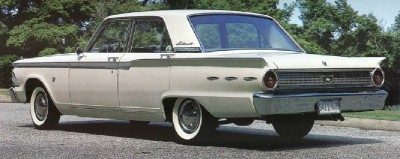
The 1962 Fairlane didn’t reinvent the wheel so much as stretch it. To anyone who had walked Ford showrooms in the preceding decade, the styling and dimensions felt like home. It was essentially a stretched Falcon. The wheelbase grew to 115.5 inches, slotting the car squarely between the compact Ford line and the full-size Galaxie. Price and size followed the same logic.
Motor Trend noted the resemblance to 1952 through 1954 Fords. The proportions were there. The difference? The Fairlane sat lower. It was nearly three inches narrower. The name itself carried weight. Ford had used Fairlane on standard-size models from 1955 through 1961. This mid-size version kept the lineage but changed the physics.
Interior Space and Instrumentation
Inside, the layout prioritized function. Legroom improved over the early 50s Fords. Shoulder room got a boost too. Hip space took a slight hit in both front and rear seats. It was a trade-off for that lower, narrower stance.
Motor Trend described the cabin as “simplicity without austerity.” The dashboard avoided clutter. Instruments lived in three round housings. Shrouds cut down glare. Reflections didn’t distract. The design served the driver. Nothing extra. Nothing unnecessary.
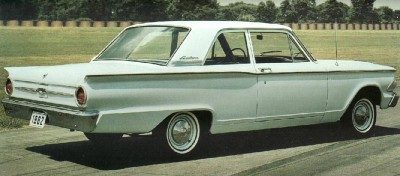
The 1962 Fairlane 500 two-door sedan landed alongside one other Fairlane model that year, but it wasn’t exactly a radical departure for Ford. Critics at the time noted that compared to late-Fifties rides, the changes were undramatic. You couldn’t measure the upgrades with a ruler. The improvements were in the feel. Quieter operation. Smoother driving. Easier controls. A promise of greater durability.
On the surface, the new unit-construction intermediate looked like a throwback. The bodyside trim. The taillights. Even those canted mini-tailfins seemed ripped from a 1957 Ford. It was easy to see the lineage. Yet, the Fairlane had a spark. A personality that separated it from the standard Ford pack.
The New 221 V-8 Engine
That spark came from under the hood. A distinctive new small-block V-8 made its debut here, shared only with the Mercury Meteor. Engineering logic dictated the need. The standard Ford six was getting old. The base 292-cubic-inch V-8 was too heavy and thirsty for these planned intermediates.
Engineering chief Harold McDonald pushed management. He needed a light, compact power plant. George Stirrat led the team. They got a $250 million budget. The result was a narrow-block, short-stroke engine displacing 221 cubic inches.
It breathed through a two-barrel carburetor. Output sat at 145 horsepower at 4,400 rpm. Hydraulic valve lifters and an automatic choke kept maintenance simple. Weight was critical. The team used Ford’s pioneering “thin-wall” casting process to hit the 450-pound limit.
Mid-year brought a tweak. The 221 was overbored by .30 inches. This created an optional 260-cubic-inch mill. It pushed 164 horsepower. The block design was so sound it later served as the basis for the aluminum engine in the Lotus-Fords that revolutionized rear-engine racing at Indianapolis in 1963.
Standard Power and Drivetrain
The small-block eight was optional. Standard power remained with the Falcon six. This was the bigger of the two Falcon sixes. A 170-cubic-inch unit making 101 horsepower. It also utilized the modern thin-wall casting technology.
Every engine got a new rear mount. The goal was reducing vibration and sound transmission into the cabin. Transmission choices were familiar territory. The standard gearbox was a three-speed manual with a column-mounted shift lever.
Buyers could specify overdrive, though only for the 221 V-8. The other option was the two-speed Fordomatic. These were essentially the same choices offered on 1952-1954 Fords. Simple. Reliable.
Comfort and Convenience Features
Buying a Fairlane meant more comfort options than a Falcon buyer ever saw. You could equip it almost like a luxury car. Almost to the level of a Galaxie.
Power steering and power brakes were available. Either factory-installed or dealer-installed. They were highly popular. These features had caused complaints among buyers of cheaper compacts who wanted the same conveniences.
Tires offered variety. White-wall tires came in 6.50 or 7.00 sizes. Wheels were a choice of 13- or 14-inch diameters. The 7.00X14 tires came only as blackwalls.
Other options cluttered the checklist. A 30-amp generator. Tinted glass. Two-speed electric windshield wipers. Full wheel covers. A heavy-duty battery. Brackets for seatbelts were installed in all models. The belts themselves were optional.
Why the 1962 Ford Fairlane 500 Still Matters
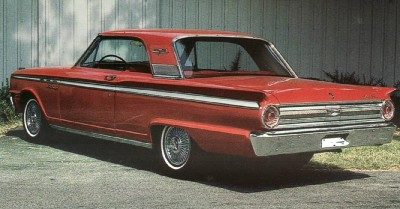
The 1962 Ford Fairlane 500 wasn’t just another Tuesday on the highway. It was a car that promised sprightly performance, even if you were stuck in an automatic. Car and Driver looked at the Fairlane 500 Sports Coupe with the V-8 and saw an inviting appearance. The ride? Comfortable. The suspension limber enough to soak up road shocks without feeling like you were bouncing over every pebble. It felt solid.
But not everyone was singing the same tune. Road testers at Motor Trend had a bone to pick. Specifically, the two-speed automatic transmission. It was smooth, sure. But did it take full advantage of the engine’s horsepower and torque curves? No. They believed a three-speed or four-speed box, or even a manual, would have wrung out far more performance. The result? Their test car with the “performance” axle ratio hit 60 mph in 13.3 seconds. That is not exactly awesome action by any stretch of the imagination.
Yet, the engine itself was lively and well-designed. Testers noted it had plenty of potential for power increases. They predicted it could become as big a favorite with the hot rod set as the old flathead V-8 had been in previous decades. The trade-off? Gas mileage. The V-8 Fairlane with an automatic averaged an uninspiring 15.5 mpg. A prominent selling point, sure, but hardly a record-breaker.
Motor Trend also pointed out a geometry issue. The test car felt too big for its 13-inch wheels. Sure, 7.00×14 tires were available, but only as a police option. Regular buyers were stuck with the smaller rubber. Despite this, the ride quality was undeniable. On every surface, from rough country roads to smooth freeways, the Fairlane delivered a smooth, solid ride. You needed some real pot holes to bottom the suspension.
Handling was another story. There was noticeable lean in hard cornering. But here is the thing: the car stuck like glue. You really had to bend it to lose adhesion. Noise levels were among the lowest they had encountered in any car. Front-seat space comfortably fit three average-sized adults. Except for that two-speed automatic, the editors advised the Fairlane offered a rare combination of economy, satisfying performance, solid comfort, and high-quality construction that belied its low initial cost.
Sales figures back up the enthusiasm. More than 297,000 Fairlanes went to first-year customers. Prices were moderate. A base two-door sedan set you back just $2,154. The vinyl buckets-and-console Fairlane 500 Sports Coupe stickered for $2,403. Chevrolet did better with the Chevy II, but that is a different story. The Chevy II offered shoppers a far greater variety of models and body styles. It also had a price advantage by virtue of being a smaller car.
What Changed in the 1963 Ford Fairlane
By 1963, Ford gave the Fairlane a facelift. They also rolled in the same technical improvements given to other Ford products, many of them designed to ease maintenance. The lineup expanded. Nine models made the 1963 roster, and five of them were new.
The two- and four-door sedans returned in both trim levels. The Fairlane 500 line got a makeover. It took on two new two-door hardtops. One of them actually usurped the Sports Coupe title, changing the hierarchy of the range.
Wagon buyers got options, too. Three station wagons joined the line. There was a Ranch Wagon with base Fairlane trim. A Custom Ranch Wagon with the Fairlane 500 look. And a pseudo-“woody” Squire for those who wanted a bit of rustic flair.
The front end got a fresh grille pattern. New bumpers followed, not unlike those on the senior Fords. The hood’s leading edge lost its pronounced overhang, cleaning up the profile. Back ends still sported little angled fins. It was a styling touch that was gradually disappearing from most American cars, but Ford kept it a little longer.
For more information on cars, see:
-
Muscle Cars
-
Sports Cars
-
New Car Search
-
Used Car Search
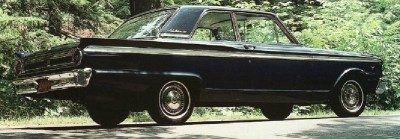
Ford moved the needle significantly with the 1963 model year. After selling 297,000 first-year Fairlanes, the Blue Oval pushed out nearly 344,000 of the revised 1963s. The body got a subtle but effective tweak. It sat an inch lower than the standard sedans.
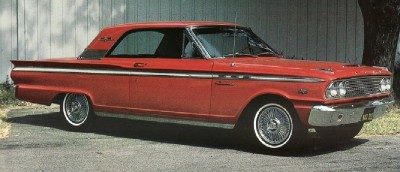
The highlight of this lineup was the Fairlane 500 Sports Coupe. It was easily the sharpest-looking option in the range. Ford borrowed heavily from the Thunderbird’s design language for the new hardtop roof. You can spot it by the large, square C-pillars and the rectangular rear glass. It wasn’t just about style, though. The interior offered bucket seats and a center console. Standard spinner wheel covers added to the flair.
“The Fairlane 500 Sports Coupe featured Buick-style front-fender ‘ventiports’ to distinguish it from the plainer bench-seat hardtop.”
The slightly plainer bench-seat Fairlane 500 hardtop didn’t have all those extras. But you could still kit both versions out with a vinyl roof covering if you wanted that premium look.
Utility Meets Design
Ford didn’t ignore practicality. The six-passenger wagons could be specced with a rear-facing third bench. That bumped capacity to eight people. Need to haul gear? Open the tailgate and fold the second seat down into the floor. You get a flat load space more than nine feet long. There was also a big, covered luggage area tucked beneath the floor.
Engine Specs and Horsepower
The powertrain story got more interesting in ’63. Ford reprised the three engines from 1962 but added new choices. If you paired the Fordomatic transmission with a six-cylinder, you got a new 200-cubic-inch engine. It made 116 horsepower.
At the other end of the spectrum sat the sizzling 289-cubic-inch small-block V-8. This engine was available for sedans and hard-tops. Ford increased the cylinder bores to a full four inches. Compression rose to 11.0:1. It drank super-premium fuel through a four-barrel carburetor.
The numbers were serious. Horsepower hit 271 at 6,000 rpm. Torque peaked at 312 pound-feet at 3,400 revs. That was enough muscle to propel the intermediate to 60 mph in less than nine seconds. One magazine ad for the hardtop with the 289 warned drivers to “Wait till you feel Fairlane’s Sunday punch!”
Transmission Choices
Transmissions were shuffled for ’63. A new “Synchro-Smooth” three-speed stickshift came standard for all V-8s. It had synchronizers on all three forward gears. Note that the manual with the 170-cubic-inch six only had synchros on the top two gears.
You could also get overdrive or a new Borg-Warner four-on-the-floor stick with any V-8. The Fordomatic was compatible with the large six and the two smaller V-8s. Buyers had several choices of final-drive ratios too. You could maximize economy or push for performance potential.
1964 Ford Fairlane
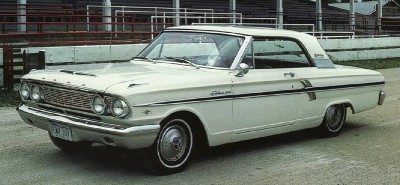
By 1964, the Fairlane got another facelift. Ford aligned the look with the concurrent full-size Galaxie. The front suspension saw improvements as well. The vestigial fins from previous years were gone. In their place were slightly rounded rear fenders.
The model lineup remained largely the same. The only exception was the departure of the Squire wagon. The rest of the family stayed put, ready for the next wave of buyers.
The 1964 Fairlane: A Quiet Giant with a Punch
The lineup stayed consistent. You still had the 1964 Sports Coupe sitting at the top of the hierarchy, flanked by a practical four-door sedan and the Custom Ranch Wagon. But underneath the sheet metal, Ford made subtle tweaks that mattered more than they looked.
Carburetion got an overhaul across all V-8 engines. A new automatic choke meant cold starts didn’t require a prayer and a wrench. Fairlanes also got self-adjusting brakes and electric wipers. Safety was still an afterthought for most buyers, but you could tick boxes for seatbelts and a dashboard crash pad. No fewer than five engines and six transmission combinations meant there was a setup for almost every budget.
The Chevelle was circling. Chevy’s intermediate was aggressive, hungry for Ford’s turf. So the Fairlane doubled down on refinement.
Power Train Split
Ford kept the 101-horsepower inline-six with a three-speed manual at the bottom of the stack. If you wanted the stronger 116-horse six, you had to accept the two-speed automatic. The 221-cubic-inch V-8 vanished from the option sheet.
The Challenger 260 took the entry-level V-8 spot. It wasn’t exciting. It was just there. Above it sat the new 195-horsepower 289 V-8. Two-barrel carburetor. 9.0:1 compression ratio. That was the sensible choice.
At the top of the food chain remained the solid-lifter 271-horsepower 289. This was for people who cared about torque curves.
Transmission logic got tighter. Overdrive was now exclusive to the 260 V-8. If you wanted a four-speed manual, you needed a 289. The 260 got the Fordomatic. The milder 289 could take the Cruise-O-Matic. The high-performance V-8? You could spec it with extra-long gearing. 3.89:1 or 4.11:1 rear-axle ratios. Leadfoots had options.
The Motor Trend Verdict
Motor Trend hated to admit it, but they liked the Fairlane. Jim Wright, the technical editor, called the handling a virtue. He described a “solid, quiet, big-car feeling” from a car that wasn’t actually a big car.
He rated the Sports Coupe with the mild 289 and four-speed as “very high in satisfaction potential.” His conclusion? For an all-around daily driver, it was hard to beat. You got the responsive handling of a lightweight sedan wrapped in the solidity of a full-size cruiser. Intermediate size. Best of both worlds.
Handling wasn’t perfect. The Fairlane leaned excessively through sharp corners. But the suspension refused to bottom out on severe dips. It was compliant. Damped. Controlled.
0 to 60 mph took between 9.8 and 10.2 seconds. The quarter-mile came in at 17.5 seconds with 78 mph trap speed. Tame by today’s muscle car standards. Respectable for a family hauler in 1964.
Noise and Wagons
Wright praised the sound-deadening. The unibody construction eliminated the vibration and noise usually associated with that style. It felt as quiet and free of rattle as a traditional frame-and-body car, even on rough roads.
The option list added value. That was the appeal.
Wagons were different. They had that big-car feel. Low noise. But the six-cylinder engines were inadequate. They struggled under the weight. Motor Trend despised the two-speed automatic for wagons. If you bought a wagon, you needed the 195-horse 289 with the Cruise-O-Matic. The 271-horse engine was not offered in wagons.
The third seat was gone. Or rather, it was useless. Previous years had included cushions to make the rear well into a makeshift bench. This year? Storage only.
The Decline Begins
Production numbers told the story of shifting market dynamics. Buoyed by the new station wagons in 1963, Fairlane production shot up to nearly 344,000 units.
Then came 1964. Competition stiffened. The Chevelle was gaining ground. Sales dipped below 277,600.
1965 saw a further drop to 224,000. The dominance was slipping. The intermediate war had just begun.
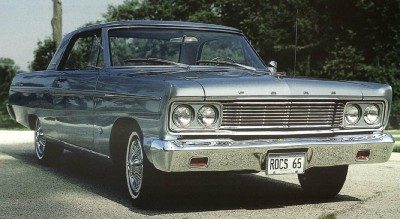
The 1965 Ford Fairlane: Angular Shifts and Technical Cuts
The first generation of the Fairlane hit its final year in 1965 with a facelift so drastic it barely resembled its predecessors. Ford kept the rooflines. Everything else got angular. Those soft curves from the 1962-1964 models vanished, replaced by straight-edged panels and a subtle mid-body beltline kick-up. The front end got slimmed down with horizontal grille bars and a narrower bumper. Headlights moved into rectangular, body-color bezels. Rear lights shifted from round to rectangular. It was a sharp, boxier look.
Critics were not impressed. Motor Trend pointed out the styling missed a massive opportunity. The magazine argued that Ford had a chance to capitalize on the Indianapolis and Shelby Cobra alliance to create a truly desirable “bread-and-butter” performer. Instead, they got a generic facelift.
Under the metal, changes were just as heavy. Wheelbase stretched to a clean 116 inches. 14-inch wheels became standard equipment. Ford killed the small engines. The 170-cubic-inch six and the 260-cubic-inch V-8 were gone. The new baseline was the 200-cube six, rated at 120 horsepower. The big news came from the 289 V-8. Ford introduced a new 225-horsepower version with a four-barrel carb and a 10.0:1 compression ratio. The two-barrel version got a boost to a clean 200 horsepower. The top-tier engine stayed at 271 horsepower.
Transmission options narrowed. Ford banned the Fordomatic. The Cruise-O-Matic became the sole automatic choice, even available for the high-performance V-8s. Engine-saving overdrive was restricted to the tamest V-8 only.
Total Performance Era Begins
Lacocca had already signaled the direction at the 1964 Chicago Auto Show. He told Automotive News that performance was the only way to prove a car’s capability. Ford was deeply committed to racing. They couldn’t pull out gracefully even if they wanted to. The Fairlane needed to fit this new marketing scheme.
The 289 four-speeds were fine. But bigger things were coming. The Fairlane Thunderbolt had already started haunting dragstrips in 1964. A run of 100 stripped-down Fairlane 500 sedans carried the mighty 427-cubic-inch V-8 under fiberglass front clips. They were barely street legal. The second-generation Fairlane for 1966 would arrive with a hardtop roofline and more room under the hood for big-block engines.
The muscle car war between Ford, GM, and Chrysler was escalating. The weapon of choice was increasingly an intermediate car with a full-size engine. Ford wasn’t about to let rivals eclipse their performance reputation without a fight.
1965 Ford Fairlane Specs and Production Numbers
The first generation concluded with the 1965 model year. Production numbers dropped compared to earlier years, reflecting the changing market and the transition to the next era. Here are the specific weights, prices, and production figures for the 1965 models.
1965 Ford Fairlane Models, Prices, Production
Series 30 (wb 116.0)
| Model | Weight | Price | Production |
|---|---|---|---|
| 4d sedan | 2,954 | $2,271 | 25,378 |
| 2d sedan | 2,902 | $2,230 | 13,685 |
| 4d wagon | 3,279 | $2,567 | 13,911 |
| Total Series 30 | 52,974 |
Series 40 500 (wb 116.0)
| Model | Weight | Price | Production |
|---|---|---|---|
| 4d sedan | 2,959 | $2,353 | 77,836 |
| 2d sedan | 2,901 | $2,312 | 16,092 |
| hardtop coupe | 2,973 | $2,377 | 41,405 |
| Sports coupe htp cpe | 2,984 | $2,538 | 15,141 |
| 4d wagon | 3,316 | $2,648 | 20,506 |
| Total Series 40 500 | 170,980 |
Total 1965 Fairlane Production: 223,954 units
The end of an era. The sensible family car was evolving into something faster, heavier, and far less forgiving.