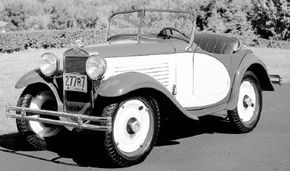
Sir Herbert Austin arrived in the United States in 1929 with a confidence that bordered on arrogance. The English manufacturer had a plan to build cars in America, and for a moment, it seemed like the industry would salute him. After touring the country, he picked Butler, Pennsylvania, as the home for the American Austin.
Detroit laughed. They shouldn’t have. Butler was a logical pick. It had industrial services, a workforce ready to work, and proximity to East Coast ports for importing parts from England. The car itself seemed promising. As production kicked off in May 1930, the company claimed nearly 200,000 orders for what they pitched as an ultralight, ultra-economical vehicle. It was a bold number. It was also completely wrong.
The Engine and The Models
The American Austin rolled off the line through 1934. Throughout that entire run, it used the same engine. It was an L-head four-cylinder displacing 46 cubic inches. It had only two main bearings. It made 13 to 14 brake horsepower at 3200 rpm. That’s it. Not much power. Not much torque. Just enough to move a car that barely weighed anything.
Initially, you could buy a roadster or a coupe. By 1931, the lineup expanded to include a business coupe, a Deluxe coupe, and a 2/4 passenger cabriolet. Prices dropped as sales stagnated. They dropped again in 1933 in a desperate move to boost volume. It didn’t work.
The 1930 output hit 8,558 units. That number would never be exceeded. Two things killed the American Austin. First, the Great Depression. The economy tanked. People stopped buying new cars. Second, and more importantly, Americans hated midget cars. Even in bad times.
The American Austin was tiny. Its wheelbase was 75 inches. For comparison, the future VW Beetle would have a wheelbase 16 inches longer. The Austin weighed between 1,100 and 1,200 pounds. Light cars carried a stigma then that persists today. Many Americans were leery of them. They felt unsafe. They felt cheap. The car was designed partly by Alexis de Sakhnoffsky. It was attractive. Nobody cared. Production stopped in 1935.
The Celebrity Paradox
Austins provided amusement during a drab period. They became a reverse status symbol. Think of the VW Beetle in the 1950s. If you drove one, you were either broke or cool. Or both.
Al Jolson loved cars. He usually drove Packards or Lincolns. He bought the first Austin coupe delivered to a private buyer. He wasn’t alone. Buster Keaton drove one. Slim Summerville drove one. The “Our Gang” kiddies drove them. They even starred in a movie.
The Austins were used as “steeds” for a knightly battle in Will Rogers’ A Connecticut Yankee in King Arthur’s Court. The scene looked great. It didn’t help sell cars. People didn’t want to drive a toy. They wanted to drive a statement. The American Austin was neither.
Why Did It Fail?
The American Austin failed because it misunderstood its audience. Herbert Austin thought Americans wanted economy. They didn’t. They wanted space. They wanted safety. They wanted to feel important. The Austin gave them none of that. It was too small. Too weak. Too British.
Butler, Pennsylvania, was a good choice for manufacturing. It wasn’t a good choice for branding. The car was an anomaly. A curiosity. A footnote.
If you’re looking for defunct American cars, check out AMC, Duesenberg, Oldsmobile, Plymouth, Studebaker, and Tucker. They all had their moments. The American Austin had a few months.